Wednesday, May 31, 2017

Love and Redemption: A Movie Review of "Beyond the Mask"

To what lengths would we go to receive love and be redeemed from a terrible lifestyle? For believers, the answer is that we trusted in Christ and repented. In the film Beyond the Mask, an ex-assassin falls in love and learns that he must turn to God to redeem himself from his former life of murder and deception.
The Christian-themed movie did well, considering its relatively small budget of $4 million. It reached over one hundred theaters across America. The film stars Andrew Cheney as ex-assassin William Reynolds, Kara Killmer as Charlotte Holloway, and John Rhys-Davies as Charles Kemp.

SUMMARY
   William Reynolds is an expert assassin for the British East India Company in the 1770s. Whenever something is not going according to plan, William is called in to eliminate some "obstacles." However, he is ready to be done with his job. Charles Kemp, an EIC official, regrets that he will lose William's services, but he understands. Well, not really. Because William has witnessed too many secrets, Charles has an explosive planted on William's carriage. Yet young Reynolds manages to escape without being detected.
   After the escape, William pretends to be the local pastor for a small town. Over time, he accepts this as his new life and during his hiding, he meets a beautiful young woman named Charlotte. The two fall in love and draw closer to marriage. But Charlotte is not quite ready for matrimony, as she is unsure of William's relationship with Christ. 
  *SPOILER* One day, Charlotte wishes to introduce William to her beloved uncle, but there is one slight problem: her dear uncle is Charles Kemp. *SPOILER ENDS* Suddenly, the chase is back on and William must flee for his life...again!
   William knows that Charlotte and her uncle are on their way to America. He decides to go there and change his life, in hopes that Charlotte will accept him as a suitable husband.
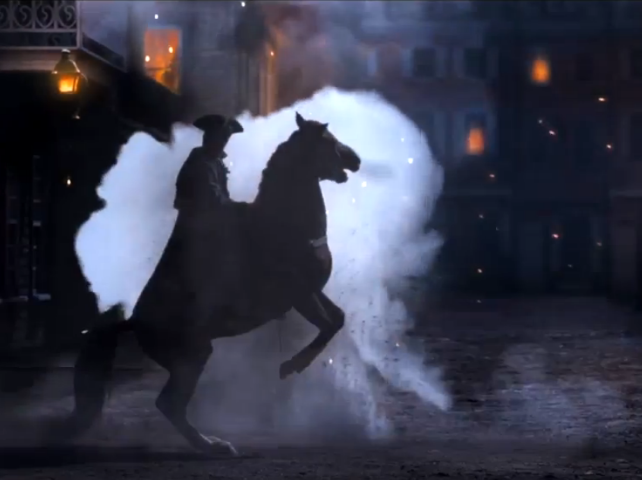
   Once he arrives in the New World, he travels to Philadelphia where he meets a printer named Benjamin Franklin, and begins working for him. While not working, though, he does good deeds against the tyranny of the British soldiers. His acts gain him the nickname of "the Highwayman."
   Eventually, William uncovers a secret plot of Kemp's to destroy Philadelphia. He must figure out a way to stop Charles Kemp before time runs out!

CONTENT
   While I would not necessarily say this movie deserved a PG-13 rating, I would warn parents of young children concerning the violent content. Two assassins murder British soldiers. There are also swordfights and fistfights, some of which result in blood. Several deaths occur during these fights as well. A man is electrocuted, though this isn't as realistic as it could have been. A man orders soldiers to kill a woman, though they fail. 
   There is no language in the film. The closest it gets is an "Oh, heavens!"
   This film gives a respectful view of love, while showing two kisses between the main characters. Beyond the Mask's take on romance is refreshing in today's sexually-driven culture. Rather than "trust her emotions" and jump headlong into marriage with William, Charlotte uses wisdom in waiting until she is absolutely sure.
   Continuing the thoughts above, Charlotte tells William that it is not her favor he needs, but God's. She tells him that he can only redeem himself from his past actions through Jesus Christ. The filmmakers were able to expertly impart basic truths of the gospel while making it fit nicely into the story. Kudos to them for accomplishing this!
   I really must say that in terms of quality, Beyond the Mask is the best Christian film I've seen. No, it is not like Courageous or Facing the Giants in the sense that characters quote Scripture or preach often. But it provides solid Christian lessons, all the same. The story, music, and acting were stupendous! Christian films are often categorized as low budget, which is true. But Beyond the Mask has accomplished things that I don't believe have been accomplished by any other faith-based films before.
   While there are some scenes that parents will want to take caution with when young children are present, this is a wonderful family adventure film, complete with swashbuckling swordfights and passionate romance. 

GENERAL INFORMATION
Length: 103 minutes
Rating: PG (for action, violence and some thematic elements)
Director: Chad Burns
Producer: Aaron Burns
Music: Jurgen Beck
Year of release: 2015
Primary audience: Pre-teens, teens, adults

Monday, May 2, 2016

2016 Family-in-Mind Awards: Summary

   There were some great films in 2015! This was certainly a hard year to wade through nominees and eventual winners. Cinderella swept the Kids/Family category (and all of the nominated films) with a total of 8 awards, winning the major awards of Best Film, Best Actress, and Best Visual Effects.
   In the Teens/Adults categories, TomorrowlandBeyond the Mask, and Star Wars: The Force Awakens came out on top, all with 3 awards (the first winning Best Film). Ant-Man won Best Visual Effects for its revolutionary visual techniques. Woman in Gold took both major acting awards for the Teens/Adults category, as well as Best Adapted Screenplay. 

Friday, April 29, 2016

A Newer New Hope: A Movie Review of "Star Wars: The Force Awakens"

It was the moment I had been anticipating for nearly two years: finally seeing the seventh Star Wars film. I sat down in the dimly-lit theater and prepared to watch the return of familiar faces, as well as the exciting debut of new ones. I was blown away by the experience, but I do have a mixed review as a Star Wars fan myself.
Star Wars: The Force Awakens has become the second film to open to an income of more than $500 billion (the other being Jurassic World). Its pre-release ticket sales broke box office records and it is the third highest-grossing film of all time. The film stars Daisy Ridley as orphaned scavenger Rey, John Boyega as stormtrooper Finn, Adam Driver as Sith warrior Kylo Ren, and Harrison Ford as smuggler Han Solo.

Lucasfilm and Disney have worked so hard to keep details about Star Wars: The Force Awakens a secret. I do not want to ruin this endeavor. I promise that I will make this review as spoiler-free as possible. Do be aware, however, that I will discuss some main plot points (and some potentially minor spoilers). But as a side note, if you are of the few who have not seen the film, you likely already have heard the major spoilers. So if your desire is not to be spoiled, it's high time to see the film...after reading the review, of course!

SUMMARY
   Thirty years have passed since Return of the Jedi. Luke Skywalker, the powerful Jedi, has gone missing! His twin sister General Leia plans to search the galaxy for her brother, in order to gain his assistance in fighting a new evil regime: the First Order. Resistance pilot Poe Dameron visits a small village and secures a piece of the map that leads to Luke. However, the First Order shows up, led the fearsome Kylo Ren, and they begin attacking the village. Dameron hides the map inside his droid BB-8. While Dameron is captured by Ren, BB-8 manages to escape the massacre. Kylo Ren interrogates Poe Dameron using his dark side Force powers. Ren learns that Dameron has hidden the map with BB-8, and he sends his troops to the planet Jakku to search for the fugitive droid. 
   Meanwhile, BB-8 is rescued by a scavenger named Rey. We learn that Rey is alone on Jakku and must find mechanical parts if she is to survive. However, back on Ren's command ship, there is a stormtrooper who is not so loyal as he seems. Stormtrooper FN-2187 believes that what the First Order has been doing is wrong, so he helps Poe Dameron escape. Poe suggests a new name for his new ally: Finn. In a stolen TIE fighter, Finn and Poe crash on Jakku.
   After Poe goes missing, Finn eventually meets Rey. The two are chased by First Order forces, and they are able to escape Jakku. After running into an unexpected ally, they plan to return BB-8 back to the Resistance. Finn makes it to  the Resistance, but Rey has been captured and taken to Starkiller Base.
   The Resistance sends a small group to the base in order to destroy the destructive weapon located there. Time is running short as the Resistance is threatened. However, the heroes must also rescue Rey and confront the evil Keylo Ren.

CONTENT
   The seventh installment of the Star Wars series is the second one to be rated PG-13, and for good reasons. While the content of this film is not necessarily as dark as Revenge of the Sith, it certainly has some violence. There is little blood in the film (a stormtrooper bleeds, though, and an interrogated Resistance pilot), but there are plenty of casualties. We see soldiers and pilots on both sides killed as a result of blaster guns, explosions, and other weapons of war. Beyond this, many starfighters explode and, therefore, their pilots also. People are eaten by an octopus-like creature, which also loses limbs in a battle. A person is stabbed with a lightsaber. One of the villains is a menacing alien with a disfigured face; he might frighten children, but his intimidating looks won't daunt adults. 
   Any foul language is pretty light, like other Star Wars films. There are two uses of h*** and d***. I'm pleased that director J.J. Abrams did not fully use the language limits of his PG-13 rating. 
   There is an embrace between lovers Han and Leia. The two had a child and later separated, but it is not clear whether they were ever married. A young woman kisses a man's forehead, though this didn't seem to be sexual in nature.
   If it's not broke, don't fix it. I guess J.J. Abrams took this phrase to heart in creating The Force Awakens. Why? It could be said this seventh film is a revised remake of the classic 1977 Star Wars film. The basic plot and events constantly bring back to mind the original film. It works, but I feel like Abrams didn't use the full potential available for a truly original story. The new characters Rey, Finn, and Poe were nice additions to the galaxy far, far away, but Rey and Poe certainly are the new "Luke and Han." BB-8 is the new R2-D2. Abrams wanted to bring a new generation into the Star Wars universe, so it seems like he figured George Lucas' original formula would be best for this, if slightly modified. In honesty, though, this film is both nostalgic and new for old fans. It also is a fresh story for those new to the film series.
   The Force Awakens did what previous films did best: provide important life lessons set in an adventure-filled world (or rather galaxy) of good versus evil. Friendship and teamwork are at the heart of this story. The scavenger Rey meets and befriends the ex-stormtrooper Finn. The two work against the First Order to bring a Resistance droid safely home to deliver classified data. Another story is one of attempted, yet failed redemption. A hero tries to redeem the villain, but with disastrous consequences. This points to real life where sometimes we can't save those who are too far gone down a dark path. Every sinner will not be saved, but that never should stop Christians from trying!
   The film's music is stunning! The score is a perfect mix of old musical themes with new melodies. Composer John Williams earned his fiftieth Oscar nomination for this film's score (though he did not win, one of the biggest disappointments of this year's Academy Awards). His new scores remind us of his past Star Wars accomplishments.
   So what about bringing the kids? I would advise caution there. Yes, this is a classic Star Wars adventure, but like the previous two films (from 2002, 2005), the violence is enough to keep parents from bringing their youngest children. After all, this is the second film in the series rated PG-13, and there is a reason. As you've read above, the content can be dark and intense at moments. For younger fans, parents will have to discern the maturity of their own children. I wouldn't recommend viewers to be younger than 11 or 12. 
   In summary, The Force Awakens is a nostalgic adventure from the galaxy we've come to know and love over the past thirty years. Yet like Revenge of the Sith, the seventh film is more violence-ridden than its lighter predecessors. Abrams was trying to reach a younger generation of fans...but not that young. Still, as a big fan of the films, I highly recommend this for a delightful experience of action, adventure, drama, and, yes, even some fun! 


GENERAL INFORMATION
Length: 135 minutes
Rating: PG-13 (for sci-fi action violence)
Director: J.J. Abrams
Producers: Kathleen Kennedy, J.J. Abrams, Bryan Burk
Music: John Williams
Year of release: 2015
Primary audience: Teens, adults

Sunday, March 27, 2016

Update: A Letter to the Readers (Family-in-Mind Hiatus End, FIM Awards, etc.)

Dear Family-in-Mind Readers,


   After a Christmas through mid-spring hiatus, reviews are hopefully going to start being posted once again. Due to technical issues, the FIM Award nominations have yet to be released. With the release of the nominations, the date for the awards post will also be announced.
   In the recent hiatus, the "Movie of the Month" section also has not been updated. Keep an eye out for changes to that, too.
   Here are a few reviews to look for that will hopefully be published in the coming weeks and months:

  • Star Wars: The Force Awakens
  • Beyond the Mask
  • Avengers: Age of Ultron
  • Various book reviews
   Also, plans are being made for some additions and branching out of the FIM blog. This includes the possibility of a YouTube channel, though nothing has been set in stone just yet. Any suggestions are greatly appreciated!
   For now, while you wait patiently for future reviews and award nominations, here are some recent DVD releases you might like to check out (FIM has not yet reviewed these films, so as a note, some of these are not recommended for the entire family):

  • The Good Dinosaur (suitable for families; some cartoon violence and emotional scenes)
  • War Room (suitable for pre-teens, teens, adults; suggestions of extramarital attraction, emotional scenes)
  • Ant-Man (suitable for teens and adults; action violence, language, brief sexual references)
  • Inside Out (suitable for families; some mild cartoon violence and emotional scenes)
   Every reader and comment for FIM is hugely appreciated! Feedback, comments, and suggestions are always welcome. Hopefully you will continue to enjoy our current and future content!


Sincerely,
Family-in-Mind Reviews
(Philippians 4:8)

Wednesday, December 23, 2015

Remember the Future: A Movie Review of "Tomorrowland"

Look around at the world today, and there is no mistaking that there is chaos everywhere. But what are we doing about it? We can't allow ourselves to ignore the future. This is a big point in Disney's Tomorrowland.
Tomorrowland did not do well at the box office, considering that it is "hard to market original movies," according to the production team. The film stars Britt Robertson as Casey Newton, an optimistic teen, George Clooney as Frank Walker, a grumpy, old inventor, and Hugh Laurie as Governor David Nix. 

SUMMARY
   Young inventor Frank Walker attends the 1964 World's Fair, with a new creation of his. He shows one of the judges his very own jetpack. While the man is unimpressed, a young girl named Athena takes an interest.
   After Frank leaves, Athena finds him. She gives him a pin with the letter "T" on it and instructs him to follow her and her group from a distance. Eventually, Frank boards the "It's a Small World” ride behind Athena. Inside the ride, his pin is scanned, and he is taken to a secret underground lake. There, he enters a machine that transports him to another dimension.
   Frank exits the machine and explores his surroundings. He finds himself on a landing platform covered in fog. But after a mishap with some robots (including a repaired jetpack) and machinery, he and his jetpack fall. However, his jetpack works, and he soars towards a giant, majestic city. Once he lands, he runs into Athena. She tells him that he has found "Tomorrowland."
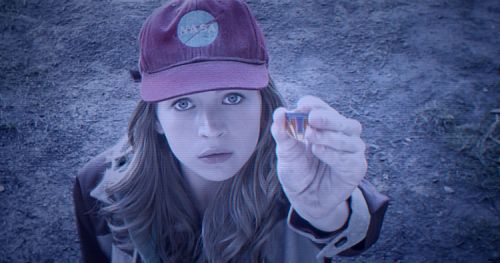
   Fast-forward to the present where we meet teenager Casey Newton. Casey is very smart and incredibly clever. However, she uses her talents to shut down NASA tech so that her dad (a NASA engineer) is not laid off.
   But her luck soon runs out, and she is caught by the police. As she is about to be released from custody, she is instructed to pick up her belongings. However, among her possessions is something that does not belong to her: a mysterious pin. Little did she know, the girl Athena had placed Casey's DNA in the pin and planted it with her belongings.
   Casey begins to grab the pin, but she suddenly finds her surroundings suddenly changed. In fear, she drops the pin and is back in the police station. After reaching to touch the pin a second time, Casey is transported to a wide-open field.
   Eventually, Casey's dad comes to bring her home. In the car, Casey attempts to explain to her dad what happened, but he just dismisses it as acting up. At home, Casey experiments with the pin. In the other world, she enters a sprawling, futuristic metropolis. As she walks through the city, she follows a group of "cadets." They board a monorail train and invite her aboard. But the other world disappears, and Casey is in the middle of a pond.
   Through research, Casey finds a science fiction store in Texas that has connections to the pin. She leaves home and heads on a trip for Houston. At the store, Casey asks the two owners about the pin, but they are reluctant to reveal any information. They quickly interrogate Casey about the pin and where she got it. They soon pull out guns, and as Casey is about to be attacked, Athena bursts in the window and helps Casey escape.
   Athena then drives with Casey in the passenger seat. They travel to an inconspicuous, worn-down house, where Athena leaves Casey. The inhabitant is the inventor Frank Walker, who stubbornly refuses Casey to enter his house. Eventually, Casey makes her way inside and discovers Frank's invention: a doomsday clock that counts down the time till utter destruction.
   After surviving a robot attack, Frank and Casey meet up with Athena and travel to Paris, where they open a portal to Tomorrowland. There, they encounter a drab, dying city. They are met by the self-proclaimed governor, David Nix, where he reveals that he is feeding humanity's obsession over the apocalypse. Casey, Frank, and Athena must work together using their creativity to defeat Nix and restore hope to our depressed world.

CONTENT
   Robots often use their guns to vaporize people into dust. These same robots, who appear to be actual humans, are smashed, stabbed, and abused, particularly in the scene where they attack Frank's house. In the same vein, a robot girl is hit by a truck but jumps back into action, unharmed. This same robot removes some fake skin to reveal machinery. A young boy receives some small injuries while testing a jetpack. Also, the heroes undergo some minor injuries when they fall and trip several times throughout the film.
   For a PG rating, this film fits in plenty of language and even hints at some profanity. H*** and d*** are both used a number of times. God's name is used a few times and we barely hear Frank say p***. Two times, characters say "son of a..." before being interrupted.
   *SPOILER* A boy falls in love with a robot girl (unbeknownst to him), and the two later meet when he is an adult, which at times makes these scenes seem awkward. *END SPOILER* Also, a robot girl's stomach acts as a storage compartment and we see some fake skin, but there is nothing sensual about this scene.
   I enjoyed Tomorrowland, but I will state my disappointments first. The film really seems to be trying to play both sides of its political audience. It touches on indoctrination from an all-powerful government and also promotes environmentalism. So it speaks to different political beliefs, which can turn out to be good or bad (more on that later).
   In light of the bad reviews Tomorrowland has received, my low expectations were far exceeded. The plot of an impending apocalypse has been overdone in films (War of the Worlds, The Day After Tomorrow, Independence Day, just to name a few). However, Tomorrowland takes a heavily-used genre and turns a new twist on it. Yes, destruction may be near, but what are humans doing about it? God knows when the end will be, but we are not to be idle in waiting for it. Christians have a responsibility to take care of the Earth and people that God has created. As one character says in the film, "What reasonable human being wouldn't be galvanized by the potential destruction of everything they've ever knwon or loved?...They gobbled it up like a chocolate eclair! They didn't fear their demise, they re-packaged it. It could be enjoyed as video-games, as TV shows, books, movies, the entire world wholeheartedly embraced the apocalypse and sprinting towards it with gleeful abandon." Our culture has embraced the apocalypse as an exciting event to be marketed in our mainstream media. People today are sadly fascinated with the destruction of the world. The film quote later goes on: "We saw the iceberg and warned the Titanic. But you all just steered for it anyways full steam ahead. Why? Because you want to sink! You gave up!" Christians must never give up. To give up is to give in to the despair and doom of our culture. Instead, let us work to save and redeem the culture. Only God knows the end, we don't. So why should we not work as hard as we can to seek and save the lost, through Christ?
   Today's self-centered culture, especially the younger generations, are focused on the here and now. What makes me happy in this moment? There is very little attention paid to the future and the consequences of our actions. This is partially why we have seen an increase in problems such as teen delinquencies, teen pregnancies, and other troubles.
   As far as the environmentalist messages of the film, there are lessons to be learned here also. Our Creator mandated us to have no other gods before Him. This includes avoiding the worship of nature. However, our Lord also meant for mankind to be the caretakers of His creation.
   Michael Giacchino did a fantastic job with the musical score. It fit perfectly with this film and stands very nicely on its own. I count this as one of my favorite film scores of 2015!
   Director Brad Bird has, I believe, effectively fused adventure, science fiction, and apocalypse. Almost all apocalyptic films end with humanity winning, but Tomorrowland does something that none have ever done before. It answers the question, "What are we to do?" For Christians, that is a vital question for our evangelistic calling, and I suggest Francis Schaeffer's book How Shall We Then Live? to help in learning where we are going.
   In the end, Tomorrowland has its share of flaws, but it is an important film for this time in history. I enjoyed it immensely and I think it is a rare gem that is both relatively clean, but also realistically portrayed.

GENERAL INFORMATION
Length: 130 minutes
Rating: PG (for sequences of sci-fi action violence and peril, thematic elements, and language)
Director: Brad Bird
Producers: Brad Bird, Damon Lindelof, Jeffrey Chernov
Music: Michael Giacchino
Year of release: 2015
Primary audience: Pre-teens, teens, adults

Monday, August 17, 2015

The Dino Zoo: A Movie Review of "Jurassic World"

In the 1993 summer blockbuster Jurassic Park, scientists cloned dinosaurs in preparation to build a dinosaur theme park. While that incident went horribly wrong, the concept lived on. In the fourth Jurassic film, Jurassic World, a fully-operational dinosaur park is flourishing. But when the scientists tamper with dino genetics, how long will it stay that way?
In terms of money, Jurassic World was no joke. It is currently the fourth-highest-grossing film ever, and it took just under two weeks to gain $1 billion. The film stars Chris Pratt as Owen Grady, a velociraptor expert, Bryce Dallas-Howard as Claire Dearing, the park operational manager, Ty Simpkins as Gray Mitchell, Claire's nephew, and Nick Robinson as Zach Mitchell, Gray's younger brother. 

SUMMARY
   Over twenty years have passed since the original Jurassic Park tragedy, but the theme park Jurassic World has reopened on the same site as the original. The new park is in perfect working order, or so the staff believes...
   Gray and Zach Mitchell, two brothers, are sent on vacation to the park to visit their Aunt Claire, the operations manager of Jurassic World. However, Claire is swamped with work and sends her assistant Zara to take the boys around the park. 

   Meanwhile, Simon Masrani, the park's owner, wants an inspection of the cage for a new, genetically-altered dinosaur: the Indominus rex. Masrani and Claire turn to Owen Grady, the lead trainer of the park's velociraptors. Owen is skeptical about the new dinosaur and the entire situation, claiming that she is too dangerous. 
   Soon, Owen's suspicions seem to be confirmed as monitors show that Indominus rex escaped. Owen and a group of security guards enter the enclosure to search for clues. However, the massive dinosaur was clever enough to fake her escape. Owen and one of the guards escape the enclosure...but unfortunately, so does the dinosaur. 
   Despite Owen's advice to kill the monster, Masrani instead sends some special forces to contain Indominus rex. Yet the team fails in its mission, with most of the men killed by the dinosaur. In light of the grave situation, Claire gives the order for the northern part of the island to evacuate.
   What Claire doesn't realize is that her nephews are on an attraction in the northern section. Gray and Zach steer their "gyrosphere" vehicle into a forest where they encounter Indominus rex. They manage to escape, with Claire and Owen hunting them down. 
   Time is running out for Jurassic World, as the Indominus rex wreaks havoc on the entire island, and it's up to Owen and Claire to figure out how to stop the monster before everyone is killed.

CONTENT
   Jurassic World is certainly the most violent and gory of the four Jurassic films. Dinosaurs kill humans throughout the movie (and not just security guards: defenseless civilians are also shown suffering terrifying deaths). The filmmakers are also not worried about showing blood; there is plenty of that. While we do hear some crunches and cracks of bones, some of the human deaths are off camera—but not all. Much of the violence is included in the scenes featuring Indominus rex, which chomps, swallows, stomps on, and mutilates both humans and other dinosaurs. However, the infamous velociraptors of the previous films have their share of tense moments. They slash their claws at Gray and Zach and also eat off the arm of one of the security heads. Also, a helicopter crashes with its passengers, though the camera shows this from a distance.
   Profanity is another concern for parents in this film. There are several uses of s***, h***, d***, and the misuse of God's name. Also there are a couple uses each of b**** and a**. 
   Claire wears a tank top throughout much of the film, and she and Owen kiss at the end of the film. Also, there is a scene where Owen flirtatiously tells Claire that dinosaurs and humans both need to eat, hunt, and mate. He wonders if she can relate to at least one of those things. Gray stares at several teen girls throughout the film for no apparent reason (this truly didn't fit anywhere in the film, and it was sorely out of place).
   On a positive note, Jurassic World delivers a good message about the importance of sticking with your family, much like Jurassic Park III did. At first, Claire is a neglectful aunt who barely knows her nephews. By the end of the film, they are holding each other close. Nothing like a dinosaur attack to bring the family together, right?
   While Owen Grady is not a perfect role model, he does show his willingness to sacrifice himself in order to protect Claire, Gray, and Zach. The noble deed of an adult man or young man risking their lives to protect women and children is something sorely lacking in today's culture. 
   Jurassic World also deals with the issue of cruelty to animals. One of the characters is bent on seeing velociraptors trained to be used as weapons, and he treats them badly throughout the film. While I am not an animal rights activist, we need to be reminded that believers have been called by God to have "dominion over the earth." God has entrusted us with our planet, which is no small responsibility. While this does not warrant placing the lives of animals above humans, we are not to show cruelty to creatures. They are, like us, designs of our Creator. The difference is that we are made in the image or likeness of God and have a soul, while animals do not. 
   For fans of the original film, there are plenty of nods to the classic 1993 adventure, including a statue of the founder John Hammond.
   Despite the language and, of course, lots of violence, I found Jurassic World surprisingly better than I had expected. I would definitely not say it is as good as the original film, but I thought it to be a nice addition to the film series. I'm excited to see what comes next for the Jurassic World story. 

GENERAL INFORMATION
Length: 105 minutes
Rating: PG-13 (for intense sequences of science-fiction violence and peril)
Director: Colin Trevorrow
Producers: Frank Marshal, Patrick Crowley
Music: Michael Giacchino
Year of release: 2015
Primary audience: Teens, adults

Tuesday, April 28, 2015

Have Courage and Be Kind: A Movie Review of "Cinderella"

Disney is on a roll with live-action fairytales. Last year, they released Maleficent and Into the Woods. This year, Cinderella was released and is currently the third highest-grossing film of 2015. (Yes, Beauty and the Beast is next...) Audiences were pleased to find that Cinderella stuck fairly close to the 1950s animated film while also keeping its own feel.
The film stars Lily James as Ella (later "Cinderella"), Richard Madden as Prince Charming, and Cate Blanchett as Lady Tremaine, Ella's stepmother (with an appearance by Helena Bonham Carter as the Fairy Godmother).

SUMMARY
   Ella is a young girl who has a "perfect life." Her parents are loving, kind to others, and wealthy enough to have everything they want. All is well and good. That is, until Ella's mother becomes sick. Soon before her death, Ella's mother passes on one last piece of wisdom to her beloved daughter: to always "have courage and be kind." So Ella takes her mother's last words to heart, always holding to those virtues.
   The years go by, and Ella grows up in kindness and beauty. She loves her father and, while her life is not what it was, it still is good. However, that changes one day. Ella's father marries a widow, Lady Tremaine. She and her two daughters, Drisella and Anastasia, come to live with Ella and her father. Although the daughters are rude to her, Ella shows kindness to them. Lady Tremaine, though, seems kind enough to Ella.

   Later, Ella's father must travel away for business. While gone, Lady Tremaine begins treating Ella worse and worse. Tremaine uses Ella's goodwill to make her move to the attic, giving her room to the stepsisters. 
   *SPOILER* But if that was not bad enough, tragedy strikes. News comes that Ella's father died during his traveling. *END SPOILER*
   In order to secure their wealth, Lady Tremaine sends all of the servants away. She then gives all of the chores to Ella. 
   One day, to escape her troubles, Ella goes for a horse ride in the woods. She comes across a hunting party and runs into a young man. He introduces himself as Kit, telling her that he is an apprentice from the palace (he is actually the Prince). Kit is immediately attracted to Ella, though they part ways before he can learn her name.
   Kit's father, the King, tells him that he must marry a princess. Yet the Prince cannot forget the beautiful young woman he met in the forest. He succeeds in convincing his father to allow all young women in the kingdom to attend the upcoming ball, hoping to run into the mysterious girl there.
   Lady Tremaine sees this as a way to get one of her daughters married into the royal family. Ella fixes up her mother's old dress in hopes of wearing it to the ball. However, Tremaine and her daughters, upon seeing Ella in the dress, tear it up and leave.
   Heartbroken, Ella flees to the garden and begins to weep. Suddenly an old woman asks about something to eat. While Ella gets some food, the woman reveals herself to be Ella's beautiful fairy godmother. 
   She then proceeds to turn a pumpkin into a stagecoach, lizards into footmen, and mice into horses. Then she transforms Ella's tattered pink dress into a magnificent ball gown and also gives her a pair of glass slippers. The fairy godmother sends Ella on her way with the warning that the spell will only last until midnight. 
   Ella makes it to the ball (fashionably late, of course!) and manages to dance with the Prince. Afterwards, the two walk through the palace gardens. However, midnight begins to approach, so Ella needs to leave...but not before accidentally leaving behind a glass slipper!
   That night, Tremaine and her daughters return. Because of Ella's carefree attitude, Tremaine suspects something.

   Later, the King gives permission for his son to marry whomever he chooses, even if he does not wed a princess. So the Prince decrees that every maiden in the land will be visited, so that the glass slipper can be tested on their feet.
   But Tremaine discovers Ella's other glass slipper in her attic room. She tells Ella she wishes to be made head of the royal household and that her daughters be given advantageous marriages. Ella will not consent, so Tremaine smashes the shoe. She then locks Ella in the attic.
   She then uses the shattered slipper to blackmail the Grand Duke into giving her and her daughters power and wealth. The Duke then tries to discourage the Prince from continuing his search for the mysterious girl, but there is no stopping him.
   They discover Ella when they hear her singing a song. They try on the shoe, and the rest is happily ever after.

CONTENT
   There is precious little violence in Cinderella. There is some mild, comical violence. Cinderella's carriage ride home is a little tense for younger children. Three people die as a result of illness or old age. Also, one of the stepsisters threatens to "scratch" the other's "eyes out."
   There is no foul language. The worse it gets is a use of "gosh" and "oh lords."
   Many dresses show part of the chest. Two young woman are seen in underwear (extremely modest by today's standards, as it covers their entire body). There are also two kisses between married couples.
   In one scene, Lady Tremaine holds a party, full of gambling and even some alcohol (presumably), though neither are glorified nor dwelt upon.
   Cinderella holds excellent moral lessons for all ages and some pointed specifically towards girls and young women. Cinderella holds to her vow to be courageous and kind. But she doesn't flaunt her virtue. Instead, she is humble, and even admits her own faults when she declares that she doesn't feel very brave. 
   Also, as a lesson for girls, there was a point made about the stepsisters having beautiful appearances, but inside, they are cruel and wretched. This can have a good impact on girls who worry about their appearance. It isn't everything! Although the main character is supposed to be beautiful, it is really her gracious spirit and goodness that draws the Prince to her. 
   The musical score was really something special. It was done by composer Patrick Doyle, known for his work on especially Chariots of Fire. It had a nice classical touch, for those who enjoy that genre.
   The acting was great! Lily James was a superb Cinderella, and Cate Blanchett was magnificent as the aloof, evil stepmother. Also, Sophie McShera and Holiday Grainger were good in their roles as the bumbling stepsisters. Besides this, it was a treat to see the talented Helena Bonham Carter as Ella's fairy godmother.
   This is actually a good film that is appropriate for all ages. I was very impressed with Disney's handling of the story, as well as the wonderful life lessons they put in the film. This was truly a great family movie. I especially liked it for its emphasis on girls holding to their virtue before beauty. 

GENERAL INFORMATION
Length: 105 minutes
Rating: PG (for mild thematic elements)
Director: Kenneth Branagh
Producers: Simon Kinberg, David Barron, Allison Shearmur
Music: Patrick Doyle
Year of release: 2015

Primary audience: Pre-teens, teens, family

Thursday, March 26, 2015

The Master of Temptation: A Movie Review of "The Phantom of the Opera"

In 1986, musician-composer Andrew Lloyd Weber released his new stage musical The Phantom of the Opera, based on the classic French horror book. After the success in London, it became a massive hit in America, where it still continues to this day. The number-one Broadway play (currently second behind The Lion King) was transposed into a film in 2004, though the movie did not fare as well as the play. 
The Phantom of the Opera was nominated for three Academy Awards (Best Art Direction, Best Cinematography, and Best Original Song for "Learn to Be Lonely"). Emmy Rossum won the Saturn Award for Best Performance by a Young Actor (she turned seventeen during filming). The film stars Emmy Rossum as singer/dancer Christine Daae, Gerard Butler as Erik the "Phantom," and Patrick Wilson as the Viscount Raoul de Chagny. 

SUMMARY
   The year is 1870 and an opera house in Paris has just been purchased by two new owners. Madame Giry, the ballet teacher, introduces the owners to a talented young singer, Christine Daae. The actors practice their performance of Hannibal, as the owners meet Christine, and the theater's resident soprano, Carlotta Giucdicelli. 
   The opera also has a new patron, Raoul de Chagny. Christine recognizes him as her childhood sweetheart but tells her friend Meg Giry she doubts if he remembers. 
   During that night's performance, the stage's backdrop falls and almost smashes Carlotta. A masked man in the shadows flees before anyone can spot him, though he drops a letter. Madame Giry retrieves the letter which is from the "Opera Ghost," a mysterious person who lurks about the opera house. Carlotta is furious that she was nearly killed, so she quits her job, and Christine Daae takes her place. Her singing voice is so beautiful, and it stuns the audience, as the Opera Ghost listens in a hidden location. 
   After the play, Christine goes to the opera chapel to light candles for her deceased father. Meg finds Christine and asks to know how she is able to sing so well. Christine confides that when her father died, he promised he would send to her the "Angel of Music." She explains that a voice has been tutoring her, and she assumes it must be the angel (as she has seen no physical person accompany the voice). 
   She returns to her dressing room, and Raoul comes to find her, as he has remembered his childhood friend. He agrees that she has been visited by the Angel and insists she go to dinner with him. However, Christine responds that the Phantom would not allow it. 
   Raoul will take none of her words, so he goes to prepare his carriage. While he is gone, someone locks Christine's door from the inside, and she sees a masked man in her mirror. The man, who is the Phantom, leads Christine through the mirror, and into the catacombs of the opera house. He takes her across an underground lake to his secret lair, where he professes his love for her. He shows Christine an image of herself as a bride and she faints.
   The next morning, Christine goes to the Phantom and removes his mask. She catches a glimpse of his face, which is deformed. Christine returns his mask, and the Phantom decides to return Christine to the opera house. 
   Meanwhile, the owners/managers are worried that Christine's appearance will cause trouble but realize that it is getting them a lot of attention from the press. They also feel angry over letters from the Opera Ghost, asking for money. Then, Carlotta returns, upset by a letter sent to her saying that if she were to sing instead of Christine, something disastrous would happen. 
   The managers decide to challenge this Ghost, so they put Carlotta in the lead role. After finding Christine, they cast her in a silent role for the opera's next show. 
   During one solo that night, Carlotta's voice cracks. Suddenly, a man is hanged on the stage, causing panic among the audience and the performers. Christine and Raoul retreat to the rooftop, where they speak of their love for each other.
   However, the Phantom overhears their conversation, as he hides behind a statue. The Phantom promises his revenge on Raoul for "stealing" his love. 
   Time passes, and the opera house holds a special gala. All is going marvelous…until the Phantom appears. He presents the opera managers with a play he has written, and demands it to be produced. 
   During the said play, the Phantom abducts Christine and once again takes her to his underground lair. Madame Giry helps Raoul find his way as he attempts to rescue his love.

CONTENT
   There is not a lot of violence, but what graphic content is included earns the PG-13 rating. A man is dropped to the opera stage, hanging. Another man is strangled with a rope. In this same vein, the Phantom threatens some people. A crashing chandelier starts a fire, though it seems that no one is harmed in it. There is a swordfight resulting in some cuts. Also, a man is nearly drowned and is choked (he does not die). The Phantom angrily begins smashing mirrors. In one scene, a young boy with a deformity is a captive circus performer. People mockingly gawk at him, and he attacks his captor (the strangled man). As far as appearances, we see the Phantom maskless, as his scarred and deformed face is bared to the open. A circus performer, presumably, tugs on his eyelids to a gruesome and haunting effect (this lasts for only a few seconds).
   There are a few uses of God's name, as well as a few uses each of h*** and d***.
   Phantom is, primarily, a passionate love story, so some romance is to be expected. There is nothing explicit to worry about, but a lot of song lyrics lightly imply sexual seduction. During a couple of song numbers, the Phantom runs his hands over Christine's body, mainly her torso. In the song Point of No Return, Christine wonders how long she and the Phantom should "wait before [they’re] one," and she allows her dress to slip off of her shoulders. Also, many dresses reveal chests, some to more degree than others. There are a few kisses between the three main characters. As people walk through the opera, there is a scene where a man on a balcony bares his behind, but this is very brief. In short, most of the sexual content is implied.

   For musical fans, The Phantom of the Opera is about as good as you can get. While I prefer the latter Les Miserables, the former has beautiful, moving songs. Some of the more famous are "Angel of Music," "The Phantom of the Opera," "Music of the Night," and "All I Ask of You." These songs expertly articulate the deep feelings of love felt by Christine, the Phantom, and Raoul. There is a reason that the Broadway musical (upon which the movie is based) is one of the highest-grossing plays of all time!
   In addition to the songs, the storyline is very intriguing. At the heart of the story is this: Christine and Raoul love each other, but the Phantom loves Christine. The young woman may not truly love the Phantom, but she admires and pities him. That alone makes for a great story in my book. However, as a fan of the book, I was disappointed with how much was cut from that when they crafted both the play and the movie. 
   The acting was simply marvelous! Gerard Butler shone out as Erik, the Phantom, and the seventeen-year-old Emmy Rossum was surprisingly amazing, both in terms of singing and acting. I can't believe that neither were nominated for an Oscar! The other actors are good, though Patrick Wilson felt a bit lacking to me. 
   For me, this film was a bit of a parable, in a way. Raoul, though flawed, is like a representation of Christ, and the Phantom as Satan. We humans are like Christine, as we waver between goodness and sin. In the end, it is Raoul who rescues Christine from the "Opera Ghost," like how Christ has rescued believers from wickedness. The Phantom is at first referenced as the Angel of Music, but he is certainly more of a demon of darkness. 
   The Phantom of the Opera is a beautiful story, complete with beautiful music and characters. But be forewarned, parents: this is not appropriate for children. Adults can certainly handle it. For teens, however, I would recommend ages fifteen and up, as some lyrics and motions are rather sensual. It all depends on the maturity of the individual, though.
   I sincerely hope you enjoy this musical gem as much as I do!

GENERAL INFORMATION
Length: 143 minutes
Rating: PG-13 (for brief violent images)
Director: Joel Schumacher
Producer: Andrew Lloyd Webber
Music: Andrew Lloyd Webber (musical songs/lyrics and score)
Year of release: 2004
Primary audience: Adults (older teens should be able to handle this film)

Saturday, March 21, 2015

The Father Who Found His Son: A Movie Review of "Finding Nemo"

Original 2003 poster
2012 3D release poster
If you're a Disney fan, like me, you have probably seen most (if not all!) Disney/Pixar films. Furthermore, if you are a high school Disney fan, like me, you very likely grew up with films such as Toy StoryMonsters, Inc., and Finding Nemo. The last one is the story of a young fish kidnapped by divers and his father's hunt to find him. 
Finding Nemo won the Academy Award for Best Animated Picture (and was nominated for three additional categories). It is also the 27th highest-grossing film of all time, and the AFI (American Film Institute) named it the 10th greatest animated film of all time. The movie stars the voices of Alexander Gould as Nemo, a young clownfish, Albert Brooks as his father Marlin, and Ellen DeGeneres as Dory, a forgetful blue tang. 

SUMMARY
   Clownfish Marlin and his wife Coral have a cave-full of eggs, ready to hatch soon. They love their home (on the Great Barrier Reef) and each other, and they are excited about the prospect of being parents. 

   *SPOILER* However, a barracuda attacks their home. Marlin tells Coral the eggs will be fine, and that they need to hide in their anemone. But, sadly, Coral doesn't listen. She swims for her eggs, and the barracuda dashes after her. Marlin tries to save her, but he is knocked unconscious. When he awakens, he is alone. *END SPOILER*
   Marlin looks for his wife and checks the cave of eggs, but he finds the cave empty. As he mourns, he notices something on the sea floor below him. He sees a slightly damaged egg. He picks it up and reassures the tiny fish inside, and he names it Nemo (which was a name Coral wished for one of the baby fish). 
   Time goes by, and Nemo has started to grow up. Although, due to the damage from the barracuda attack, one of his fins is small than the other (that results in some difficulties swimming). Nemo wakes up his dad, announcing that it is time for the first day of school.
   On their way, Marlin demonstrates his "over-protectiveness" (which is understandable if you lost all but one of your eggs in a barracuda attack!). 
   At the school yard, Nemo meets his science teacher, Mr. Ray. Marlin explains Nemo's fin problem and encourages Mr. Ray to give him some time-outs (much to Nemo's chagrin). The class takes off on their field trip. However, the other dads swim up to Marlin and compliment him on his calmness. Marlin says you can't hang on to them forever, but when a dad mentions the "drop-off" (i.e. where the reef meets the open sea), Marlin freaks out and swims after the class.
   During the field trip, Nemo and some other fish sneak away. They see a boat and dare each other to see who can get closest to it. Nemo is not so sure about it, but suddenly Marlin appears and scolds Nemo. Marlin and Mr. Ray discuss the situation, but now embarrassed, Nemo disobeys his father and begins swims to the boat. 
   But his back is turned to a human diver, who scoops Nemo up in a net. While Mr. Ray protects the students, Marlin goes after his son. Another diver temporarily blurs Marlin's vision with an underwater camera. The divers take Nemo above the ocean, into the boat. As they sail away, a diver accidentally knocks his mask into the ocean (this is important later).
   Marlin chases the boat, but he quickly loses it. While crying over the loss of his son, he is approached by a female blue tang. She introduces herself as Dory and tells him that she just saw a boat pass by, leading him in the correct direction. However, Marlin soon discovers Dory has "short term memory loss," so she forgets things almost instantly.
   The two are confronted by "friendly" sharks, but one eventually attacks them. They survive and find the mask the diver knocked off the ship. Fortunately, an address (42 Wallaby Way, Sydney, but it's not a real address...I've checked) is stamped on the strap. 
   While Nemo is taken to a dentist office fish tank, Marlin and Dory survive many dangers while "finding Nemo."

CONTENT
   Finding Nemo doesn't have too much violence, but there are some scenes/characters that could frighten younger children. Some talking fish are shoved around and harmed. One character gets hurt, and we see a little blood floating in the water (this triggers a shark attack, where two fish are almost devoured for lunch). In that scene, some mines explode, but no one is hurt. Marlin and Dory encounter an anglerfish which is probably the most frightening fish in the film. They also are electrocuted by jellyfish and encounter a dark passage full of fish bones. A man hits his head on some dentistry instruments. A little girl violently shakes a bag of water that holds a fish, and the fish goes belly-up (but he's just pretending). Some fish are captured in a fishing net and pulled above water; they breathe heavily and choke because of this. A man screams while a dentist does work in his mouth (if you have children who are fearful of the dentist, this might not do you any favors, as the dentist is the "villain"). 
   The worst of the language is a "darn" and a "gosh," as well as a few uncompleted utterances of "What the...?" 
   As far as anything else offensive, there is a joke made about a pelican passing gas (he doesn't really, it's just assumed). A squid releases an ink cloud when she is scared, saying, "You guys made me ink." Some fish belch a couple times, and there is a scene that briefly includes seagull droppings. Also, Dory says evolution is what made her a fast swimmer. 
   Marlin sacrifices his safety to find and rescue Nemo. This is a great example of a sacrificial father. Christ as our spiritual Father saved His people from sin, just as Marlin saves his son from danger. A sacrificial father character is so hard to find in today's entertainment (let alone even a competent one). In a culture full of father images from The Simpsons, it's encouraging when movies or other forms of media promote fatherhood as a good and noble calling. Finding Nemo does exactly that (though Marlin blames himself for Nemo's disobedience, which is not right). 
   As far as a family film, Finding Nemo is rather clean (it is far cleaner than many of Dreamworks' animated films like Shrek or Madagascar).  Despite some frightening scenes for younger kids, and some "roll of the eye" moments, I loved the movie. Unless your kids can't handle some of the more violent parts (you could always skip those), I highly recommend families to enjoy this great movie!

GENERAL INFORMATION
Length: 100 minutes
Rating: G (PG would have been a more appropriate rating)
Director: Andrew Stanton
Producer: Graham Walters
Music: Thomas Newman
Year of release: 2003
Primary audience: Kids, Family

Great Power, Great Responsibility: A Movie Review of "The Amazing Spider-Man 2"

When we last saw Spider-Man, he had just defeated the evil Lizard. However, his girlfriend's police officer father had heroically died in the process. He realized how his heroic deeds, while good, could potentially be harmful to those close to him. With that thought in mind, he promises Captain Stacy that he will "leave [Gwen Stacy, his girlfriend] out of it." That didn't last too long...
The Amazing Spider-Man 2 (sequel to 2012's The Amazing Spider-Man) was the eighth-highest-grossing film of 2014. Although it did well money-wise, critics gave it mixed reviews. Basically, it was not the best-loved Marvel super hero film. It stars Andrew Garfield as Peter Parker/Spider-Man, Emma Stone as Gwen Stacy, and Jamie Foxx as Max Dillon/Electro.

SUMMARY
   The Amazing Spider-Man 2 opens with a continuation of the mystery of Peter Parker's missing parents. Dr. Richard and Mary Parker leave their only child, Peter, with his Uncle Ben and Aunt May. They then board a plane for Switzerland, carrying something about a mysterious "Project Roosevelt," and Dr. Parker begins uploading information on a computer. But he and his wife are attacked by an assassin. After dealing with the killer, Dr. Parker uploads the valuable information but only moments before the airplane crashes into the ocean.

   Back in New York City, years go by, and Peter Parker has become the "amazing" Spider-Man. He helps the police catch a criminal who had stolen a van containing dangerous chemicals (a little trivia: this criminal becomes the villain "Rhino" in the Spider-Man comics). During this encounter, he rescues a clumsy Oscorp employee named Max Dillon. The man becomes a huge fan of the masked hero.
   Later, Peter Parker talks to Gwen Stacy, though it seems he feels guilty, as he made a promise to her father to keep her safe (doing so by staying away from her). The two have their high school graduation. Afterwards, he meets with her and explains that he needs to keep the promise he made to Capt. Stacy. As you can imagine, she is not happy.
   Meanwhile, a childhood friend of Peter's comes home, after being away at school. His name is Harry Osborn, the son of Oscorp's CEO, Norman. Harry and Peter are able to meet with each other, since they haven't seen one another in many years.
   Later, Harry's father gives him an electronic device that contains his entire life’s work. His father dies the next day (of a terrible disease), leaving his son as the new CEO.
   At the Oscorp building, Max Dillon is working on maintenance. However, some workers left a tank full of electric eels wide open. Max falls inside, but instead of being killed, his genetics are changed by the electricity. Cue the villain!
   Max Dillon, now electrically-charged, goes to Times Square. The police seem bent on harming him, viewing him as a threat, but Spider-Man shows up. He tries to calm down Max, but the police have snipers who try to take out Max. The electrified man gets angry and begins causing chaos. Spider-Man is able to calm him down, but he is taken away.
   However, there is not one but two villains in this film. Harry Osborne researches his father's work and, with the help of technology, turns himself into a powerful new foe. 
   Things get harder for Spider-Man when Harry (now the Green Goblin) teams up with Max (now Electro). Things get even harder when the two kidnap Gwen Stacy!

CONTENT
   Throughout the entire film, guns are fired and people are punched, kicked, knocked out, and harmed in all sorts of ways. Buildings are blown to bits, crumbled to ruins, and smashed. Max falls into the water container of electric eels, and his body is burned. His skin crumbles away, revealing a translucent body beneath. This "Electro" could frighten kids. Electro also uses his electricity to harm many people. At the beginning of the film, when Peter's parents are attacked in the airplane, a woman is punched and then shot. A man is strangled with a seat belt, the airplane crashes, and the pilot is shot. Spider-Man is repeatedly beat-up by the villains, though he manages to make it through the film alive. After Electro is taken away by scientists, he is strapped into a machine and tortured. Norman Osborne has a disease that leaves him looking like a Halloween monster. Towards the end of the film, a woman falls from a high ledge, and, while Spider-Man attempts to rescue her, she hits pavement. We hear a crack and see a little blood.
   There are a few kisses between Peter and Gwen. Spider-Man humiliates a criminal by using his webs to pull down his pants, leaving him like that for the cops. In one or two scenes, Gwen wears a short skirt. There are several times Peter is seen shirtless. In one scene, attempting not to let his Aunt May see him in his Spidey costume, Peter tells her he is naked (obviously, we do not see him naked, since he's not). 
   God's name is used a few times in the film. D*** and h*** are uses a couple times each, and there is one use of p***. 
   There is some alcohol use in the film. Harry mentions that he was sent scotch for his birthday, and we see him drinking alcohol. He seems to be drunk. 
   There are some good things to take away from the film. Peter's intentions to keep his vow to Capt. Stacy are honorable. And it seems like he is going to do so, but he does eventually get back together with Gwen. Still, his original intentions of keeping a promise are great (but his breaking of the vow is not so great). 
   Although Peter is a flawed hero, his battle of good versus evil is a wonderful cause. Wickedness will always be in this world, because of sin, and we need to fight it. Jesus Christ gives believers the ability to stand against temptations, just as Spider-Man stands strong against the attacks of Electro and Goblin. 

   As a film, The Amazing Spider-Man was, I think, no better than OK. I didn't enjoy it nearly as much as the previous movie. The storyline was mediocre, except for the slow, awkward scenes between Peter and Gwen. I have to admit, there was some good acting, and the special effects were amazing. But because of the violence, language, and some sensual parts (not to mention the flat story), I would only recommend this if you are a Spider-Man fan, wanting to see how the story will continue. As a Marvel fan, I did not feel that this was their best movie, but there are a few parts of it that were enjoyable. 
   (As a side note, Andrew Garfield was recently fired by SONY Pictures, and it was announced that the Spider-Man film series would once again be rebooting, this time with a new actor. So the entire story set up in The Amazing Spider-Man and its sequel will not be finished in the now-cancelled third or fourth films.)

CONTENT
Length: 142 minutes
Rating: PG-13 (for sequences of sci-fi action/violence)
Director: Marc Webb
Producers: Alex Kurtzman, Roberto Orci, Jeff Pinker
Music: Hans Zimmer, The Magnificent Six
Year of release: 2014
General audience: Teens, adults