Showing posts with label Historic. Show all posts

Wednesday, May 31, 2017

Love and Redemption: A Movie Review of "Beyond the Mask"

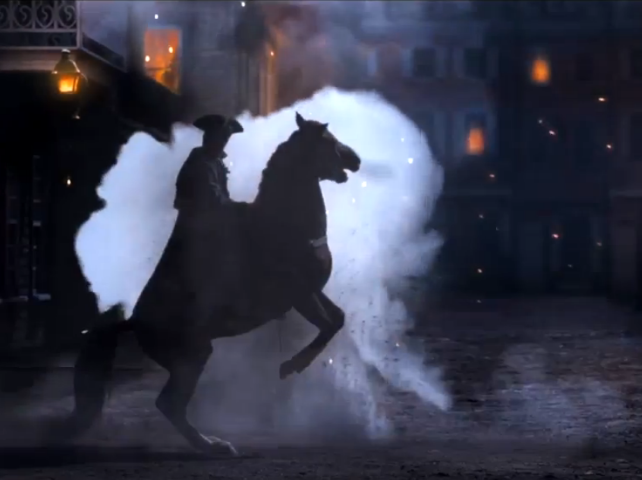
To what lengths would we go to receive love and be redeemed from a terrible lifestyle? For believers, the answer is that we trusted in Christ and repented. In the film Beyond the Mask, an ex-assassin falls in love and learns that he must turn to God to redeem himself from his former life of murder and deception.
The Christian-themed movie did well, considering its relatively small budget of $4 million. It reached over one hundred theaters across America. The film stars Andrew Cheney as ex-assassin William Reynolds, Kara Killmer as Charlotte Holloway, and John Rhys-Davies as Charles Kemp.

SUMMARY
   William Reynolds is an expert assassin for the British East India Company in the 1770s. Whenever something is not going according to plan, William is called in to eliminate some "obstacles." However, he is ready to be done with his job. Charles Kemp, an EIC official, regrets that he will lose William's services, but he understands. Well, not really. Because William has witnessed too many secrets, Charles has an explosive planted on William's carriage. Yet young Reynolds manages to escape without being detected.
   After the escape, William pretends to be the local pastor for a small town. Over time, he accepts this as his new life and during his hiding, he meets a beautiful young woman named Charlotte. The two fall in love and draw closer to marriage. But Charlotte is not quite ready for matrimony, as she is unsure of William's relationship with Christ. 
  *SPOILER* One day, Charlotte wishes to introduce William to her beloved uncle, but there is one slight problem: her dear uncle is Charles Kemp. *SPOILER ENDS* Suddenly, the chase is back on and William must flee for his life...again!
   William knows that Charlotte and her uncle are on their way to America. He decides to go there and change his life, in hopes that Charlotte will accept him as a suitable husband.
   Once he arrives in the New World, he travels to Philadelphia where he meets a printer named Benjamin Franklin, and begins working for him. While not working, though, he does good deeds against the tyranny of the British soldiers. His acts gain him the nickname of "the Highwayman."
   Eventually, William uncovers a secret plot of Kemp's to destroy Philadelphia. He must figure out a way to stop Charles Kemp before time runs out!

CONTENT
   While I would not necessarily say this movie deserved a PG-13 rating, I would warn parents of young children concerning the violent content. Two assassins murder British soldiers. There are also swordfights and fistfights, some of which result in blood. Several deaths occur during these fights as well. A man is electrocuted, though this isn't as realistic as it could have been. A man orders soldiers to kill a woman, though they fail. 
   There is no language in the film. The closest it gets is an "Oh, heavens!"
   This film gives a respectful view of love, while showing two kisses between the main characters. Beyond the Mask's take on romance is refreshing in today's sexually-driven culture. Rather than "trust her emotions" and jump headlong into marriage with William, Charlotte uses wisdom in waiting until she is absolutely sure.
   Continuing the thoughts above, Charlotte tells William that it is not her favor he needs, but God's. She tells him that he can only redeem himself from his past actions through Jesus Christ. The filmmakers were able to expertly impart basic truths of the gospel while making it fit nicely into the story. Kudos to them for accomplishing this!
   I really must say that in terms of quality, Beyond the Mask is the best Christian film I've seen. No, it is not like Courageous or Facing the Giants in the sense that characters quote Scripture or preach often. But it provides solid Christian lessons, all the same. The story, music, and acting were stupendous! Christian films are often categorized as low budget, which is true. But Beyond the Mask has accomplished things that I don't believe have been accomplished by any other faith-based films before.
   While there are some scenes that parents will want to take caution with when young children are present, this is a wonderful family adventure film, complete with swashbuckling swordfights and passionate romance. 

GENERAL INFORMATION
Length: 103 minutes
Rating: PG (for action, violence and some thematic elements)
Director: Chad Burns
Producer: Aaron Burns
Music: Jurgen Beck
Year of release: 2015
Primary audience: Pre-teens, teens, adults

Sunday, September 28, 2014

The Heritage of All Mankind: A Movie Review of "The Monuments Men"

In 1943, World War II is in full swing in Europe as the Allied armies are forcing the Axis powers to retreat further towards Germany. However, precious artistic works of mankind are being destroyed in the midst of heavy fire. A single Lieutenant devises a plan to create a small band men to go in and rescue works of art before the Nazis can steal them.
The Monuments Men boasts a huge cast, including several famous names. The film stars stars George Clooney (as Lt. Frank Stokes), Matt Damon (as Lt. James Granger), John Goodman (as Sgt. Walter Garfield), Bill Murray (as Sgt. Richard Campbell), Hugh Bonneville (as Lt. Donald Jeffries) Jean Dujardin (as Lt. Jean-Claude Clermont), Bob Balaban (Pvt. Preston Savitz), and Cate Blanchett (as Claire Simone).

SUMMARY
   America has been in World War II for just under a year now and the Allies are finally driving the Germans back into their own territory. But Lieutenant Frank Stokes tells the President that victory will not mean as much if precious works of art are destroyed in the war, whether by weapons or thieves. 

   Stokes is given permission to create a new group of seven man named the "Monuments Men." These men are historians, art experts, and museum curators, not specially trained soldiers. Yet they are given command and head to Europe to lead the hunt for artwork stolen by Nazis.
   Unfortunately, the officers of the U.S. Army refuse to change their battle strategies for the sake of protecting art. The Monuments Men split up to cover better ground: Stokes sticks with the U.S. Army; Lt. Jeffries leads a rescue mission for a Belgian cathedral; Lt. Granger seeks out French art historian Claire Simone; Sgt. Campbell and Private Savitz hunt down a Van Eyck altarpiece; and Sgt. Garfield and Lt. Clermont go off in search of other pieces of art.
   Eventually, the team gets back together, minus a few men lost in combat. They begin locating secret hordes of art within castles, mines, and other places. However, time is running out as they learn that the Nazis are blowing up their stolen art collections. To make matters worse, the Russians are also attempting to steal as much artwork as they can.
   In the climax of the movie, the team must enter a mine and rescue as much artwork as possible before the Russians get there. 

CONTENT
   As this is a war film, there is a good amount of violent content. Two main characters die: one is shot, and we see blood staining his uniform; the other is shot and died a little while later, with some blood in the scene. There are many other wounds sustained in the film, some containing blood. Also, while not depicted, the Holocaust is mentioned. A man mentions that his grandfather was sent to a concentration camp, and a Nazi officer says he should be thanked for his work in the Holocaust. In connection with this, a barrel full of gold teeth is found.
   The inappropriate language in the film is moderately heavy, including seven uses of s***, as well as several uses of d***, God's name, and h***. Christ's name is also used around a half-dozen times.
   In Paris, Claire Simone attempts to lure Granger into an adulterous relationship against his wife. But, in a good moral twist, Granger resists, yet still continues historical research with her. Besides this, there are some nude sculptures as well as nudity in artwork, but none of these artworks are focused on in particular. 
   Also, there is some smoking throughout the film, as well as some brief scenes including alcohol.
   Aside from some foul language, The Monuments Men is an enjoyable movie, I think. There is plenty of action and drama, but also some spattering of comedy (mostly from Bill Murray). The movie is not likely for everyone, but I believe most might enjoy it. 
   The acting was superb, especially with the performances of George Clooney, Hugh Bonneville, and Cate Blanchett. Also, the musical score by Alexandre Desplat was really great and fit perfectly with the film.

   Those who have read the historical book upon which the movie is based will notice the change in names and even the number of the Monuments Men. I am not entirely sure why certain things such as names were altered, but it could have something to do with the descendants of the real soldiers involved.
   There are some good points made about the importance of art to civilization. Our international history is vital to our future, I believe, and The Monuments Men displays this. Yet there is still some argument in the film of whether the art is worth human lives.
   The Monuments Men is certainly not for the whole family, but some pre-teens might possibly enjoy parts of it. 

GENERAL INFORMATION
Length: 118 minutes
Rating: PG-13 (for some images of war violence and historical smoking)
Director: George Clooney 
Producers: George Clooney, Grant Heslov
Music: Alexandre Desplat
Year of release: 2014
Primary audience: Teens, adults

Tuesday, August 12, 2014

Words Are Life: A Movie Review of "The Book Thief"

The late 1930's bring great changes to Germany. The Nazi party is fully in control and their plans for world domination are about to be put into effect. Yet in the midst of this upheaval, one young girl quietly lives her life. The Book Thief tells the story of Liesel Meminger, the title character, as she is taken into a foster home, steals books, and befriends a Jew.
The movie stars Sophie Nélisse as Liesel Meminger, Geoffrey Rush as her foster parent Hans Hubermann, and Emily Watson as his wife Rosa.

SUMMARY
   The Book Thief opens with a voice narrating the beginning of Liesel's story. She is on a train with her mother and ill brother. The train makes an unscheduled (yet necessary) stop, during which Liesel finds a book dropped in the snow. She picks it up and hides it in her coat. 
   Eventually, Liesel is taken to a foster home (we are not told why her mother is sending her, but it is implied that she might have been a Communist). Rosa Hubermann, her new foster mother, displays her rough personality. Her prodding does not get Liesel to budge from the car. After Rosa gives up, Hans goes to the car and invites Liesel outside, calling her "Your Majesty." That does the trick. Liesel begins to learn how to live with the Hubermanns, though Rosa is convinced Liesel is a mute, as she will not speak. On her first night, Hans shows acts of kindness to her, and a special bond begins to form between the two.
   On the first day of school, Liesel is accompanied by Rudy Steiner. However, things are worse at school than at home. Liesel cannot write and signs her name with "X"s. Later, she is taunted by fellow classmates, and a fight breaks out. Through this, Liesel finds a second true friend in Rudy.
   After school, Hans tells Liesel that he is not a very good reader, and they can help each other. They start by using the book Liesel stole while the train was stopped. Hans soon sets up a blackboard in the basement, where Liesel can keep track of every new word she learns. Liesel Meminger becomes quite the reading aficionado.
   As time goes on, Liesel becomes part of the Hitler Youth and (at a Nazi book burning) is forced into throwing books into a massive bonfire. However, after the crowd leaves, "the book thief" manages to find a book that escaped the fiery fate.
   Eventually, the movie reaches the historic event known as Kristallnacht (or "the Night of Broken Glass"), a night of great violence and persecution towards Germany's Jewish population. Max Vanderburg, a Jew, is able to escape the massacre. He flees to the Hubermanns' home, as Hans was a friend of Max's father. The Hubermanns hide Max in their basement, and he befriends Liesel, as they both love books and words. 
   The Hubermanns, Liesel, and Max undergo struggles and a final, climatic disaster. 

CONTENT
   While The Book Thief has a lot of dialogue, there are some tense scenes. Within the first few minutes, a small child dies, and blood comes from his nostrils. Liesel also fights the school bully, but the worst is a skinned knee. However, there are several wartime bombings and one scene in which an army truck explodes violently. Also, the Kristallnacht scene depicts some violent persecution of the Jews. Toward the end of the film, the audience is shown the dead bodies of several people. One scene also includes a crowd of weary people being prodded and hurried along by Nazi soldiers (the victims are clearly Jewish). 
   There is one use of h*** and a few uses of G*d. Hans also utters two phrases: "God in heaven" and "Christ on a cross..."
   The Book Thief is refreshingly clean from sexual content, besides a small bit of flirting from Rudy to Liesel. 
   The story is narrated by Death personified. He is not said to be God, Satan, or a specific spiritual individual. The movie is, sadly, void of any reference to a living God and where the characters find refuge during the Nazi trouble. Without God, they turn to books; even good books are passive, though, and are no substitute for our Lord. 
   With that aside, however, the film brings out some great things about the use of words. Max tells Liesel "words are life," which is true in a certain sense; our earthly lives can change based on what we say to someone or write on paper. Another quote from Max is when he asks Liesel, "If your eyes could speak, what would they say?" As Christians, how can we translate what we see into our spiritual lives? 
   Also, as a John Williams fan, I do have to add that his music expands the emotions felt in this movie, and I found some songs being reminiscent of his music from Schindler's List.
   The Book Thief may not be an amazing film, but it is a very good one; it is one that brings out good points about the power of words. Sophie NĂ©lisse and Geoffrey Rush shine marvelously as Liesel and Hans (Emily Watson was rather good, as well). The movie is obviously not a choice for the entire family, but it is one from which even adults can benefit. 

GENERAL INFORMATION
Length: 131 minutes
Rating: PG-13 (for some violence and intense depiction of thematic material)
Director: Brian Percival
Producers: Karen Rosenfelt, Ken Blancato
Music: John Williams
Year of release: 2013
Primary audience: Pre-teens, teens, adults

Thursday, May 29, 2014

Survival of the "Weakest": A Book Review of "The Pianist"

In September 1939, World War II began with Nazi Germany's invasion of Poland. Upon reaching Warsaw, the Nazis set up a ghetto for the Jews, and things appeared alright at first, perhaps just a little tense. Yet things escalated, and the true purpose of Germany was revealed: all Jews were to be killed.
The Pianist is a memoir by Wladyslaw Szpilman, a Polish Jew. In his book, Szpilman recalls his time in the Jewish ghetto of Warsaw as he struggled to survive and hide from Nazi soldiers. It was published following the war, but because the Soviet Union disapproved, it was banned. It was not until the late 1990's that it was republished in German and English. It was later adapted into a film version, though Szpilman passed away before the movie was completed.

SUMMARY
   The Pianist's author is also the main character (as this is an autobiographical memoir), Wladyslaw Szpilman in the 1930's, at both Berlin, Germany, and Warsaw, Poland. When the Nazis rose to power, Szpilman returned to Poland in 1933.
   He begins working for the Polish Radio until Germany invades in the fall of 1939. The station goes off air as he plays one of Chopin's Nocturnes. Not long after, Warsaw surrenders to Germany. The Nazis put up notices for the Poles: they will be cared for by Germany. There is even a special section for Jews! This is a relief for many Jews, though some still suspected treachery.
   It doesn't take long for the true intentions of the Nazis to be made clear. Raids occur all over Warsaw, in which Jews are abused. A little later, Jews are required to hand in property and valuables to the German state; Jewish families are permitted to own only a small portion of money, regardless of the family's size.
   The Szpilmans did not go along with their enemies and instead hid their money and valuables in strategic places around their home. But by the time 1940 came around, a section of Warsaw had been blocked with walls, and rumors circulated that this was to be the ghetto for Jews. 
   Still, Szpilman and his family were fortunate enough to already be living within the ghetto walls; they would not have to evacuate and be subject to Nazi abuse...yet.
   The ghetto quickly became a terrible place to live: full of fear, unsanitary, under the watchful eye of Nazis. However, the worst was yet to come, but Wladyslaw would (quite miraculously) survive the horrors of occupation under the Third Reich. 

CONTENT
   As a memoir of the Nazi Holocaust, The Pianist has much strong violence, some of it told in detail. It includes (but is not limited to) shootings, beatings, verbal insults, and mass murder. In one part, an elderly Jew cannot move because he is paralyzed from the waist down. Nazi soldiers take the chair in which he sits and throw him out the window, where the man hangs in a tree. There is another scene in which Jews are instructed to lie on the ground; a Nazi commander then calmly walks down the row, shooting each Jew. 
   There are occasional uses of G*d and only once is d*** used. 
   I recall no sexual content, for which I was glad. However, this was a non-fictional book, and there were not many places where such things would fit.
   The Pianist is a good story of one man's survival of brutal tyranny and death. Christians who read the memoir will clearly see God's hand in this man's life, whether he recognized it or not. 
   Szpilman's memoir delves into the human psychology of a wartime Polish Jew. There are many rewarding scenes in the book, but this book will likely leave you with a sick feeling of those who did not make it out of the ghetto alive. And this is right, as human lives are created by God. As Scripture tells us, man is made in the likeness of God, our Creator. 
   Yet this book also proves that not all Germans of the time were like the Nazis, as Winston Churchill led Great Britain to believe. Even some of the soldiers were compassionate, as one sees in the memoir. 
   I would say this book is targeted mainly for adults. I am not suggesting that teens should not read this book (as I did), but no one, even adults, should read this book lightly. The Pianist is a remarkable account of German invasion and the war years in Warsaw, but it is also a grave story of man's depravity without God, when he is left to himself.

GENERAL INFORMATION
Number of pages: 224
Author of book: Wladyslaw Szpilman
Published in: 1946 (under the name Death of a City), 1998 (German/English editions), 2002 (movie tie-in edition)
Primary audience: Adults

Wednesday, May 28, 2014

The Ideal Leader: A Movie Review of "Captain Phillips"

On April 8, 2009, a small group of Somali pirates hijacked a cargo ship, the Maersk Alabama. The ship's captain was kidnapped and taken aboard a life boat with the pirates; the U.S. Navy came to make an attempt at a rescue mission for Captain Richard Phillips. In 2013, a movie inspired/based on Richard's biographical book was released.
The film's cast included Tom Hanks as Capt. Richard Phillips, Barkhad Abdi as pirate leader Abduwali Muse, and Michael Chernus as first officer Shane Murphy.

SUMMARY
   Captain Phillips wastes no time getting to the beginning of the story. Captain Richard Phillips is placed in charge of the cargo ship Maersk Alabama. They are to go past the Somalian coast and around the Horn of Africa. With that, the ship sets off for its fateful (and historic) voyage.

   Phillips is confident they can avoid problems with pirates, yet the crew has no weapons at all. The Alabama is unarmed. Still, Phillips makes sure that the crew runs drills to be prepared in the event of a pirate attack.
   Eventually, two small boats carrying pirates give chase to the Alabama. Phillips tricks one boat into turning around by making it appear that he is calling the military by radio. The other ship is not nearly well-equipped enough to chase the cargo ship, and thus turns aside.
   All is not well, though; the pirates improve their ship with new parts. One ship, now equipped with two engines, makes another attempt at catching the Alabama. This time, the pirates finally succeed, and they board the cargo ship.
   Phillips and the officers are held hostage in the control room. The lead pirate, Abduwali Muse, makes it clear that he is now the new captain. He informs Phillips that he is no longer captain of the Alabama.
   Captain Phillips tries to stall for time. He attempts to keep a cautious relationship with the pirates. The band of pirates eventually takes the money from the ship's safe and board the lifeboat. However, they take Phillips with them, and now the Navy races to rescue the kidnapped sailor.

CONTENT
   Throughout the film, guns are fired many times. Rarely, though, do we see someone shot. Most of the film's violence is made up of tense situations. The pirates are constantly pointing guns at the Alabama's crew. There is one scene where a gun is held to a man's head, and a pirate nearly kills him. Also, toward the end, a group of people are shot, and the Captain is covered in blood. 
   As far as profanity, there is sadly quite a usage of foul language. A** is used once and s*** is used a few times. H*** is used a couple of times, as well as several uses of d*** and God's name. Unfortunately, there is also one or two brief uses of Jesus' name (completely unnecessary).

   There is no sexual content of any kind.
   Captain Phillips is a great thriller movie and a rather intense one. While there are not many deaths, the threat of guns is ever-constant. With the unfortunate amount of profanities, anyone who views this movie will want to be on guard. This is definitely not a film for the entire family, but still a good film, nonetheless, save for the language. Yet Captain Phillips is portrayed as a sacrificial leader who is willing to put his own life in danger before those of his crew (as Christ Himself laid down His life for all mankind). With some good lessons to take from Captain Phillips, moviegoers will still want to be cautious of some violence and the swear words.

GENERAL INFORMATION
Length: 134 minutes
Rating: PG-13 (for sustained intense sequences of menace, some violence with bloody images, and for substance use)
Director: Paul Greengrass
Producers: Michael De Luca, Dana Brunetti, Scott Rudin, Kevin Spacey
Music: Henry Jackman
Year of release: 2013
Primary audience: Teens, adults

Monday, May 26, 2014

Don't Trust Anyone: A Book Review of Agatha Christie's "The Secret Adversary"

Two young people are not doing well monetarily. So they naturally do what anyone else would do and place an ad for two adventurers to go anywhere, doing anything. Before they know it, they get tangled in an international conspiracy!
The Secret Adversary was Agatha Christie's second novel, though far less known today than others such as Death on the Nile and Murder on the Orient Express. However, her second book won admiration from the New York Times Book Review. 

SUMMARY
   In May 1915, the Great War is in full swing and the RMS Lusitania has been hit by a German submarine torpedo. A mysterious man asks a young woman if she is a patriotic American and, after her answer, discreetly gives her a packet of paper. He tells her it is vital and that her chances of surviving the disaster are greater than his.
   Fast-forward four years to post-war London, just after the end of World War I. A young man, "Tommy" Beresford, and a young woman, "Tuppence" Cowley, both are out of money...and jobs. After some discussion in a cafĂ©, the two create their own enterprise: "The Young Adventurers." No "unreasonable offer" will be refused.
   They find business sooner than they expected when Tuppence is trailed and hired by a Mr. Whittington. In his office, he asks her for her name. However, Tuppence decides not to give her real identity. Rather, she answers with an odd name she had overheard in the cafĂ©: Jane Finn. Whittington's attitude changes at once, and he angrily asks what her demands are. Tuppence manages to bluff long enough to get some money from Whittington, who later vanishes. 
   Tommy and Tuppence decide to tackle the mysterious questions: who really is Jane Finn, and what is her importance? The pair decide to place an advertisement for anyone with information on this Miss Finn. 
   One reply to the advertisement leads the Young Adventurers to Mr. Carter, who ranks high in British intelligence. He tells the tale of Jane Finn, a young American who traveled to Europe on the Lusitania when it sank. A man gave her a vital yet secret treaty which she is to give to the American ambassador in London, England. However, both Jane Finn and the treaty disappeared. If the treaty was to resurface, it would mean great trouble for Great Britain and possibly another war. Carter offers a job to Tommy and Tuppence, who readily accept. Yet Carter warns that their job is secretive and full of great perils, including the mysterious figure of their opposition: "Mr. Brown."  
   The two young people set out on the case and eventually enlist the help of Jane's cousin, American millionaire Julius Hersheimer. The remainder of the story is packed with chases, kidnappings, espionage, and revealed mysteries.

CONTENT
   There is not as much violence in The Secret Adversary as there are tense moments. The threat of enemies constantly loom over Tommy, Tuppence, and Julius. Still, there are a few times when guns are fired at people, often during a chase scene in the book. 
    In an otherwise enjoyable adventure novel, there is a rather large amount of objectionable language. This includes many uses of h***, d***, and the British swear word "bloody." Although, I recall only one or two uses of God's name. 
   Julius plans to marry his cousin, which may seem strange (not to mention illegal) today, but it was rather common in the pre-1930's. Two characters also are surprised to find they have feelings for each other, and it is hinted that they will marry, but there is not much else in this area.
   When one hears the name "Agatha Christie," you often think of "murder mystery." While The Secret Adversary is undoubtedly a mystery, it seemed to me more of a spy thriller. While the main characters are not real "spies," the novel is quite similar to the spy and espionage genre. If you are not one for mysteries, this still might be a nice book for you to consider. 
   As a huge Agatha Christie fan, I believe The Secret Adversary can't quite compare to her other, more popular novels. Still, this was a great book to read and kept me on my toes (as the "Queen of Mystery" is known to do to her readers). While this novel is certainly too intense for children, teens and adults will likely find a great time in the book.

GENERAL INFORMATION
Number of pages: 320 (first edition)
Author of book: Agatha Christie
Published in: 1922

Primary audience: Teens, adults

Thursday, May 8, 2014

The Boy and His Robot: A Movie Review of Martin Scorsese's "Hugo"

Based on the award-winning book The Invention of Hugo Cabret, the film Hugo tells the tale of an orphan who runs the clocks in the Paris train station. The boy Hugo is obsessed with fixing an automaton (or robot), believing it will help him find a message from his father. However, he encounters so much 
more than this...
The film won five Academy Awards (as well as a nomination for Best Picture) and was considered by many to be the best family film of 2011. Directed by Martin Scorsese, Hugo stars Asa Butterfield as Hugo Cabret, ChloĂ« Grace Moretz as Isabelle, and Ben Kingsley as Georges MĂ©liès. 

SUMMARY
   It is the early 1930s, and a twelve-year-old boy resides in hidden apartments located inside the Paris train station. "Why?" you might ask. The boy, Hugo Cabret, attends to every clock in the station. But that is not all: he also steals mechanical parts from a toy booth.

   One day, he is caught by the bitter booth owner, and the man takes Hugo's notebook, refusing to return it. The toy-shop owner questions Hugo as to the individual who drew the pictures in the notebook. Hugo stubbornly will not answer, and the man calls for the Station Inspector. Hugo flees to his apartment. 
   The audience then learns of Hugo's past: how he lived with his father, became an orphan, and was adopted by his alcoholic Uncle Claude. The boy is taught by his uncle how to care for the clocks of the Paris train station. And here Hugo has remained day after day. However, he has been working on a mysterious mechanical man which he and his father had attempted to fix. This accounts for the stolen parts.
   That night, Hugo follows the old toy-maker to his home, and the door is slammed in his face. After inspecting the outside of the building, Hugo sees a girl in one of the upstairs bedroom. He gets her attention, and she comes down to speak with him. After hearing him out, she agrees to keep an eye on his notebook.
   The next day, Hugo goes to the toy-maker once again. The old man informs the boy that he may have a chance at earning the notebook back. Hugo must work in the shop to repay each and every part he stole. The owner will decide "when, if ever" the notebook will be returned. 
   Eventually, Hugo and the girl, named Isabelle, become friends. The two soon make a shocking discovery that will light Hugo's way, "all the way home."

CONTENT
   Hugo is not really a violent film, having little action, and just a few "chase" scenes. Still, there are two scenes where a boy is nearly run over by a train (one is a dream, the other is reality). Also, for younger children, there is a frightening (and frankly strange) scene in which Hugo imagines himself turning into a mechanical boy. In another brief scene, police find a dead man on the bank of a river. Still, this is much more of a drama than an action film. 
   This film is actually almost completely clean of foul language. There is one unfortunate, yet brief use of God's name, as well as a few minor insults. I was especially pleased with this aspect of the film, save for the one word!
   In two or three scenes, the Station Inspector speaks with a police officer concerning sexual matters. It is vague enough for younger kids to not understand, but teens and adults will grasp the meaning. The officer mentions that his wife is pregnant, and the Inspector asks as to their last "relations." When the officer says not within the past year, the Inspector remarks that the wife's pregnancy is "suspicious." Also, the Inspector tries to make conversation with the flower stall owner. After a lapse of speaking, he mentions cows having "perfectly-formed udders."
   There are a few brief scenes in which Hugo's Uncle Claude drinks alcohol and smokes cigars, being put forward as an alcoholic.
   All in all, I found Hugo to be a delightfully wonderful movie. It is rare that I find a film which I enjoy as much as the book that it was based on, and this is one such case. I even loved the music, which fit right into the classic era of 1930's France. Being clean, for the most part, it is a good movie for families, also including good lessons in perseverance and friendship. I particularly enjoyed the message that we are all here on this earth for a reason. Christians know an ultimate reason: the glorification of Christ.

GENERAL INFORMATION
Length: 126 minutes
Rating: PG (for mild thematic material, some action/peril and smoking)
Director: Martin Scorsese
Producers: Graham King, Timothy Headington, Martin Scorsese, Johnny Depp
Music: Howard Shore
Year of release: 2011
Primary audience: Family, pre-teens, teens

Monday, March 17, 2014

A Friend Inside the Fence: A Book Review of John Boyne's "The Boy in the Striped Pajamas"

The 1930's and 40's in Germany were especially dark times. Not only was Germany infested with hatred, anger, and evil, but also Poland had cruelty under Nazi rule. When it comes to the Holocaust, we often look back through the eyes of adults: Corrie ten Boom and Oskar Schindler are among the more notable eyewitnesses. But how often do we consider the views of children? John Boyne takes a fictional account of a young Germany boy, the son of a soldier, in his book The Boy in the Striped Pajamas (originally spelled "Pyjamas").
The book won numerous awards, just a couple of them being the Irish Book Award Children’s Book of the Year and the Bisto Book of the Year. 

SUMMARY
   To start out, as this novel tells the Holocaust story through the eyes of a young boy, he mispronounces some words. Thus, the actual word will be in parentheses.
   Nine-year-old Bruno lives with his family in Berlin, Germany. His father is a well-respected soldier, and both his father and mother are caring. Bruno also has an older sister named Gretel, whom he names "the Hopeless Case." But one day, his entire world is turned upside down. Father has been promoted by the "Fury" (the FĂĽhrer, Adolf Hitler) and now they must move far from Berlin. They move to a place called "Out-With" (Auschwitz, a concentration camp in Warsaw, Poland), and things become dull for Bruno.
   Having lost his three "best friends for life,” Bruno has no one to play with. He does, however, see a "farm" from his window. There, behind fences, he sees all sorts of people: fathers, children, grandfathers, and uncles (in his mind, anyway). He is not quite sure why he cannot go play with them, since he has been restricted from exploring behind their house.
   He goes exploring back there, despite his parents' commands. He meets a boy his age named Shmuel, who wears striped "pajamas" (according to Bruno) and a striped cloth cap. They have a few things in common, and Bruno is thrilled to have met a new friend. There is just one problem: Shmuel gets to have a great time on the "farm," on the other side of the fence. Bruno begins to wonder why the fence is there, assuming it is to keep everyone who is outside from going in. The reader immediately sees the differences, however, between Bruno and Shmuel: one is a German and one is a Polish Jew; one is naĂŻve about the entire Jewish problem, while the other has suffered in the Auschwitz death camp.
   The two boys have conversations nearly every day, for an entire year. But as Bruno begins to uncover more and more of the truth behind Out-With, his father and mother make a decision: Bruno and Gretel are to accompany their mother in returning to Berlin. Their father, though, will stay at Out-With.
   Bruno delivers the saddening news to Shmuel, but the two plan their final day together. Shmuel and Bruno (who will wear a spare pair of striped pajamas) will search for Shmuel's missing father, who left with a group and never came back.
   The two, unfortunately, cannot find Shmuel's father. While this is not the end, I won't say anything more except that it is heart-wrenching and touching at the same time.

CONTENT
   Since The Boy in the Striped Pajamas is told from a little boy's perspective, the violence is clear to those who know of the Holocaust, but not for the main character himself. It is implied that people are killed, beaten, and ridiculed (most of these being Jews). A young boy is punched by a soldier, resulting in a black eye. Also, while not clearly stated, deaths in a gas chamber are implied.
   Again, since the story is from a different point of view, the sexual content is implicated but not specifically dealt with. While there was little sexuality in the story, it is heavily implied that Bruno's mother is having an adulterous affair with a young officer. As I said, it is not stated, but implied.
   There is no specific use of swear words, but it is again implied that adults use foul language. As Bruno does not recognize these words, they are not used in the book.
   The Boy in the Striped Pajamas is ultimately a story of friendship, loyalty, and the innocence of children (in a certain sense). It was originally written for children and meant to be a teaching tool for elementary students, but I would personally not let a child read this without at least an adult pre-reading it. I think it is more suitable for teens and adults, as they would get more out of such a story.
   The idea behind a child's point of view of the Holocaust was actually quite brilliant. Although it has the implications of strong violence and brief sexual content, this really is an enjoyable read and a beautiful picture of friendship between races.

GENERAL INFORMATION
Number of pages: 216
Author of book: John Boyne
Published in: 2006 (original publication, UK)
Primary audience: Meant for children, but probably should be for teens and adults

Thursday, February 20, 2014

All Hail the Emperor: A Book Review of Genevieve Foster's "Augustus Caesar's World"

Many have heard of Octavian, better known as Augustus Caesar. Very few, though, have thought about his story from a first-person standpoint. Genevieve Foster used a process called "horizontal history" to write about Augustus' life. Horizontal history is when you study a person or place and also the other cultures/people around the world at that time. In addition to the main story of Augustus, Augustus Caesar's World also has side stories concerning the Jews (as well as King Herod and Jesus), Buddha, Confucius, and others.

SUMMARY
   As Augustus Caesar's World covers Augustus' life, there is a lot of information. On top of that, there are also the stories of Herod, Julius Caesar, Cleopatra, and Jesus Christ, among others.
   The book starts with Augustus (called Octavian at this point) consulting with a soothsayer (or fortune teller). She reads the stars and is stunned by the amazing future Julius Caesar's nephew has ahead of him.
   The initial story sees the rise of Octavian to power and especially the favor he gains with his uncle Julius Caesar, dictator-emperor of Rome. The boy Octavian is weak, pale, and often sickly, though he does accompany Caesar on his conquest of Africa. Readers are also told the tales of Cleopatra and her devious relationships with Marc Antony and Julius Caesar (as well as her son Ptolemy).
   There are also some chapters that focus on Virgil, Livy, and the loyal Cicero. These chapters also are about the rise of Octavian to Emperor Augustus Caesar, and how he corrupted the political system of Rome (essentially becoming a dictator, like his uncle before him).
   Between stories from Rome and its surrounding lands, readers also are told the stories of Israel, Egypt, China, India, and Persia. There is a lot of focus on the Jewish rebellions against Rome, as well as the general hatred for the Roman-placed king.
   The book ends with the death of Augustus Caesar and Christianity as the new religion for Rome.

CONTENT
   As this book deals mostly with Rome, you can imagine there is quite an amount of violence. During the reigns of Julius and Augustus Caesar, their empire was at war, especially with the German "barbarians." While the violence is not too descriptive (with a few possible exceptions), it is a recurring theme throughout the book.
   While there is no specific sexual content, some things are hinted at. For example, Julius Caesar is not married to Cleopatra, though their son Ptolemy is mentioned several times. Also, Mark Antony is quite the womanizer, as (by the end of the book) he has two wives and a lover. Like I said, there is nothing specifically detailed, but it is mentioned.
   Since Augustus Caesar's World is more of a biography than a novel, there is no foul language that I remember.
   Because the book shows not only Rome, but other countries at the time, there are multiple religions mentioned and discussed (i.e. Buddha, the Greco-Roman Olympians, etc.). While Christianity has more of a focus than others, none of the beliefs are presented as true or false. Foster, though, seemed to believe that all religions lead to heaven, though this is quite subtle and likely won't be clear unless you are looking for it.
   Augustus Caesar's World is a well-written, interesting, and informative account of the life of Caesar and the world in which he lived. While it is written more simplistically than most biographies, it is not a children's book. There are, however, many parts than can be beneficial to elementary-aged students. Overall, I liked it and I think any history fans will too!

GENERAL INFORMATION
Number of pages: 334
Author of book: Genevieve Foster
Published in: 1947
Primary audience: Pre-teens (with parent supervision), teens (readability is at a slightly younger level, but not necessarily content)

Thursday, January 30, 2014

Her Father, Their Father: A Movie Review of Disney's "Saving Mr. Banks"

Most people, at least adults, remember the Disney songs, A Spoonful of Sugar, Feed the Birds, and Let's Go Fly a Kite. The movie which these come from, Mary Poppins, has a very interesting production history. The film Saving Mr. Banks portrays the childhood of P.L. Travers and also her picky attitude when it came to the possibility of a Disney film.
While the movie received critical acclaim, it only has one Oscar nomination, though I was highly disappointed that this did not even get a shot at Best Picture (seeing as it has not been nominated for that category).
The film stars Emma Thompson as P.L. Travers, Tom Hanks as Walt Disney, and Colin Farrell as Travers Goff, P.L.'s father.

SUMMARY
   The movie begins in 1961 London where the audience meets a financially-troubled author named P.L. Travers. Her agent implores her to at least consider film rights to Disney (who we find later has been after the rights for about twenty years) for her book Mary Poppins. She hesitantly goes to Los Angeles to meet with Walt Disney and his production team.
   There are then some scenes from Travers' childhood in 1906. She lives with her seemingly well-to-do family in Australia and has an adoring father (who affectionately nicknames his daughter Ginty). 
   Back in 1961, Travers arrives at Disney Studios, where she insists on some conditions before she signs: that the film is live-action and that nothing is included without her approval. Unfortunately, as she begins working with Disney employees, there is very little that meets with her approval. Everything from facial hair, to houses, to character hobbies! She soon hints to the real intention of her book when Disney mentions Mary Poppins coming to save the children. Travers asks, "You think she's come to save the children?", then scoffs, and walks away. She later becomes frustrated and tells the others that Mr. Banks (the father of the book's children) is not as cruel as Disney Studios will depict.
   Eventually, Walt takes Pamela (Travers) to Disneyland where she actually somewhat lets down her cold exterior. This, combined with other factors, leads Pamela to be more gentle. When she is presented with the new ending of Mr. Banks fixing a kite for his children, she is pleased and begins singing Let's Go Fly a Kite and dancing with the others.
   Between scenes from 1961, there are some more "flashbacks" to Pamela's childhood, including an alcoholic father and some other troubles.
   Three years into the future, P.L. attends the premiere for Disney Pictures' Mary Poppins. I am not going to spoil the ending, since this is by far the best part!

CONTENT
   Most of this movie could easily have been rated PG, as it would be pretty slow from a child's perspective. There are, however, some moments of violence. There are repeated uses of alcohol in the film and a character coughs up blood a few times. Also, it is implied that a person is going to commit suicide when she wades into a deep river (though she ends up living).
   There is no sexual content, except for a scene when a hotel worker asks P.L. Travers if he can help her unpack. Travers retorts, "If you want to handle women's underclothes, I suggest working in the laundry room."
   Foul language is sparse, but still there, which includes a couple uses of God's name and a few utterances of d***. 
   Another point is that Walt Disney makes a comment about a tree in Disneyland, saying something to the effect that God isn't the only one who can create. Later, Travers makes a remark about Disney creating man in his image. 
   Despite some language and some minor offenses to Christianity (if they can be called that), Saving Mr. Banks is certainly the best new movie I have seen this year! It highly deserved more nominations (including something for Emma Thompson, or at least Tom Hanks), and although it did not, it is still a marvelous film. This is definitely appropriate for adults and teens, though there are several scenes that parents will not want children watching. While this is not a film for the whole family, it is interesting, funny, inspiring, and pure Disney!

GENERAL INFORMATION
Length: 125 minutes
Rating: PG-13 (for thematic elements including some unsettling images)
Director: John Lee Hancock
Producers: Alison Owen, Ian Collie, Phillip Steuer
Music: Thomas Newman
Year of release: 2013
Primary audience: Pre-teens (with parental supervision), teens, adults

Wednesday, December 4, 2013

Bravery in A Most Unlikely Hero: A Book Review of Lois Lowry's "Number the Stars"

When wickedness and evil invade your country, what will you do to stand up for it? When you mention the heroic acts of people during the 1940's, we think of adults helping Jews. Names like Corrie ten Boom, Dietrich Bonhoeffer, and Oskar Schindler pop into our heads. What about children, though? Lois Lowry's Number the Stars is a work of historical fiction about a young Danish girl and her Jewish friend.
Number the Stars, published in 1989, was the Newberry Medal winner the following year.

SUMMARY
   Ten-year-old Annemarie Johansen and her friend Ellen Rosen walk home from school, Annemarie's little sister Kirstie tagging along behind. On their way home, they are stopped by Nazi soldiers (as Denmark is being occupied by Germany), who question them about all sorts of things. Kirstie gets angry, but the soldiers just laugh and let them go.
   Bad news reaches the Johansens that night. Annemarie's late sister's fiancĂ© tells them that the Nazis are shutting down Jewish stores in Denmark. This spells out bad trouble for their neighbors, the Rosen family. The next day, it is discovered that the Nazis have obtained lists of Danish Jews from the synagogues and will use them to arrest all Jews they find.
   Mr. and Mrs. Rosen disappear, and Ellen stays with the Johansens. She disguises herself as the dead eldest Johansen daughter, Lise (pronounced LEE-ZA). While Kirstie sleeps with her parents, Ellen and Annemarie stay in the other bedroom.
   However, that night Nazi soldiers enter the Johansen apartment, searching for Jews, specifically the Rosens, as they were not to be found in their own apartment. The door to the girls' bedroom is shut, so Annemarie has enough time to realize Ellen is wearing a necklace of the Star of David and rips it off her neck. She does not have time to hide it safely, but must keep it clasped in her hand. When the Nazis see Ellen, they notice how her hair color does not match anyone else's. The Johansens are able to trick them, using an old baby picture of the real Lise who once had dark hair (as opposed to blond).
   Once the soldiers have left, Mr. Johansen calls his brother-in-law, Henrik. He uses a secret code to explain that Mrs. Johansen is bringing her daughters for a visit...along with a Jewish child.
   Eventually, Annemarie's mother takes the Rosen family to her brother. Hours later, though, Annemarie discovers her mother outside with a broken leg (she tripped on a dark trail). The two also discover a packet sitting by the steps of Henrik's house. "Mama" knows that it is vital to the Rosen's escape. Annemarie must brave the dangers of a dark forest, as well as Nazi soldiers (and their dogs), to save the Rosens and Uncle Hendrik from certain doom.

CONTENT
   While this is a book about Nazi-controlled Denmark, it is not as violent as one might expect. Number the Stars is a children's book, of course. There is some minor violence, though. Mrs. Johansen is smacked by a soldier, along with several tense encounters with Nazi soldiers (one including their dogs). The dangers of Jews being captured by Nazis are not specifically stated, but are hinted at (i.e. something along the lines of, "If they are caught..."). As this book is for kids, there is not specific or graphic Holocaust violence.
   There is no sexual content in this book.
   I was surprised at the language used in the story, as a kids’ book. There was one use of d*** and some inappropriate uses of God's name (all by Annemarie's mother, I recall). This annoyed me that someone would put these words in a children's book (not that it is alright for any age). 
   Apart from the language, I was extremely pleased with Number the Stars. It was a wonderful story about two Danish girls living under Nazi oppression. Without depicting the utter horrors of the Holocaust, it was able to introduce kids to that time period. It definitely deserved the Newberry Medal.
   You probably will not want kids younger than nine to read this, but older kids might just find Number the Stars to be a treasure!

GENERAL INFORMATION
 Number of pages: 138
Author of book: Lois Lowry
Published in: 1989
Primary audience: Children (older elementary), pre-teens

Tuesday, October 29, 2013

They Were Blind, but Then They Saw: A Movie Review of Michael Apted's "Amazing Grace"


In America, we all know about the fight against slavery in the 1860's, but do you know much about the fight against it in England, during the late 18th century? The anti-slavery campaign was largely led by William Wilberforce, a godly and bold politician.
Amazing Grace did fairly well in the box office and won the 2008 Christopher Award and Best Spiritual Film. The movie stars Ioan Gruffudd as William Wilberforce, Romola Garai as Barbara Spooner Wilberforce, and Benedict Cumberbatch as Prime Minister William Pitt.

SUMMARY
   The film opens in 1797 with William, who is severely ill, taking a holiday with his cousin and wife. Although William and a Miss Barbara Spooner are both annoyed at attempts to put the two of them in a romance, William begins to convey the story of his battle against slavery.
   Fifteen years earlier, William is a rather young member of Parliament. He considers leaving politics for theology, but his friend William Pitt (along with some anti-slavery activists) implores him to stay in politics. He visits the aging John Newton, ex-slave ship captain and current pastor, who tells William he should fight against slavery.
   Years and years of disappointing attempts and failures follow. William becomes frustrated and tired with the political battles. He soon becomes quite ill, and the story comes back to 1797, with him and Barbara. It is she who tells him that he must continue battling slavery, and the two are married shortly afterward. The two have children, and William is given hope.
   William and his political allies find a backdoor way of weakening the slave trade. Twenty years after beginning his campaign, William Wilberforce's bill of anti-slavery is passed in 1807.

CONTENT
   I would not say that the content in Amazing Grace should give it a PG-13 rating, but the content is definitely not for a younger audience. There are references to violence and cruelty to human beings, as well as one scene where Wilberforce dreams of young African boys being burned. If the length of the film does not get to younger children first, then the violence in this matter might frighten them.
   There is not any bad sexual content. I don't even think there is but one kiss between husband and wife. I do recall one brief mention of adultery but nothing else.
   For all the good in this movie, there was some inappropriate uses of language, including a**, h***, and God's name. I wondered why they would include this in an otherwise clean movie.
   Amazing Grace is an inspirational and moving story about the evils of slavery and the political life of William Wilberforce. The acting by Gruffudd and Cumberbath, I thought, was especially wonderful. Apart from some violent descriptions and an occasional swear word, this is a clean family film that many will likely enjoy.

GENERAL INFORMATION
Length: 118 minutes
Rating: PG
Director: Michael Apted
Producers: Terrence Malick, Patricia Heaton, David Hunt, Edward R. Pressman, Ken Wales 
Music: David Arnold
Year of release: 2006
Primary audience: Pre-teens, teens, adults

For an interesting interview with director Michael Apted, visit this link at Christian Answers: Spotlight, titled Faith, Politics, and Moviemaking: http://christiananswers.net/spotlight/movies/2007/amazinggrace2007-interview.html

Thursday, October 17, 2013

Broken Promises, Battling Warriors: A Book Review of William Shakespeare's "Troilus and Cressida"

Kindle edition
What is really behind vows of love and marriage? Is it just words you speak into the air, or is it something more than that? Shakespeare attempts to answer questions surrounding these issues in his play Troilus and Cressida. Although it is not one of his most well-known plays, the story has some interesting and good lessons to take from it. 

SUMMARY
   Paris, prince of the mighty city of Troy, kidnapped Helen, Queen of Greece. Her enraged husband Menelaus and the High King Agamemnon gather an army of Greeks to take back Helen. The war has lasted for seven years, so far...
   While the above paragraph does not have too much to do with the story, it is an important piece of background history. Troilus is the younger brother of Paris and Hector, sons of King Priam and Queen Hecuba of Troy. Troilus loves Cressida, daughter of a Trojan priest. She secretly loves him, but her uncle Pandarus is trying to get her and Troilus together.
   The two are finally brought together and pledge their love to one another. Nothing can go wrong now, right? Wrong! The Trojan council is offered a deal: a Trojan warrior (currently a Greek prisoner) will be returned if Cressida is given to Diomedes, a Greek warrior. Cressida's father, a Trojan priest, has joined the Greeks and orchestrated the entire deal. The Trojan council makes their decision: Cressida will be traded for the Trojan. 

CONTENT
   There is not too much violence in the book. Of course, a war is going on and soldiers talk about how they wish to kill their enemies. The last act of the book especially has many battle scenes. The story is not about the war, though; it really is about Troilus, Cressida, and the predicaments they find themselves in.
   Sometime in the first half of Troilus and Cressida, the titles characters are sent to bed. While not described or specifically stated, it is implied that the two lovers have sex before they are married. Troilus' brother Paris makes an excuse for Troilus' absence from a feast. Also, towards the end of the play Cressida and Diomedes speak lovingly to one another, causing Troilus anger at the broken vows.
   I recall no foul language.
   The reader of Troilus and Cressida can walk away with some moral lessons concerning loyalty, love, honor, and keeping vows/promises. Readers are faced with a choice (if they look hard enough): will I be like Troilus and honor my vows, or will I be like Cressida and break my vows?
   The play is a classical piece of literature (and on some high school reading lists) and provides some insightful thoughts. Younger children will definitely not want to read this.

GENERAL INFORMATION
Number of pages: 179 (Kindle edition)
Author of book: William Shakespeare
Published in: 1602 (believed to be the original year)
Primary audience: Teens, adults