Showing posts with label Animated cartoon. Show all posts

Saturday, March 21, 2015

The Father Who Found His Son: A Movie Review of "Finding Nemo"

Original 2003 poster
2012 3D release poster
If you're a Disney fan, like me, you have probably seen most (if not all!) Disney/Pixar films. Furthermore, if you are a high school Disney fan, like me, you very likely grew up with films such as Toy Story, Monsters, Inc., and Finding Nemo. The last one is the story of a young fish kidnapped by divers and his father's hunt to find him. 
Finding Nemo won the Academy Award for Best Animated Picture (and was nominated for three additional categories). It is also the 27th highest-grossing film of all time, and the AFI (American Film Institute) named it the 10th greatest animated film of all time. The movie stars the voices of Alexander Gould as Nemo, a young clownfish, Albert Brooks as his father Marlin, and Ellen DeGeneres as Dory, a forgetful blue tang. 

SUMMARY
   Clownfish Marlin and his wife Coral have a cave-full of eggs, ready to hatch soon. They love their home (on the Great Barrier Reef) and each other, and they are excited about the prospect of being parents. 

   *SPOILER* However, a barracuda attacks their home. Marlin tells Coral the eggs will be fine, and that they need to hide in their anemone. But, sadly, Coral doesn't listen. She swims for her eggs, and the barracuda dashes after her. Marlin tries to save her, but he is knocked unconscious. When he awakens, he is alone. *END SPOILER*
   Marlin looks for his wife and checks the cave of eggs, but he finds the cave empty. As he mourns, he notices something on the sea floor below him. He sees a slightly damaged egg. He picks it up and reassures the tiny fish inside, and he names it Nemo (which was a name Coral wished for one of the baby fish). 
   Time goes by, and Nemo has started to grow up. Although, due to the damage from the barracuda attack, one of his fins is small than the other (that results in some difficulties swimming). Nemo wakes up his dad, announcing that it is time for the first day of school.
   On their way, Marlin demonstrates his "over-protectiveness" (which is understandable if you lost all but one of your eggs in a barracuda attack!). 
   At the school yard, Nemo meets his science teacher, Mr. Ray. Marlin explains Nemo's fin problem and encourages Mr. Ray to give him some time-outs (much to Nemo's chagrin). The class takes off on their field trip. However, the other dads swim up to Marlin and compliment him on his calmness. Marlin says you can't hang on to them forever, but when a dad mentions the "drop-off" (i.e. where the reef meets the open sea), Marlin freaks out and swims after the class.
   During the field trip, Nemo and some other fish sneak away. They see a boat and dare each other to see who can get closest to it. Nemo is not so sure about it, but suddenly Marlin appears and scolds Nemo. Marlin and Mr. Ray discuss the situation, but now embarrassed, Nemo disobeys his father and begins swims to the boat. 
   But his back is turned to a human diver, who scoops Nemo up in a net. While Mr. Ray protects the students, Marlin goes after his son. Another diver temporarily blurs Marlin's vision with an underwater camera. The divers take Nemo above the ocean, into the boat. As they sail away, a diver accidentally knocks his mask into the ocean (this is important later).
   Marlin chases the boat, but he quickly loses it. While crying over the loss of his son, he is approached by a female blue tang. She introduces herself as Dory and tells him that she just saw a boat pass by, leading him in the correct direction. However, Marlin soon discovers Dory has "short term memory loss," so she forgets things almost instantly.
   The two are confronted by "friendly" sharks, but one eventually attacks them. They survive and find the mask the diver knocked off the ship. Fortunately, an address (42 Wallaby Way, Sydney, but it's not a real address...I've checked) is stamped on the strap. 
   While Nemo is taken to a dentist office fish tank, Marlin and Dory survive many dangers while "finding Nemo."

CONTENT
   Finding Nemo doesn't have too much violence, but there are some scenes/characters that could frighten younger children. Some talking fish are shoved around and harmed. One character gets hurt, and we see a little blood floating in the water (this triggers a shark attack, where two fish are almost devoured for lunch). In that scene, some mines explode, but no one is hurt. Marlin and Dory encounter an anglerfish which is probably the most frightening fish in the film. They also are electrocuted by jellyfish and encounter a dark passage full of fish bones. A man hits his head on some dentistry instruments. A little girl violently shakes a bag of water that holds a fish, and the fish goes belly-up (but he's just pretending). Some fish are captured in a fishing net and pulled above water; they breathe heavily and choke because of this. A man screams while a dentist does work in his mouth (if you have children who are fearful of the dentist, this might not do you any favors, as the dentist is the "villain"). 
   The worst of the language is a "darn" and a "gosh," as well as a few uncompleted utterances of "What the...?" 
   As far as anything else offensive, there is a joke made about a pelican passing gas (he doesn't really, it's just assumed). A squid releases an ink cloud when she is scared, saying, "You guys made me ink." Some fish belch a couple times, and there is a scene that briefly includes seagull droppings. Also, Dory says evolution is what made her a fast swimmer. 
   Marlin sacrifices his safety to find and rescue Nemo. This is a great example of a sacrificial father. Christ as our spiritual Father saved His people from sin, just as Marlin saves his son from danger. A sacrificial father character is so hard to find in today's entertainment (let alone even a competent one). In a culture full of father images from The Simpsons, it's encouraging when movies or other forms of media promote fatherhood as a good and noble calling. Finding Nemo does exactly that (though Marlin blames himself for Nemo's disobedience, which is not right). 
   As far as a family film, Finding Nemo is rather clean (it is far cleaner than many of Dreamworks' animated films like Shrek or Madagascar).  Despite some frightening scenes for younger kids, and some "roll of the eye" moments, I loved the movie. Unless your kids can't handle some of the more violent parts (you could always skip those), I highly recommend families to enjoy this great movie!

GENERAL INFORMATION
Length: 100 minutes
Rating: G (PG would have been a more appropriate rating)
Director: Andrew Stanton
Producer: Graham Walters
Music: Thomas Newman
Year of release: 2003
Primary audience: Kids, Family

Thursday, January 8, 2015

Becoming a True Hero: A Movie Review of "Big Hero 6"

Unless you live in Japan, it would not be surprising if you've never heard of the Marvel comics hero team called Big Hero 6. However, they do exist, and in the fall of 2014, a Disney film loosely based on these heroes was released. 
Big Hero 6’s opening week was highly successful, placing it second only to Frozen. It is also the 46th highest-grossing animated film of all time. The movie includes the voices of Ryan Potter as teen Hiro Hamada, Scott Adsit as robot physician Baymax, and James Cromwell as science professor Robert Callaghan.

SUMMARY
   The film opens with teenager Hiro Hamada participating in an illegal robot fight. He pays his fee and challenges the reigning champion. He is defeated but convinces the winner to give him a second chance. The amused rival consents, and a second round is played, in which Hiro's robot becomes a magnetic monster. Hiro ends up winning that round and all of the cash money.
   However, his older brother Tadashi finds him and scolds him for joining illegal bot fights. He encourages Hiro to use his genius for the benefit of others. Tadashi takes Hiro to his college, where he shows him his robotics lab. Hiro is introduced to Tadashi's friends (by their nicknames): GoGo, Honey Lemon, Wasabi, and Fred. Finally, Tadashi shows Hiro his latest invention: a medical robot named Baymax. 
   Hiro wants into the robotics lab, so he applies for a scholarship awarded to gifted high-school students. He tries to come up with an amazing piece of technology to enter in the scholarship contest. He eventually creates "microbots," mini robots that can join together to create massive structures, all controlled by a band worn on your head. His entry manages to impress Tadashi's professor, Robert Callaghan, and Hiro is accepted into "nerd school," as it is called.
   *SPOILER* But tragedy strikes. A fire breaks out at the college during the exhibition. Hiro and Tadashi escape, but Professor Callaghan is still inside the building. Tadashi returns to try to save him. Neither come out. Hiro enters into a depressed state, isolating himself, and cannot be helped by his aunt who raises him nor Tadashi's college friends. *END SPOILER*
   While in his room, Hiro hurts himself and accidentally activates Baymax, who hears the boy's cry of pain. While Baymax tries to discover the extent of Hiro's injury, the teen discovers one of his microbots, though they were supposedly all destroyed in the fire. He places it in a container, but it appears to be trying to find the other microbots. 
   Annoyed by Baymax's constant medical inquiries, Hiro tells the robot to take the microbot and find the others. However, Baymax takes the instruction to heart and leaves the house in search of the microbots. Hiro chases after him, and the two discover an abandoned warehouse where they uncover lots of crates full of microbots. 
   A dark man in a mysterious mask appears, and it is obvious that he can control the microbots. Hiro and Baymax barely escape to return home. 
   Eventually, Hiro, Baymax, and Tadashi's friends form a team of super heroes, using their gadgets. Their mission is to track down the mysterious villain and defeat him before his unknown plans are fulfilled. 

CONTENT
  Big Hero 6 is much like a kids' version of a Marvel hero movie. There is some violence, but it is pretty toned down compared to The Avengers or other superhero films. Microbots are used to cause chaos, destroying buildings, streets, and cars. They also attack the Big Hero 6 team. A car is driven into the ocean, and it begins to fill with water (they are rescued, however, and no one dies). The team also uses their gadgets in fights, causing some destruction, though not intentionally. In one scene Hiro reprograms Baymax to kill the villain, and he nearly does. In that scene, his eyes glow red, and he harms the other super heroes when they try to stop him (this scene could possibly frighten younger kids). Also, it is implied that a fire kills some people, and we see their pictures at a funeral.
   Baymax says Hiro's bad mood is a result of puberty. He begins explaining that Hiro will have body hair and "urges," but Hiro stops him before he continues. Overall, there is little to be worried about in this scene, though older viewers will likely understand what is implied. 
   There is no language besides a "gosh" and some mild name-calling. 
   When Baymax's battery becomes low, this causes him to seem drunk, as he slurs his words and wobbles around. Also, Fred says that he wears his underwear for extended periods of time.
   One other thing for parents to take note of is that Hiro lies to his aunt in order to cover up his heroic deeds with Big Hero 6. 
   Big Hero 6 is really an enjoyable family film. It is quite unlike other Disney movies I have seen. Some of the content might be too strong for young children to handle, but I saw it with my eight-year-old brother who was alright throughout the film. Parents will need to make their own decisions, of course, but I think a child aged six or seven would likely be fine with at least most of the movie.
   The film has good lessons about friendship and the loss of people we love. Even when we go through the loss of someone close to us, we need to persevere through the trial. God sends trials to us so that we can become stronger in Him. Trials shape us and help us grow.
   While Big Hero 6 was better than I had expected, it was not an amazing film. It was good, even great, but I would not place it among Disney's greatest cinematic achievements. Still, if you have the chance, I would encourage you and your family to watch this movie. I did enjoy it, and I'm sure many others also will.

GENERAL INFORMATION
Length: 102 minutes
Rating: PG (for action and peril, some rude humor, and thematic elements)
Directors: Chris Williams, Don Hall
Producer: Roy Conli
Music: Henry Jackman
Year of release: 2014
Primary audience: Kids, family

Thursday, December 11, 2014

Chasing Your Dreams: A Movie Review of "Tangled"

Disney is known for its animated retellings of fairytales. Many of us have seen the classic films Snow White & the Seven Dwarfs, Cinderella, and Sleeping Beauty. Then in the 1980s and 90s came some new fairytale movies: The Little Mermaid, Beauty and the Beast, and Aladdin are just a few. In 2010, Disney returned to the princess fairytales they were so well known for. They released the family musical Tangled, centered on the story of Rapunzel of the long hair.
Tangled is, to this date, one of the best-selling Disney DVDs of all time and broke records in theaters when it was released. In theaters, it is Disney's third highest-grossing film (just behind Frozen and The Lion King). The film includes the voices of Mandy Moore as Rapunzel, Zachery Levi as convict Flynn Rider, and Donna Murphey as "Mother" Gothel.

SUMMARY
   In a magical land, a king and queen are going to have a child. But the queen becomes very ill, and so the king initiates a search for a mystical flower that was grown from a drop of sunlight. The plant is found, but little do the royal soldiers know, they were being watched by a mysterious woman who would use the flower's magical healing powers.
   The queen is cured, and she gives birth to a baby girl. The girl's hair shines golden, just like the sunlight from which the magical flower grew. But in the middle of one night, the mysterious woman, named Gothel, kidnaps the baby girl.
   She takes the baby, whom she names Rapunzel (nicknamed "Flower") to a hidden tower. There, Rapunzel's hair grants long life to Gothel, just as she had from the flower many years ago. Her hair has the magical powers to heal. 
   The king and queen launch floating lanterns every year on the birthday of their missing daughter, hoping against hope that she will one day reappear. From Gothel's tower, Rapunzel grows up seeing the lanterns every year.
   As she grows older, she longs for the freedom to go find these floating lanterns (which her "mother" Gothel says are merely stars). One day, while Gothel is gone, a fugitive thief sneaks into the tower to hide. Rapunzel, not quite sure what to do, knocks the man out with a frying pan. Once the man, Flynn Rider, is conscious, she informs him that she has hidden his bag which contains a precious treasure. The two make a deal: Flynn takes Rapunzel to see the floating "lights," and she will then return his bag to him.
   So the two set off on an adventure (accompanied by Rapunzel's pet chameleon Pascal), though it is the first time Rapunzel has been outside of the tower since she was kidnapped as an infant. Eventually, Flynn takes Rapunzel to a pub full of rough, dangerous-looking customers in an attempt to scare her away from her quest. However, it turns out that the people, just like Rapunzel, have dreams that they wish for to come true. They help Flynn and Rapunzel escape from guards, who are tracking Flynn.
   Rapunzel and Flynn, now joined by the royal horse Maximus, arrive at the kingdom. They enjoy an afternoon of celebrations, treats, and dancing. To watch the flying lanterns, the two take a boat out on the lake. This is where they realize that their new dream is each other.
   However, Gothel has joined with two former partners-in-crime of Flynn. The criminals kidnap Flynn and turn him over to the royal guards, while Gothel takes Rapunzel back to their tower. But Flynn will not give up until he saves Rapunzel from the imposter, Gothel.

CONTENT
   Any violent content within Tangled is pretty minimal. It is not too unlike that of the classic Loony Toons. Rapunzel knocks Flynn out with a frying pan. He also gets knocked about while tied up in a chair. Later, they nearly drown while trapped in a cave. There are several sword fights throughout the movie. The most violent scene is when a person is stabbed unexpectedly. Also, a lady's appearance becomes gruesome, and she falls from a building, though she turns to dust before hitting the ground. 
   Any sensual content is pretty minor. However, both Mother Gothel and Rapunzel wear dresses that show at least a little bit of their chest. In one scene, Gothel briefly flirts with a short, bearded man wearing a diaper (apparently supposed to be like Cupid, as he carries a bow). There are a couple of kisses between Rapunzel and Flynn.
   Throughout Tangled, magic is used. Rapunzel's hair heals wounds and grants long life to Gothel. 
   It is interesting to note that this film, in 2010, is the last Disney film to date in which the princess finds true love with a prince. 2013's Frozen and 2014's Maleficent both found the princesses discovering their happy ending through family love, rather than romantic love. It's an interesting trend that the princess no longer is happy with the prince. This can have both positive and negative effects, but Tangled still held to the classic Disney prince-princess relationship.
   Tangled is certainly one of my favorite cartoons from Disney Pictures. When our family went to see it in a theater, I was assuming I would find it boring and dull. I was very wrong! Tangled is a delight for all ages of both genders. It includes adventure, romance, comedy, and great music. The songs are great Disney tunes, including When Will My Life Begin?, Mother Knows Best, I've Got a Dream, and I See the Light. The musical numbers were done by Alan Menken, a veteran Disney composer, who has previously worked on The Little Mermaid, Beauty and the Beast, Aladdin, and Enchanted (with lyrics by Glenn Slater, who also did the lyrics for Little Mermaid).
   In one scene, Rapunzel expresses concern at what she will do once her dream of seeing the "floating lights" is fulfilled. Flynn tells her that the great thing about dreams is that, once one has been found, we get to chase another one. This is true! God gave us a great gift when He gave us the ability to dream and wish for things. Chasing your dreams can be wonderful, yet there is also a danger. As fallen humans, we can easily fall into the temptation to place our desires in front of God's plan for us. Our plans can often conflict with God's plans. We need to be careful not to let our dreams become idols. How do we do this? God has not said it is evil to want something (assuming it is a good thing), though it is evil to covet something; it is wrong to want something so badly that we believe we cannot find happiness without it. When we find ourselves dreaming for something, we need to remind ourselves that we can be happy without it, no matter how much we wish for it. 
   This is truly an enjoyable movie. If you are a fan of Frozen, you will likely fall in love with this film as well. This is definitely feels like a classic Disney fairy tale, but with some new twists. I'm sure Tangled will have your family laughing and maybe even crying. 5 stars!

GENERAL INFORMATION
Length: 100 minutes
Rating: PG (for brief mild violence)
Directors: Nathan Greno, Bryon Howard
Producers: John Lasseter, Roy Conli, Glen Keane
Music: Alan Menken (score and music), Glenn Slater (musical lyrics)
Year of release: 2010
Primary audience: Kids, family, pre-teens

Monday, December 8, 2014

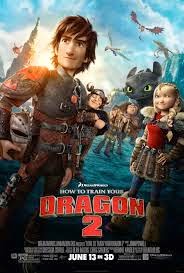
Discovering Who We Are: A Movie Review of "How to Train Your Dragon 2"

On the island of Berk, things have changed a lot since we first met Hiccup and his friends (both humans and dragons). Now, the island is home not only to the Vikings, but also to their pet dragons. However, things take a turn for the worse when an insane warrior unleashes an army of mind-controlled dragons.
How to Train Your Dragon 2 was a huge success for 2014. It received high reviews and made more money than any other animated film in 2014 (at the time this review was written). The film stars the voice talents of Jay Baruchel as Hiccup, Cate Blanchett as Valka, a dragon trainer, and Gerard Butler as Stoick the Vast, Hiccup's father and chieftain of Berk.

SUMMARY
   The film opens five years after the first film in a way reminiscent of the original How to Train Your Dragon, though with one radical difference: dragons are now part of everyday life on Berk. This includes competitions involving flying dragons and catching sheep.
   Hiccup and his dragon companion Toothless have begun exploring new territories, mapping them as they go along. However, Stoick, Hiccup's father, wants to pass on the role of chieftain to his son. Hiccup is less than thrilled and admits to his "fiancée" Astrid that he fears he is not suited to the task as his great father has been. 
   While Hiccup and Astrid talk, Hiccup notices dark smoke rising in the horizon. The humans, with their dragons Toothless and Stormfly, go to investigate. They find the destroyed remains of some sort of fort that is stuck in a giant formation of ice. They meet a dragon trapper named Eret who tells them he works for a man named Drago Bludvist, who is raising an army of dragons under his control. 
   Hiccup and Astrid, with their dragons, escape Eret and his men. They return to Berk and warn Stoick of the trouble. Stoick tells Hiccup he knows of Drago: he is an insane man who claimed to have the power to control dragons. Years ago, when the Viking chieftains refused to bow to him as their ruler (in exchange for protection from dragons), he called in armored dragons. Stoick was the only chieftain to survive the attack.
   Hiccup wants to attempt to reason with Drago in the hopes of preventing war. Stoick tells his son that there is no reasoning with the lunatic, and that Berk must prepare for invasion. 
   However, Hiccup and Astrid leave the island in search of Drago. They find Eret and allow him to "capture" them, in order to meet Bludvist. Yet Stoick, his friend Gobber, and some young dragon riders come to save Hiccup and Astrid. Hiccup escapes from his father and friends, so he and Toothless continue their search for Drago.
   They are captured (for real this time) by a mysterious, mask-wearing dragon rider named Valka. She reveals a truly life-shaking secret to Hiccup and shows him a hidden island where dragons live in peace. She tells Hiccup that, like him, she was unable to kill dragons and instead befriended them and learned all of their secrets. She shows Hiccup an Alpha-species dragon, whom all other dragons in the area obey. 
   Soon, Stoick and Gobber track Hiccup to the "dragon island," where they meet Valka. Meanwhile, Astrid and the other young adult dragon riders, with assistance from Eret, find their way to Drago. They are captured by Drago's men, as are their dragons. 
   Eventually, Drago's army attacks Valka's secret home. She and the Berk dragon riders fight Drago's forces to protect it, but are defeated when Drago reveals his own Alpha dragon. His Alpha defeats the other one and begins controlling all of the dragons, even those belonging to Berk's Vikings. The Berk dragon riders also suffer a hard casualty of the battle.
   Bludvist and his army make way for Berk where they plan to steal the remaining dragons and conquer the Viking world. However, Hiccup and his friends race to defend their island in a final battle against Drago. 

GENERAL INFORMATION
   How to Train Your Dragon 2 definitely has its violent scenes. Kids of kindergarten age or younger might be frightened by the battles or the dragons. There are many explosions (complete with fire and destruction) as well as battles between both dragons and humans. In one scene, a dragon kills someone by blowing fire; we see the dead body of the person, though it appears mostly unharmed. Also, there are several scenes where dragons threaten humans. Drago Bludvist might scare young children, as he is a dark, foreboding character. Not to mention, he is violent and murderous. Twice we see wounds: one is when a man reveals scars on his chest, and the other is when Drago removes his metal arm, revealing the stump of his original one. Besides this, there are some more mild violent scenes and references, including some mild cruelty to sheep.
   While there are no specific swear words used, there are a couple of unfinished sentences ("what the..." and "kick [his]..."). There is a small amount of name-calling. Also, a young woman calls Eret, "Son of an Eret," perhaps implying something more crude.
   There are three kisses in all, two including Hiccup and Astrid, another between a married couple. But worse than this are scenes in which the young dragon rider Ruffnet eyes Eret several times, including slow-motion shots of his arms. Two young Viking men compete for Ruffnet's affections throughout the entire film.
   Related to the above paragraph is one scene that sparked some controversy among audiences. While a married couple engaged in an argument, Gobber turns to Hiccup and says, "This is why I never married. This and one other reason." While this could have been taken many different ways, director Dean DeBlois said that it implies Gobber is homosexual. Otherwise, this won't be fully understood by younger kids. Even teens and adults could have taken this a different way, had it not been for the director's comment in an interview.
   Much of the disaster in the movie is caused by Hiccup who refuses to comply with his father's wishes. When Stoick tells Hiccup to stay on Berk, rather than searching for Drago, Hiccup and Astrid leave Berk. Later, once Stoick finds Hiccup, he tells his son not to continue looking for Drago, but to return home. Again, Hiccup flees with his dragon.
   Although there are these areas of concern, there are also some good aspects of the movie. One of the main aspects of the film is that Hiccup is trying to discover who he is. In the end, he does discover his purpose. All humans have a purpose, because we have a loving and all-powerful God. Ultimately, our most important purpose is to glorify God. Astrid tells Hiccup that his purpose can be found in his heart, but true and lasting purpose will never be found in ourselves alone, but only through Jesus Christ.

   As far as the acting, it was very good. Gerard Butler and Cate Blanchett were magnificent in their voice acting as Stoick and Valka respectively. On the whole, the acting was pretty convincing.
   Just as with the previous film, John Powell's musical score is fantastic once again. The score was reminiscent of the original movie, while still having its own feel. Also, the song For the Dancing and the Dreaming (performed by Gerard Butler and Mary Jane Wells), while relatively short, was a nice touch to one of the scenes. 
   To be honest, I really loved How to Train Your Dragon 2. So, yes, this whole review is a little biased. However, if you enjoyed the previous movie or Dreamworks' Kung Fu Panda films, this will likely be an enjoyable film for you. Young boys, I'm sure, will also be thrilled to see the return of Hiccup and Toothless.
   Even though there are some tense scenes for smaller kids, this is still a film I believe many families will enjoy. I certainly recommend it as one of the year's best family movies.

GENERAL CONTENT
Length: 102 minutes
Rating: PG (for adventure action and some mild rude humor)
Director: Dean DeBlois
Producers: Bonnie Arnold
Music: John Powell
Year of release: 2014
Primary audience: Family, pre-teens, teens

Sunday, October 12, 2014

The Boy Who Became a King: A Movie Review of "The Sword in the Stone"

Most everyone knows of England's mythical hero King Arthur, his wife Queen Gwynevere, and the Knights of the Round Table. But how did Arthur become the great and legendary king everyone knows him as? Disney's classic animated film The Sword in the Stone retells T.H. White's book about the boyhood of Arthur.
The Sword in the Stone received an Academy Award nomination for George Brun's musical score. The songs were done by the very duo behind the award-winning songs of Mary Poppins. The film stars the voices of Rickie Sorensen; Richard Reitherman; and Robert Reitherman as Arthur (nicknamed "Wart"), Karl Swenson as Merlin the magician, and Junius Matthews as Merlin's pet owl Archimedes.

SUMMARY
   The movie opens with England's king dying, without an heir of any kind to leave behind. However, a magical sword appears in an anvil, which bears an inscription that says whoever removes the sword is the rightful king of England. And yet no one can remove it. The legendary sword is forgotten and Great Britain enters into the Dark Ages.

   A long time later, a young orphan named Arthur is living with a grumpy retired knight named Sir Ector, and his bully son Kay. One day, while assisting Kay on a hunt, Arthur (or Wart, as everybody has named him) causes an accident, and Kay misses his targeted deer. The arrow from Kay's bow went into a dark forest and Wart is forced to go after it.
   While looking for the arrow, Arthur stumbles upon a little old cottage. Inside, he meets the powerful magician Merlin and his talking owl Archimedes. Merlin tells Arthur he is prepared to become the boy's tutor. Arthur is interested but reluctant. Merlin and Archimedes then accompany Arthur back to Sir Ector's dilapidated castle.
   Later, Sir Pellinore, a friend of Ector's, comes to the castle bearing wonderful news. The winner of the New Year's Day jousting tournament is to become king of England. Ector decides to get Kay into rigorous training for the tournament, making Arthur Kay's squire.
   In order to begin teaching Arthur, Merlin uses magic to continue Arthur's chores while they leave the castle. Afterwards, they have amazing adventures as they are transformed into fish, squirrels, and birds. Arthur is taught about wit, wisdom, love, and courage during the lessons. 
   During one lesson, Arthur as a bird finds himself trapped in the cottage of Mim, a witch of dark magic. Coming to the rescue, Merlin and Mim engage in a battle of wits. Each of them turns into some sort of creature in order to gain the upper hand over the other. Merlin reigns triumphant even with treachery and lies from Mim, as he infects her health as a bacteria. This further enforces his lesson of cunning for Arthur.

   Finally, the day of the great tournament comes. But Arthur forgot Kay's sword in the tavern at which they were staying. Arthur searches for another sword and finds one in an overgrown churchyard. He pulls the sword from an anvil, as light shines down on him from an undefinable source. 
   When he takes the sword to Kay, Ector takes a look and realizes what sword it is. Arthur leads a large group of people back to the churchyard, and he places to sword back into the anvil. Many men attempt to pull it out, but none can. Finally, Sir Pellinore gives Arthur a chance to prove himself. 
   The boy removes the sword from the stone and is declared as king of England. He begins his reign using the lessons taught by his wise tutor Merlin.

CONTENT
   Since The Sword in the Stone is a Disney cartoon, the violence is rather minimal. There are some sword fights and jousting, but the most injuries anyone suffers are a bruised head or a fall from their horse. Mim tries to harm Merlin during their duel, using dangerous animals as ways to destroy the wizard. She might also come across as frightening to younger children when she turns herself into different creatures.
   Aside from some minor name-calling (such as "Wart"), there is no foul language in the movie.
   There is a scene when Mim turns herself into a beautiful woman and Arthur is amazed by her appearance. Also, while squirrels, Arthur and Merlin run into a pair of female squirrels. During this, Merlin sings the song The Most Befuddling Thing, which is all about love and romantic feelings. While the song is relatively harmless, parents might not want their children getting their views of romance from Disney. However, this could be a good place to discuss the world's definition of love versus a biblical one.

   Since Merlin is a wizard and Mim is a witch, both obviously use magic. Merlin declares his magic as good and helpful, while Mim openly brags that hers is dark magic. Either way, sorcery of some kind or another is heavily involved in the film. There are no real-life spells used, but Merlin uses several magical chants throughout the film. Parents will have to judge whether or not they believe this is appropriate for their kids.
   While the songs aren't Disney's best, there are a few that are enjoyable. These include Higitus Figitus, That's What Makes the World Go Round, and Mad Madam Mim. The songs, as I stated above, are from the same two brothers who penned the music for Mary Poppins.
   Sword in the Stone is definitely not my favorite Disney film, though it did have the personal touch of Walt Disney himself. I do find it interesting and pretty good. It is a relatively clean film, unlike many so-called "family" movies of today. Depending on your personal decisions about magical content, this is a great movie for kids and families.

GENERAL INFORMATION
Length: 79 minutes
Rating: G
Director: Wolfgang Reitherman
Producer: Walt Disney
Music: George Bruns (score), Richard & Robert Sherman (songs)
Year of release: 1963
Primary audience: Kids, family

Sunday, April 6, 2014

Ordinary People are Great, Too: A Movie Review of "The Lego Movie"

The song Everything is Awsome of The Lego Movie says that "everything is awesome when you work as a team." An unlikely hero must lead a band of creative Lego people against an evil, corporate villain. Learning to work together is one of the major themes in the film The Lego Movie.
 The Lego Movie stars Chris Pratt as Emmet the construction worker (and the film's main protagonist), Elizabeth Banks as Wildstyle the "Master Builder," and Will Ferrell as President/Lord Business. The film also stars big-name actors Liam Neeson and Morgan Freeman. The movie was a box office success and a favorite of family audiences.

SUMMARY
   In a secret fortress, the magical Vitruvius must protect a weapon known as the "Kragle" from the villainous yet orderly Lord Business. However, Lord Business blinds Vitruvius and is about to steal the Kragle when Vitruvius prophesies about the "Special" who will find the "Piece of Resistance" in order to stop the Kragle. 
   A little over eight years later, President Business controls everything, seeming to be a benevolent leader. The audience is introduced to an ordinary, every-day construction worker named Emmet Brickowski. While at work one day, he runs into a mysterious female named Wildstyle. He accidentally falls down a deep hole and finds the Piece of Resistance.

   After touching the Piece, Emmet passes out only to awaken in a black room. He has been captured by President Business' top henchman Bad Cop (who has a split personality with Good Cop). The officer interrogates Emmet, but learns nothing because Emmet, of course, knows...nothing. 
   Emmet is rescued by Wildstyle, who believes he is an interesting, creative, and amazing person until she finds out he is just another brain-washed citizen. She takes him to meet Vitruvius, and the three must escape the evil police robots and find the other "Master Builders" (who secretly oppose President Business) and hatch a plan to defeat the Kragle.
   The heroes must battle evil, with help from Batman and other Master Builders.

CONTENT
   Since The Lego Movie is a cartoon film dealing with Lego bricks, any violence is not quite realistic. There are, however, multiple uses of guns and other destructive weapons. When things are destroyed (such as buildings and vehicles), the worst it gets are Lego bricks flying around. A major number of robots are destroyed, but there is also the death of a "human" Lego person.
   When Emmet first comes across Wildstyle, he is taken aback by her appearance, and we see light shining on her. Also, Wildstyle and Batman are in a relationship and constantly call each other "babe" throughout the film. But there is not a single kiss to be found.

   There is no foul language, but there is occasional name-calling with words such as darn and dang. "Heck" and "gosh" are also used, as well as a few mentions of "butt" (and in one scene, robots sit on a copying machine and make photocopies). 
   The Lego Movie starts to lightly touch on some strange theology, and one character returns as a ghost. Also, there is reference to "The Man Upstairs," but this is not referencing God (and I am not even sure if that phrase was to mean anything like that). And like many animated films of today, one of the main "lessons" is just to belief in yourself. 
   Also, the movie's main villain is President Business who runs a society of order with nothing unexpected and no creativity. This struck me as a possible slight on capitalism, which certainly does have its own share of evils, but I was hoping that they were not implicating that Communism is better. However, on a good note, the movie was much like a kid-version of 1984 in which a dictator sees and controls all things and attempts to keep everyone under his rule. This carries a few good messages for kids (and adults, too!). 
   The film did have a lot of good points, though. The main lessons encourage team work and individual creativity. It does not matter how ordinary any of us are; if we work hard, we can do great things (just look at many historical figures, for example). Also, the movie portrays that we can turn from evil, which mirrors real life; a sinner can turn to Christ for mercy and repentance. 
   Of course, this review would not be complete without mentioning Liam Neeson's great Scottish accent as Bad Cop or Morgan Freeman's role as Vitruvius, as both were wonderful (as usual!).
   In conclusion, The Lego Movie has some funny moments and good lessons. The ending scenes of the movie are both creative and witty. While this was certainly not a favorite of mine, I would encourage families to enjoy this film at least once or twice. Who knows? You might just find yourself "building a good time" (that was a bad pun)!

GENERAL INFORMATION
Length: 100 minutes
Rating: PG (for mild action and rude humor)
Directors: Phil Lord, Christopher Miller
Producers: Dan Lin, Roy Lee
Music: Mark Mothersburgh
Year of release: 2014
Audience: Kids, family

Saturday, February 1, 2014

Love Breaks Frozen Hearts: A Movie Review of "Frozen"

Most of us are familiar with fairy tales such as Cinderella, Little Red Riding Hood, and Beauty & the Beast. But likely fewer of us are as familiar with the tale of the Snow Queen. Walt Disney Pictures loosely based their new animated musical Frozen on this fantasy story. The film has become Disney's highest-grossing cartoon of all time, even blowing past The Lion King!
The film (at the time of the writing of this review) has two Oscar nominations, for Best Animated Picture and Best Original Song. It won awards for both of those categories at the Golden Globe Awards. The film stars 
Idina Menzel as Queen Elsa, Kristen Bell as Princess Anna, and Jonathan Groff as roughneck mountaineer Kristoff.

SUMMARY
   In a kingdom called Arendelle lives two sisters named Elsa and Anna, who are the young princesses of the land. The pair of little girls obviously enjoy playing together, especially when Elsa uses her special ice powers. Unfortunately, Anna is hurt by the magic and her family takes her to the magical trolls, as they are the only ones who can help her.
   Although Anna is saved, her memories are changed while Elsa and her parents agree to hide the truth of her powers from everyone...including her dear sister.
   However, this leads Elsa to become reclusive to the point of never seeing her sister and staying locked in her room for years.
   Three years later, Elsa is to have a coronation in order to become queen. For the first time in three years (or "for the first time in forever," as Anna's song suggests), Elsa must order the castle gates to be open to the villages and also foreign dignitaries.
    That night, Anna and Elsa get into an argument which causes Elsa to use her powers. After a lifetime of secrets, she is finally found out. With no other choice, she flees the kingdom and heads for the northern mountain where she builds herself an ice palace. Here, she sings a song signifying her act to "let it go" (a brilliant performance by Idina Menzel).
   Anna heads out to find her sister because Arendelle was cast into winter. Along the way she meets mountain miner Kristoff (as well as his reindeer friend Sven) and a snowman named Olaf.
   The remainder of the movie brings surprises and a wonderful ending!

CONTENT
   The violence in Frozen was appropriate for the PG rating, though some things might frighten younger children (though my five-year-old sister was alright). Elsa's magic accidentally harms people (although once she purposely hurts someone). Crossbows are also fired at both fantasy creatures and humans, but we never see someone hit. Also, there is a giant snow monster which could possibly scare young kids.
   There a kiss or two in the film, but this is pretty innocent. Two characters sing a song entitled Love is Open Door, and they want to marry on the spot (this is later shown to be unwise and irrational).
   There was fortunately no foul language in the film.
   There was some mild rude humor, but nothing too much. Olaf the snowman makes a couple of references to his behind.
   The movie focuses on Elsa's magical skills. She is referred to as a sorceress, and a man remarks that her powers are sorcery. It is not, however, made clear where these powers came from. But this is far from dark magic, rather what you would find in classic Disney movies such as Beauty and the Beast.
   The songs were amazing, and I must say that I really enjoyed them. Just a few of the songs are For the First Time in Forever, Love is an Open Door, Let It Go, and In Summer. While all of the singing was great, Idina Menzel was particularly good (I suppose some of that might have to do with the fact that she is a Broadway "veteran")!
   This is a great movie for the whole family and is certainly a new favorite of mine. While all may not have had (or will have) the chance, it was stunning in 3-D. This was definitely a wonderful new addition to the Disney collection!

GENERAL INFORMATION
Length: 108 minutes
Rating: PG (for some action and mild rude humor)
Directors: Chris Buck, Jennifer Lee
Producer: Peter Del Vecho
Music: Christophe Beck (film score), Robert Lopez & Kristen Anderson-Lopez (lyrical songs)
Year of release: 2013
Primary audience: Family

Friday, January 10, 2014

The Tale as Old as 1991: A Movie Review of Disney's "Beauty and the Beast"

2012 3D release poster
Original 1991 poster
How can anyone learn to love a hideous monster? Is it even possible? In Disney's
Academy Award-winning Beauty and the Beast, it certainly is! The movie won two academy awards, which is impressive considering it is hard for animated pictures to win more than one (and even then they have other contenders for the "Best Animated Film" award). It was also the very first Disney movie to be adapted as a Broadway musical.
The film stars the voices of Paige O'Hara as Belle (the "Beauty" of the movie), Robby Benson as the Beast, and Richard White as the hunter Gaston. I should also mention that Angela Lansbury is the voice of the castle cook Mrs. Potts, and she does a marvelous job.

SUMMARY
 Belle and her inventing father live in the countryside, just outside of a small village. She has no friends except for her books, which she borrows from a bookkeeper constantly. Although she is quite "strange" (according to the townsfolk), she has at least one quality: she is definitely the most beautiful person in the village. And she has caught the eye of the self-consumed hunter Gaston.
   Belle's "papa" Maurice says that his new invention will make a new life for them. That day, he is off to take his invention to the fair, where Belle believes he will win first place.
   However, Maurice's horse Philippe is spooked by wolves and runs off. Maurice is chased by wolves and only can find refuge in a large, dark castle. Inside the castle, Maurice finds an open chair by a warm fire. Oh, by the way, he also meets talking objects (such as a talking clock, candlestick, and teapot). As he warms up by the fire, with a cup of warm drink, he is confronted by a hideous monster, who drags him away.
   Back at home, Belle rejects the proposal of Gaston, much to his frustration. A little while later, the horse Philippe returns to her, and she realizes that her father must be in some sort of danger.
   The horse takes her to the dark castle. The talking candlestick Lumière secretly leads Belle to the prison tower in which her father is being held captive. The Beast enters the scene, and she takes her father's place, setting Maurice free.
   As Belle explores her new home and the enchanted occupants, her father tells everyone back in the village tavern that his daughter has been captured by a vicious creature (causing the townsfolk to think he is even more crazy). 
   While the ending is good, it is also quite tense for a Disney cartoon.

CONTENT
   Like many of Disney's animated features of the 1990's, the G-rated Beauty and the Beast has a borderline amount of violence for the film (perhaps that is even being a bit generous). Some younger children might possibly find the Beast to be frightening. Gaston fires shots from his rifle at the beginning of the film, but the gun is not shot at any people. At the end of the film, there is a "battle" between the enchanted servants and townsmen. This includes weapons such as scissors, hot water, and an oven. Afterwards, there is a tense confrontation between the Beast and Gaston. The hunter fires an arrow into the Beast's arm. Also, a person is stabbed with a knife (though we don't see any blood, if I recall correctly) and a man falls down an abyss, shouting the whole time.
   There is just a little sensual content in the movie. In the village tavern, Gaston is admired by three women who wear strapless gowns. Lumière is sometimes seen flirting with a female duster, and one scene shows the Beast in the bath (but there is nothing sexual about this, and we see no intimate parts). There is, however, only one kiss in the film. Apart from this, there is some very mild crude humor (i.e. scissors poke a man's behind).
   There is no foul language in the movie.
   Beauty and the Beast is completely based on a magical spell cast by an enchantress. This spell can only be broken by true love. There is no other use of magic in the film.
   Disney's cartoon really is a wonderful movie for mostly all ages. Apart from the violence, which could scare young children, there are a lot of positive things about the movie: loving others despite their outward appearance, loyalty, bravery, and true strength. Gaston represents a strong, yet cruel man, while the Beast shows a strong and kind soul. 
   I also would like to make a special note of the songs by Alan Menken. Some of the most popular Disney songs come from this film, including Be Our Guest, Human Again, and Beauty and the Beast. All of the songs are great, but Jerry Orbach and Angela Lansbury do marvelous jobs in their respective songs Be Our Guest and Beauty and the Beast.
   With both positive and negative aspects, this is a good family movie for anybody. It is one of my personal favorite Disney pictures and continues to be a favorite of our whole family.

   (Please note that this is a review of the Special Edition, including a few more minutes of film and some new music, though the storyline is the same regardless)

GENERAL INFORMATION
Length: 84 minutes (Original edition), 91 minutes (2002 Special edition)
Rating: G
Directors: Gary Trousdale, Kirk Wise
Producer: Don Hahn
Music: Alan Menken (music), Howard Ashman (lyrics), Tim Rice (additional lyrics)
Year of release: 1991
Primary audience: Children, family

Wednesday, January 8, 2014

Two Worlds Collide: A Movie Review of Disney's "Tarzan"


Two worlds, one family. An orphaned boy (whose family was stranded on a tropical island) is taken under the wing of a mother gorilla who has lost a child. Thus, we have the song Two Worlds, from where we get those words.

SUMMARY
   The movie opens with a burning sailing ship and a family of three fleeing the wreck. They take a rowboat to a tropical paradise. After some exploring, the mother and father find a good place to build a home for them and their infant son. 
   During this, the audience is shown a pack of gorillas. A mother gorilla loses a young son to a beast of the jungle and is obviously heartbroken.
   With this introduction finished, the mother gorilla, Kala, stumbles upon the tree-top home of the human family. Among wreckage, she finds the baby lying in his cradle. Upon picking him up, she is attacked by a vicious cheetah. She eventually escapes with the baby, both unharmed.
   Kala adopts the baby and names him Tarzan, much to the annoyance of the gorilla leader (and her mate) Kerchak. 
   A few years go by, and we are shown a young Tarzan having wild adventures and doing a daredevil act, earning the friendship and even respect of his female gorilla "cousin" Terk. He also becomes friends with a little elephant named Tantor.
   The audience is then shown Tarzan growing into a young man and all the things he does to impress his adopted father Kerchak. An ultimate test comes, though, when the cheetah that attacked Kala years ago comes to harm the gorillas. Using a spear, Tarzan is able to kill the cheetah, earning respect and acceptance from Kerchek (well, maybe not quite...).
   One day, Tarzan finds creatures roaming the jungle. They all look similar to him, though they are dressed quite differently, not to mention their speech. He investigates further and eventually saves the female from a herd of ferocious baboons. 
   The female (Jane) and her father are on the island for scientific research, but their guide Clayton has some other nasty ideas in store...
   Tarzan befriends the humans and learns to talk like them, as well as being taught about the world they live in. Although, towards the end of the film, Tarzan is faced with a choice between his family of gorillas and the newly discovered world of the humans.

CONTENT
   For a G-rated cartoon, Tarzan seems to have an overabundance of violence. There are numerous shots fired from a rifle (some hitting people & animals, though just one death) and we are shown a gorilla die (I recall a brief shot of blood). Around the last half of the movie, a man gets entangled in vines and we the shadow of his limp body, as he was hung by the vines.
   Tarzan and Jane have a near-immediate romance. When the two first meet, a curious, yet innocent Tarzan starts to lift her dress, though she kicks him. I believe that there is only a kiss or two. Also, at the very end of the film, Jane can briefly be seen in a two-piece outfit, presumable made out of leather.
   There is no language in the movie.
   In the scene where Jane's father, a professor, first meets Tarzan, he says that Tarzan might be the "missing link." Younger children likely will not catch this, but it is still there in the film, assuming that there even is a missing link. Also, the song Two Worlds might possibly be a reference to evolution ("two worlds, one family"), though this is not stated.
   There is a song called Son of Man in the film and might seem like a reference to Christ (as he was called "Son of Man" in the Bible), but I personally don't think this was the case. Also, the song Two Worlds has a line that says, "Trust your heart, let fate decide, to guide these lives we see." As most Disney movies do, Tarzan has a "moral lesson" of "trust your heart."
   For its few drawbacks, Tarzan is a clean family adventure. I enjoy it no matter how many times I watch it. Although there are a couple of scenes which parents might want to be wary of with young children, the majority of the film is appropriate for all ages.

GENERAL INFORMATION
Length: 88 minutes
Rating: G
Directors: Chris Buck, Kevin Lima
Producer: Bonnie Arnold
Music: Phil Collins, Mark Mancina
Year of release: 1999
Primary audience: Children, family