Showing posts with label Comedy. Show all posts

Wednesday, December 23, 2015

Remember the Future: A Movie Review of "Tomorrowland"

Look around at the world today, and there is no mistaking that there is chaos everywhere. But what are we doing about it? We can't allow ourselves to ignore the future. This is a big point in Disney's Tomorrowland.
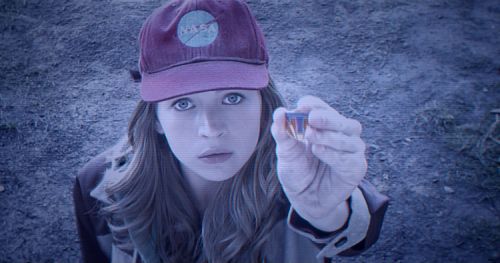
Tomorrowland did not do well at the box office, considering that it is "hard to market original movies," according to the production team. The film stars Britt Robertson as Casey Newton, an optimistic teen, George Clooney as Frank Walker, a grumpy, old inventor, and Hugh Laurie as Governor David Nix. 

SUMMARY
   Young inventor Frank Walker attends the 1964 World's Fair, with a new creation of his. He shows one of the judges his very own jetpack. While the man is unimpressed, a young girl named Athena takes an interest.
   After Frank leaves, Athena finds him. She gives him a pin with the letter "T" on it and instructs him to follow her and her group from a distance. Eventually, Frank boards the "It's a Small World” ride behind Athena. Inside the ride, his pin is scanned, and he is taken to a secret underground lake. There, he enters a machine that transports him to another dimension.
   Frank exits the machine and explores his surroundings. He finds himself on a landing platform covered in fog. But after a mishap with some robots (including a repaired jetpack) and machinery, he and his jetpack fall. However, his jetpack works, and he soars towards a giant, majestic city. Once he lands, he runs into Athena. She tells him that he has found "Tomorrowland."
   Fast-forward to the present where we meet teenager Casey Newton. Casey is very smart and incredibly clever. However, she uses her talents to shut down NASA tech so that her dad (a NASA engineer) is not laid off.
   But her luck soon runs out, and she is caught by the police. As she is about to be released from custody, she is instructed to pick up her belongings. However, among her possessions is something that does not belong to her: a mysterious pin. Little did she know, the girl Athena had placed Casey's DNA in the pin and planted it with her belongings.
   Casey begins to grab the pin, but she suddenly finds her surroundings suddenly changed. In fear, she drops the pin and is back in the police station. After reaching to touch the pin a second time, Casey is transported to a wide-open field.
   Eventually, Casey's dad comes to bring her home. In the car, Casey attempts to explain to her dad what happened, but he just dismisses it as acting up. At home, Casey experiments with the pin. In the other world, she enters a sprawling, futuristic metropolis. As she walks through the city, she follows a group of "cadets." They board a monorail train and invite her aboard. But the other world disappears, and Casey is in the middle of a pond.
   Through research, Casey finds a science fiction store in Texas that has connections to the pin. She leaves home and heads on a trip for Houston. At the store, Casey asks the two owners about the pin, but they are reluctant to reveal any information. They quickly interrogate Casey about the pin and where she got it. They soon pull out guns, and as Casey is about to be attacked, Athena bursts in the window and helps Casey escape.
   Athena then drives with Casey in the passenger seat. They travel to an inconspicuous, worn-down house, where Athena leaves Casey. The inhabitant is the inventor Frank Walker, who stubbornly refuses Casey to enter his house. Eventually, Casey makes her way inside and discovers Frank's invention: a doomsday clock that counts down the time till utter destruction.
   After surviving a robot attack, Frank and Casey meet up with Athena and travel to Paris, where they open a portal to Tomorrowland. There, they encounter a drab, dying city. They are met by the self-proclaimed governor, David Nix, where he reveals that he is feeding humanity's obsession over the apocalypse. Casey, Frank, and Athena must work together using their creativity to defeat Nix and restore hope to our depressed world.

CONTENT
   Robots often use their guns to vaporize people into dust. These same robots, who appear to be actual humans, are smashed, stabbed, and abused, particularly in the scene where they attack Frank's house. In the same vein, a robot girl is hit by a truck but jumps back into action, unharmed. This same robot removes some fake skin to reveal machinery. A young boy receives some small injuries while testing a jetpack. Also, the heroes undergo some minor injuries when they fall and trip several times throughout the film.
   For a PG rating, this film fits in plenty of language and even hints at some profanity. H*** and d*** are both used a number of times. God's name is used a few times and we barely hear Frank say p***. Two times, characters say "son of a..." before being interrupted.
   *SPOILER* A boy falls in love with a robot girl (unbeknownst to him), and the two later meet when he is an adult, which at times makes these scenes seem awkward. *END SPOILER* Also, a robot girl's stomach acts as a storage compartment and we see some fake skin, but there is nothing sensual about this scene.
   I enjoyed Tomorrowland, but I will state my disappointments first. The film really seems to be trying to play both sides of its political audience. It touches on indoctrination from an all-powerful government and also promotes environmentalism. So it speaks to different political beliefs, which can turn out to be good or bad (more on that later).
   In light of the bad reviews Tomorrowland has received, my low expectations were far exceeded. The plot of an impending apocalypse has been overdone in films (War of the Worlds, The Day After Tomorrow, Independence Day, just to name a few). However, Tomorrowland takes a heavily-used genre and turns a new twist on it. Yes, destruction may be near, but what are humans doing about it? God knows when the end will be, but we are not to be idle in waiting for it. Christians have a responsibility to take care of the Earth and people that God has created. As one character says in the film, "What reasonable human being wouldn't be galvanized by the potential destruction of everything they've ever knwon or loved?...They gobbled it up like a chocolate eclair! They didn't fear their demise, they re-packaged it. It could be enjoyed as video-games, as TV shows, books, movies, the entire world wholeheartedly embraced the apocalypse and sprinting towards it with gleeful abandon." Our culture has embraced the apocalypse as an exciting event to be marketed in our mainstream media. People today are sadly fascinated with the destruction of the world. The film quote later goes on: "We saw the iceberg and warned the Titanic. But you all just steered for it anyways full steam ahead. Why? Because you want to sink! You gave up!" Christians must never give up. To give up is to give in to the despair and doom of our culture. Instead, let us work to save and redeem the culture. Only God knows the end, we don't. So why should we not work as hard as we can to seek and save the lost, through Christ?
   Today's self-centered culture, especially the younger generations, are focused on the here and now. What makes me happy in this moment? There is very little attention paid to the future and the consequences of our actions. This is partially why we have seen an increase in problems such as teen delinquencies, teen pregnancies, and other troubles.
   As far as the environmentalist messages of the film, there are lessons to be learned here also. Our Creator mandated us to have no other gods before Him. This includes avoiding the worship of nature. However, our Lord also meant for mankind to be the caretakers of His creation.
   Michael Giacchino did a fantastic job with the musical score. It fit perfectly with this film and stands very nicely on its own. I count this as one of my favorite film scores of 2015!
   Director Brad Bird has, I believe, effectively fused adventure, science fiction, and apocalypse. Almost all apocalyptic films end with humanity winning, but Tomorrowland does something that none have ever done before. It answers the question, "What are we to do?" For Christians, that is a vital question for our evangelistic calling, and I suggest Francis Schaeffer's book How Shall We Then Live? to help in learning where we are going.
   In the end, Tomorrowland has its share of flaws, but it is an important film for this time in history. I enjoyed it immensely and I think it is a rare gem that is both relatively clean, but also realistically portrayed.

GENERAL INFORMATION
Length: 130 minutes
Rating: PG (for sequences of sci-fi action violence and peril, thematic elements, and language)
Director: Brad Bird
Producers: Brad Bird, Damon Lindelof, Jeffrey Chernov
Music: Michael Giacchino
Year of release: 2015
Primary audience: Pre-teens, teens, adults

Tuesday, April 28, 2015

Have Courage and Be Kind: A Movie Review of "Cinderella"

Disney is on a roll with live-action fairytales. Last year, they released Maleficent and Into the Woods. This year, Cinderella was released and is currently the third highest-grossing film of 2015. (Yes, Beauty and the Beast is next...) Audiences were pleased to find that Cinderella stuck fairly close to the 1950s animated film while also keeping its own feel.
The film stars Lily James as Ella (later "Cinderella"), Richard Madden as Prince Charming, and Cate Blanchett as Lady Tremaine, Ella's stepmother (with an appearance by Helena Bonham Carter as the Fairy Godmother).

SUMMARY
   Ella is a young girl who has a "perfect life." Her parents are loving, kind to others, and wealthy enough to have everything they want. All is well and good. That is, until Ella's mother becomes sick. Soon before her death, Ella's mother passes on one last piece of wisdom to her beloved daughter: to always "have courage and be kind." So Ella takes her mother's last words to heart, always holding to those virtues.
   The years go by, and Ella grows up in kindness and beauty. She loves her father and, while her life is not what it was, it still is good. However, that changes one day. Ella's father marries a widow, Lady Tremaine. She and her two daughters, Drisella and Anastasia, come to live with Ella and her father. Although the daughters are rude to her, Ella shows kindness to them. Lady Tremaine, though, seems kind enough to Ella.

   Later, Ella's father must travel away for business. While gone, Lady Tremaine begins treating Ella worse and worse. Tremaine uses Ella's goodwill to make her move to the attic, giving her room to the stepsisters. 
   *SPOILER* But if that was not bad enough, tragedy strikes. News comes that Ella's father died during his traveling. *END SPOILER*
   In order to secure their wealth, Lady Tremaine sends all of the servants away. She then gives all of the chores to Ella. 
   One day, to escape her troubles, Ella goes for a horse ride in the woods. She comes across a hunting party and runs into a young man. He introduces himself as Kit, telling her that he is an apprentice from the palace (he is actually the Prince). Kit is immediately attracted to Ella, though they part ways before he can learn her name.
   Kit's father, the King, tells him that he must marry a princess. Yet the Prince cannot forget the beautiful young woman he met in the forest. He succeeds in convincing his father to allow all young women in the kingdom to attend the upcoming ball, hoping to run into the mysterious girl there.
   Lady Tremaine sees this as a way to get one of her daughters married into the royal family. Ella fixes up her mother's old dress in hopes of wearing it to the ball. However, Tremaine and her daughters, upon seeing Ella in the dress, tear it up and leave.
   Heartbroken, Ella flees to the garden and begins to weep. Suddenly an old woman asks about something to eat. While Ella gets some food, the woman reveals herself to be Ella's beautiful fairy godmother. 
   She then proceeds to turn a pumpkin into a stagecoach, lizards into footmen, and mice into horses. Then she transforms Ella's tattered pink dress into a magnificent ball gown and also gives her a pair of glass slippers. The fairy godmother sends Ella on her way with the warning that the spell will only last until midnight. 
   Ella makes it to the ball (fashionably late, of course!) and manages to dance with the Prince. Afterwards, the two walk through the palace gardens. However, midnight begins to approach, so Ella needs to leave...but not before accidentally leaving behind a glass slipper!
   That night, Tremaine and her daughters return. Because of Ella's carefree attitude, Tremaine suspects something.

   Later, the King gives permission for his son to marry whomever he chooses, even if he does not wed a princess. So the Prince decrees that every maiden in the land will be visited, so that the glass slipper can be tested on their feet.
   But Tremaine discovers Ella's other glass slipper in her attic room. She tells Ella she wishes to be made head of the royal household and that her daughters be given advantageous marriages. Ella will not consent, so Tremaine smashes the shoe. She then locks Ella in the attic.
   She then uses the shattered slipper to blackmail the Grand Duke into giving her and her daughters power and wealth. The Duke then tries to discourage the Prince from continuing his search for the mysterious girl, but there is no stopping him.
   They discover Ella when they hear her singing a song. They try on the shoe, and the rest is happily ever after.

CONTENT
   There is precious little violence in Cinderella. There is some mild, comical violence. Cinderella's carriage ride home is a little tense for younger children. Three people die as a result of illness or old age. Also, one of the stepsisters threatens to "scratch" the other's "eyes out."
   There is no foul language. The worse it gets is a use of "gosh" and "oh lords."
   Many dresses show part of the chest. Two young woman are seen in underwear (extremely modest by today's standards, as it covers their entire body). There are also two kisses between married couples.
   In one scene, Lady Tremaine holds a party, full of gambling and even some alcohol (presumably), though neither are glorified nor dwelt upon.
   Cinderella holds excellent moral lessons for all ages and some pointed specifically towards girls and young women. Cinderella holds to her vow to be courageous and kind. But she doesn't flaunt her virtue. Instead, she is humble, and even admits her own faults when she declares that she doesn't feel very brave. 
   Also, as a lesson for girls, there was a point made about the stepsisters having beautiful appearances, but inside, they are cruel and wretched. This can have a good impact on girls who worry about their appearance. It isn't everything! Although the main character is supposed to be beautiful, it is really her gracious spirit and goodness that draws the Prince to her. 
   The musical score was really something special. It was done by composer Patrick Doyle, known for his work on especially Chariots of Fire. It had a nice classical touch, for those who enjoy that genre.
   The acting was great! Lily James was a superb Cinderella, and Cate Blanchett was magnificent as the aloof, evil stepmother. Also, Sophie McShera and Holiday Grainger were good in their roles as the bumbling stepsisters. Besides this, it was a treat to see the talented Helena Bonham Carter as Ella's fairy godmother.
   This is actually a good film that is appropriate for all ages. I was very impressed with Disney's handling of the story, as well as the wonderful life lessons they put in the film. This was truly a great family movie. I especially liked it for its emphasis on girls holding to their virtue before beauty. 

GENERAL INFORMATION
Length: 105 minutes
Rating: PG (for mild thematic elements)
Director: Kenneth Branagh
Producers: Simon Kinberg, David Barron, Allison Shearmur
Music: Patrick Doyle
Year of release: 2015

Primary audience: Pre-teens, teens, family

Saturday, March 21, 2015

The Father Who Found His Son: A Movie Review of "Finding Nemo"

Original 2003 poster
2012 3D release poster
If you're a Disney fan, like me, you have probably seen most (if not all!) Disney/Pixar films. Furthermore, if you are a high school Disney fan, like me, you very likely grew up with films such as Toy Story, Monsters, Inc., and Finding Nemo. The last one is the story of a young fish kidnapped by divers and his father's hunt to find him. 
Finding Nemo won the Academy Award for Best Animated Picture (and was nominated for three additional categories). It is also the 27th highest-grossing film of all time, and the AFI (American Film Institute) named it the 10th greatest animated film of all time. The movie stars the voices of Alexander Gould as Nemo, a young clownfish, Albert Brooks as his father Marlin, and Ellen DeGeneres as Dory, a forgetful blue tang. 

SUMMARY
   Clownfish Marlin and his wife Coral have a cave-full of eggs, ready to hatch soon. They love their home (on the Great Barrier Reef) and each other, and they are excited about the prospect of being parents. 

   *SPOILER* However, a barracuda attacks their home. Marlin tells Coral the eggs will be fine, and that they need to hide in their anemone. But, sadly, Coral doesn't listen. She swims for her eggs, and the barracuda dashes after her. Marlin tries to save her, but he is knocked unconscious. When he awakens, he is alone. *END SPOILER*
   Marlin looks for his wife and checks the cave of eggs, but he finds the cave empty. As he mourns, he notices something on the sea floor below him. He sees a slightly damaged egg. He picks it up and reassures the tiny fish inside, and he names it Nemo (which was a name Coral wished for one of the baby fish). 
   Time goes by, and Nemo has started to grow up. Although, due to the damage from the barracuda attack, one of his fins is small than the other (that results in some difficulties swimming). Nemo wakes up his dad, announcing that it is time for the first day of school.
   On their way, Marlin demonstrates his "over-protectiveness" (which is understandable if you lost all but one of your eggs in a barracuda attack!). 
   At the school yard, Nemo meets his science teacher, Mr. Ray. Marlin explains Nemo's fin problem and encourages Mr. Ray to give him some time-outs (much to Nemo's chagrin). The class takes off on their field trip. However, the other dads swim up to Marlin and compliment him on his calmness. Marlin says you can't hang on to them forever, but when a dad mentions the "drop-off" (i.e. where the reef meets the open sea), Marlin freaks out and swims after the class.
   During the field trip, Nemo and some other fish sneak away. They see a boat and dare each other to see who can get closest to it. Nemo is not so sure about it, but suddenly Marlin appears and scolds Nemo. Marlin and Mr. Ray discuss the situation, but now embarrassed, Nemo disobeys his father and begins swims to the boat. 
   But his back is turned to a human diver, who scoops Nemo up in a net. While Mr. Ray protects the students, Marlin goes after his son. Another diver temporarily blurs Marlin's vision with an underwater camera. The divers take Nemo above the ocean, into the boat. As they sail away, a diver accidentally knocks his mask into the ocean (this is important later).
   Marlin chases the boat, but he quickly loses it. While crying over the loss of his son, he is approached by a female blue tang. She introduces herself as Dory and tells him that she just saw a boat pass by, leading him in the correct direction. However, Marlin soon discovers Dory has "short term memory loss," so she forgets things almost instantly.
   The two are confronted by "friendly" sharks, but one eventually attacks them. They survive and find the mask the diver knocked off the ship. Fortunately, an address (42 Wallaby Way, Sydney, but it's not a real address...I've checked) is stamped on the strap. 
   While Nemo is taken to a dentist office fish tank, Marlin and Dory survive many dangers while "finding Nemo."

CONTENT
   Finding Nemo doesn't have too much violence, but there are some scenes/characters that could frighten younger children. Some talking fish are shoved around and harmed. One character gets hurt, and we see a little blood floating in the water (this triggers a shark attack, where two fish are almost devoured for lunch). In that scene, some mines explode, but no one is hurt. Marlin and Dory encounter an anglerfish which is probably the most frightening fish in the film. They also are electrocuted by jellyfish and encounter a dark passage full of fish bones. A man hits his head on some dentistry instruments. A little girl violently shakes a bag of water that holds a fish, and the fish goes belly-up (but he's just pretending). Some fish are captured in a fishing net and pulled above water; they breathe heavily and choke because of this. A man screams while a dentist does work in his mouth (if you have children who are fearful of the dentist, this might not do you any favors, as the dentist is the "villain"). 
   The worst of the language is a "darn" and a "gosh," as well as a few uncompleted utterances of "What the...?" 
   As far as anything else offensive, there is a joke made about a pelican passing gas (he doesn't really, it's just assumed). A squid releases an ink cloud when she is scared, saying, "You guys made me ink." Some fish belch a couple times, and there is a scene that briefly includes seagull droppings. Also, Dory says evolution is what made her a fast swimmer. 
   Marlin sacrifices his safety to find and rescue Nemo. This is a great example of a sacrificial father. Christ as our spiritual Father saved His people from sin, just as Marlin saves his son from danger. A sacrificial father character is so hard to find in today's entertainment (let alone even a competent one). In a culture full of father images from The Simpsons, it's encouraging when movies or other forms of media promote fatherhood as a good and noble calling. Finding Nemo does exactly that (though Marlin blames himself for Nemo's disobedience, which is not right). 
   As far as a family film, Finding Nemo is rather clean (it is far cleaner than many of Dreamworks' animated films like Shrek or Madagascar).  Despite some frightening scenes for younger kids, and some "roll of the eye" moments, I loved the movie. Unless your kids can't handle some of the more violent parts (you could always skip those), I highly recommend families to enjoy this great movie!

GENERAL INFORMATION
Length: 100 minutes
Rating: G (PG would have been a more appropriate rating)
Director: Andrew Stanton
Producer: Graham Walters
Music: Thomas Newman
Year of release: 2003
Primary audience: Kids, Family

Sunday, February 15, 2015

Be Careful What You Wish For: A Movie Review of "Into the Woods"

Though not many people know it now, Stephen Sondeim's 1987 Broadway Musical Into the Woods was a big hit. It won three Tony Awards but was overshadowed by the great success of the new musical The Phantom of the Opera. In 2014, Disney released their film version of Into the Woods.
The film opened in second place at the box office behind the third Hobbit film, giving it the highest opening weekend for a film version of a Broadway musical. At the time of this review, Into the Woods has three Academy Award nominations, and the American Film Institute named it one of the eleven greatest movies of 2014. The film stars James Corden as The Baker, Emily Blunt as The Baker's Wife, and Meryl Streep as The Witch.

SUMMARY
   The Baker and his wife desperately want to have a child but are unable to. One day, though, a witch storms into their bakery and informs them why they have not had any offspring: a curse. Years ago, the Baker's mother was with child, and she desired to have greens ("greens, greens, nothing but greens"). So the mother sent her husband to the witch's garden next door, telling him to take some vegetables for her. The witch caught him, but the two struck a deal: the man could take the vegetables if the witch was given his unborn baby. But the Baker's father also secretly stole some magic beans, which caused the witch's mother to smite her with the curse of ugliness. So the witch cursed the Baker's father and mother, making it so their family tree would never bear any children.
   Yet the witch offers a way for the Baker and his wife to undo the curse. They must bring her the following ingredients before midnight in three days: the cow as white as milk, the cape as red as blood, the hair as yellow as corn, and a slipper as pure as gold.
   Meanwhile, Little Red Riding Hood sets out for her granny's house (with a full basket of sweets and bread), Cinderella visits her mother's grave, and a boy named Jack is instructed by his mother to sell their cow, Milky White.

   The Baker goes into the woods and sees Red Riding Hood wearing the cape as red as blood, though he is not successful in obtaining it. Soon, the Baker's wife shows up, against his wishes. However, she convinces her husband that they will need to work together to find the ingredients. The Baker and his wife run into Jack, with his cow. In exchange for the cow (that happens to be as white as milk), the Baker and his wife give the boy five of the six magical beans.
   Eventually, through many chaotic adventures and accidents, the Baker and his wife find each item on the witch's list. The ingredients make a spell that reverses the curse of ugliness on the witch, and she undoes her curse on the Baker's house, causing the Baker's wife to become pregnant. All the characters have their happy endings!
  But wait, the story hasn't finished! Jack's mother tossed the magic beans away, and they grew into a giant beanstalk. Jack climbs the bean stalk and finds giants in the sky. He soon begins stealing treasure from them. As his climbs down, a giant chases him, but Jack begins to chop down the stalk. The giant falls to his death. This eventually causes the giant's wife to be very angry. She comes down to find Jack, though she causes earthquakes throughout the kingdom, which throws everything into chaos.
   The characters begin blaming each other for the problems, but they eventually decide to work together in order to defeat the giant.

CONTENT
   While violence is present in Into the Woods, arguably the worst of it is off-screen. These off-screen moments include the Baker cutting open a wolf's stomach, Cinderella's stepsisters having their toes and heels cut off (for the purpose of fitting into Cinderella's famous slipper), and a woman falling down a cliff (we only see her hand lose its grip on a branch). When one stepsister's toes are cut off, we see a drop of blood. A woman is pushed and hits her head on a stump, causing death. Both stepsisters are also blinded by some birds, though the camera cuts away before we see anything. The witch grows a patch of thorns in the path of a prince, which blinds him (the audience does not actually see the blinding, but the scarred and scratched eyes are seen later). One character is hit in the forehead with a stone and falls down dead. 

   When speaking of her robbed garden, the witch compares being stolen from to being raped (she isn't, but she uses the metaphor). There are several kisses throughout the film, usually not between married couples. Cinderella's stepsisters wear dresses with short skirts, and several female costumes partially show their chests. During a song about their "agony," two princes open their shirts to reveal part of their chests. Also, the Baker's wife meets Cinderella's prince (her husband) in the woods. The prince seduces the woman into kissing him a few times. However, the woman realizes that what she did was wrong (even though she does believe it made her marriage to the Baker "mean more"), while the prince is quite unapologetic for his adulterous seduction. Also, when Little Red Riding encounters the Wolf, some reviewers have felt it was meant to be sexual seduction of the girl by the wolf. I did not get that feeling (to me, it was just a hungry wolf wanting to eat human flesh, young and old), but parents will want to note the possibility.
   The profane language is sparse, having two clear uses of God's name.
   In one song, a man and a woman encourage children to decide for themselves what is good is right. They also tell them giants can be good and witches can be right. But this moral relativism is not clearly found anywhere else in the film.
   Two characters appear as ghosts, Cinderella's mother and the Baker's father. The latter could have been more of a vision, but the Baker talks to his father, who encourages his son to not make the same mistakes he did (i.e. abandoning his son). A dead woman appears to her husband, though this also was probably meant to be a memory, rather than a ghost. Also, a witch uses witchcraft to raise a cow from the dead.
   While Into the Woods has some clearly visible problems, I felt that there were a lot of good things to be taken from the movie. For one thing, the movie poster's catchphrase of "be careful what you wish for," while never explicitly spelled out, is shown and pushed through the entire film. Characters wish for things, and they get them...but they realize their wishes weren't quite what they expected (not to mention that they all come with consequences). In reality God has given us the ability to wish for things, but we need to be careful of these wishes, for a few reasons. We need to be sure that these wishes have not become idols, taking the place of God, and we also need to examine the affects our wishes will have on us and others.
   Earlier I mentioned the prince's encounter with the Baker's wife. As I said, the woman feels it makes her marriage mean more. But she does see that what she did was wrong, and she seemed to me to be apologetic. This does not, in any way, condone her actions. While sin is wrong, all people are sinners. The important thing when we sin is that we repent to the LORD for our wrongdoing.
   The witch laments, through song, that "children won't listen," but later she changes her tune. "Children may not obey/but children will listen." She warns the listener to be careful what they say because children will listen (being defined differently than "obey"). This could be a caution to parents to be certain of the things they say to their children, and later the witch's song warns parents to be wary of the path their children take. Children do need to obey, but Proverbs 22:6 instructs fathers and mothers to train up their children in the way of the LORD, so both parent and child are responsible.
   I loved the strong emphasis on fatherhood in the movie. It showed the importance of a father in the absence of the Baker's father and his own choice to stay with his infant child. Seldom do we find such strong examples of this today.

   The acting was just marvelous! James Corden and Meryl Streep were stunning in their roles (as the Baker and the witch), and Emily Blunt was great as the Baker's wife. Also, Daniel Huttlestone, Anna Kendrick, and Lilla Crawford did well portraying Jack, Cinderella, and Red Riding Hood.
   Also, the songs are quite beautiful (and some of them are even fun). I especially enjoyed the songs Prologue: Into the Woods, Stay With Me, Last Midnight, and Children Will Listen. Stephen Sondheim (writer and musician behind the Broadway play) did wonderful with this masterpiece songs.
   While there are many good things to take away from Into the Woods, viewers should also be careful of the darker aspects. The brief adultery, of course, and the call at the end to decide for yourself what is right.
   While there are some murky parts to this film, I was pleased with the morals that did shine through. Still, don't let this film's PG rating deceive you: it is not a film for children. Based on the maturity of your children, I believe ages thirteen and older could handle the movie, though they will need to think through some anti-biblical worldviews put forth. This was a great movie, and one of the best from 2014, I would say. If you get the chance, I hope you enjoy Into the Woods as much as I did.

GENERAL INFORMATION
Length: 124 minutes
Rating: PG (for thematic elements, fantasy action and peril, and some suggestive material)
Director: Rob Marshall
Producers: Rob Marshall, Marc Platt, John DeLuca, Callim McDougall
Music: Stephen Sondeim (lyrics and score)
Year of release: 2014
Primary audience: Teens, adults

Wednesday, February 11, 2015

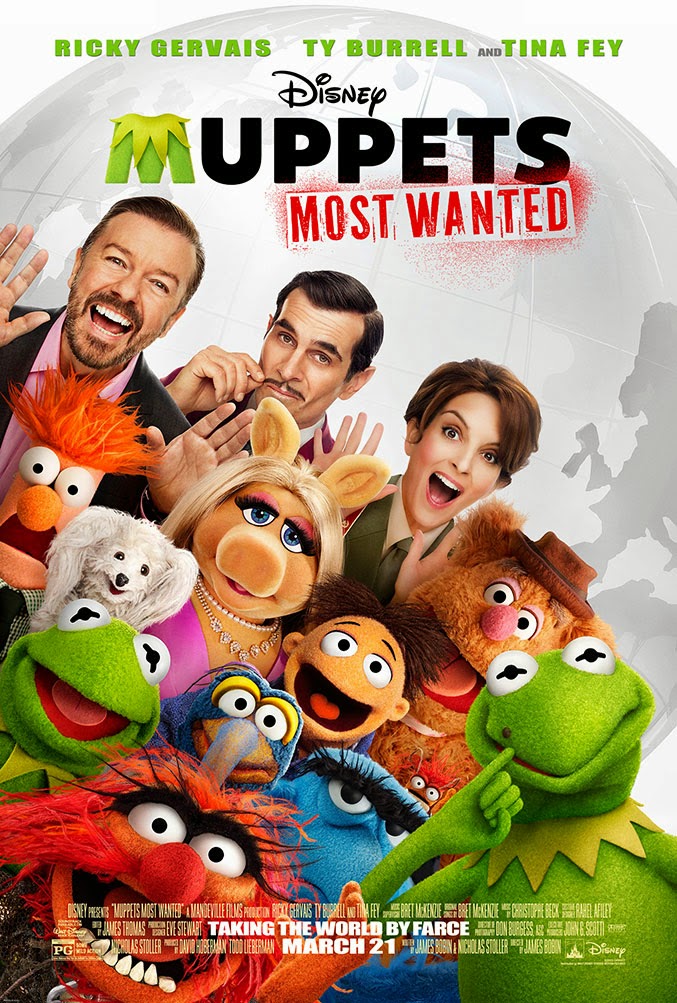
Fraudulent Friend: A Movie Review of "Muppets Most Wanted"

In 1976, the Muppets made a big name in pop culture with their television show. Then in 1979 The Muppets Movie was released. Thirty-five years later, the 12th Muppet film was released in 2014, marking a big milestone in Muppet history.
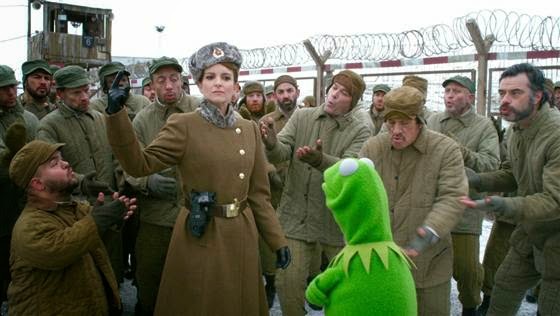
Muppets Most Wanted, the sequel to 2011's The Muppets, had mostly positive reviews. It did well at the box office during the first week of opening, but steadily dropped afterwards. Apart from Kermit the Frog, Miss Piggy, Gonzo, and all of the Muppets, the film stars Ricky Gervais as Dominic Badguy (pronounced "Badgee," as he clearly states in the movie), Tina Fey as prison guard Nadya, and Ty Burrell as Interpol agent Napoleon.

SUMMARY
   Muppets Most Wanted begins right after the end of The Muppets. The gang sings a song about doing a sequel, but they have no good ideas. That is, until a man named Dominic Badguy suggests them doing a world tour, with himself as tour manager. Kermit is reluctant, but the other Muppets are excited, so he agrees. 
   The Muppets travel to Europe, beginning in Germany. But while they head for Berlin, the world's most dangerous criminal, Constantine the frog, breaks out of a prison in Siberia. What is most astounding about him is that he is almost an exact look-alike to Kermit the Frog.
   While planning their Berlin show, Kermit is frustrated with Miss Piggy's constant assumptions of marriage, as well as ridiculous requests for acts from the other Muppets. Dominic suggests that Kermit goes on a walk, and he hands the frog a map of a route to take.
   In a smog-filled part of the city, he is attacked by Constantine. The evil frog attaches a mole to Kermit's face, making the two look identical. Kermit is taken for Constantine and arrested. He is sent to Siberia.
    Constantine disguises himself as Kermit and impersonates him, effectively taking over the Muppets. During their Berlin show, he and Dominic Badguy use the loud sound effects to mask their attempts to break down a brick wall. They then steal a painting of a Col. Thomas Blood. 
   Later, Interpol agent Napoleon and CIA agent Sam Eagle must work together to discover who stole the painting. Napoleon suspects the "#2 Most Wanted" criminal (The Lemur) as having something to do with the heist. 
   In a Siberian Gulag, Kermit attempts to escape, but he is stopped at every turn by Nadya, the prison guard. He realizes that there is no way out (at least, none that he has thought of), and so, for the time being, he helps her organize a talent show for the inmates.
   Dominic and Constantine meanwhile guide the Muppets' tour to different locations where they plan to steal valuable items, each part of their master plan. The Muppets go to Madrid, Spain, and then head for Dublin, Ireland. 
   In Dublin, the Muppet Walter finds out that Dominic is no such a good guy. And Fozzie Bear, another Muppet, discovers that "Kermit" is not really Kermit. The two, accompanied by drummer Animal, journey to Siberia, in hopes of rescuing Kermit.
   After escaping, Kermit, Walter, Fozzie, and Animal must get to London, where the Muppets are—and where Dominic and Constantine plan to go through with their master robbery!

CONTENT
   The violence in the film is minor, as it is mostly slapstick, and usually directed towards puppets. Towards the beginning, Constantine knocks out some prison guards and blows up a building when he escapes. There are a few punches and smashes, but nothing too graphic. There are a few explosions, but no one is shown dead or injured. 
   There is no outright sexual content. However, Constantine as "Kermit" sings a song to Miss Piggy ("Stick With Me"). He calls her "baby" once or twice. A female prison guard is shown to be in love with Kermit, as she has lots of pictures of him in her locker. She kisses one and passes out. The Muppets are interrogated, and when Miss Piggy is called in for questions, agent Napoleon smiles and flips the table over, creating a romantic table-setting, complete with wine. Some prisoners do a dance number for their talent show in long underwear (but this is like Little House on the Prairie, and not meant to be sensual, I think).  

   There is no bad language. One character says an unfinished, "What the...?"
   During one song, Miss Piggy asks herself, "How can something so right feel so wrong?" It is dangerous when we trust our feelings as our guides, rather than Jesus Christ. God gave us feelings and emotions to use them for good, so there is a right purpose to them. But when they become the thing that leads us, things can get very messy, very fast.
   Muppets Most Wanted has a good moral about friendship. The Muppets mistreat and ignore Kermit, which leads to problems with Dominic, Constantine, and Interpol. When three Muppets discover the truth about Constantine, they take a perilous journey to Siberia to save him (risking their own freedom in the process). 
   The movie has some clean comedy and some catchy songs ("We're Doing a Sequel," "I'm Number One," "The Big House," and "Together Again" are the catchier ones, in my opinion). Tina Fey was hilarious, especially with her Russian accent, and Ty Burrell was great as the Interpol agent.
   Muppets Most Wanted is appropriate for all ages. It wouldn't be my top choice for a family film, but it is a clean comedy, so it is worth watching in that respect. 

GENERAL INFORMATION
Length: 107 minutes
Rating: PG (for some mild action)
Director: James Bobin
Producers: David Hoberman, Todd Hoberman
Music: Christophe Beck (score), Bret McKenzie (music & lyrics)
Year of release: 2014
Primary audience: Kids, Family

Friday, January 23, 2015

Mothers are Important: A Movie Review of "Moms' Night Out"

Many called 2014 the greatest year for "Christian" films (if you consider Noah, Exodus: Gods and Kings, and Heaven is For Real as Christian films, I suppose). True, there were many films indirectly connected to Christianity. But only one big comedy film came out that was directed and written by Christians. Moms' Night Out is a comedy drama that shows the importance of mothers and their job.
Just as with 2014's God's Not Dead, the secular community bashed this film. It was called disappointing and even sexist. Among Christians, it received fairly good reviews. The film stars Sarah Drew as Allyson, a mother, Sean Astin as Sean, her husband, and Patricia Heaton as Sondra, the pastor's wife.

SUMMARY
   It's Mother's Day and Allyson is overwhelmed with her husband away on business, leaving her alone with their children. She takes the kids to church but with a few problems.
   Later, she plans a "moms' night out" with her best friend Izzy and the pastor's wife, Sondra. The three arrive at a fancy restaurant, only to find that Allyson's reservation has been mixed up. But this is just the beginning. 

   The moms go bowling, but Allyson's sister-in-law, Bridget, works there. She had asked Allyson to watch her baby son but was refused. Out of curiosity, Allyson asks who is watching the baby, Phoenix. Bridget says her "ex," Joey, is watching him. However, earlier in the evening, Allyson had seen Joey at the restaurant. 
   The four moms, including Bridget, find Joey and he tells them he left the baby with the owner of a tattoo parlor. The moms head down there but find out that he is gone.
   The rest of the movie holds one conundrum after another, with the fathers watching the kids, the missing baby, and a police chase.

CONTENT
   The violence in Moms' Night Out is minor. Two men find themselves tied up while children run around. It is implied that a man steps on a bird, though not intentionally. A woman is accidentally tasered. People go into a shady-looking tattoo parlor. 
   It is implied that Bridget is either divorced or separated from her husband or boyfriend. While the two have a baby, it is not clearly stated whether they were married or not (though I felt it implied they never were).
   There is no inappropriate language.
   A couple of men are shown in a somewhat mocking light. The one man is shown to be a bit irresponsible (in fact, most of the men characters are). However, this is a minor point. 
   The biggest lesson to be taken from Moms' Night Out is the importance of mothering. In the Bible, mothers play an important role. Eve was the mother of all humans; without her, indeed, there would be no us! Moses' mother saved his life by separating herself from her infant son, and he grew to lead God's people out of Egypt, out of bondage. Samuel's mother, Hannah, dedicated her son to the LORD and through that, he became a great prophet of God. The most famous biblical mother is Mary, who bore Jesus Christ, God's Son, who was conceived by the Holy Spirit. None of these mothers were particularly special (in fact, they were all ordinary), but by God's grace they all raised godly sons who were great heroes of the faith.
   Christian films are often criticized for their poor acting. Moms' Night Out may not have amazing acting, but it still was very good. It had two famous actors: Sean Astin (Lord of the Rings trilogy) and Patricia Heaton (Everybody Loves Raymond). Also, Alex Kendrick, popular for his Christian movie ministry, is featured in the movie.
   Moms' Night Out is one wild ride, from start to finish. It has enough comedy to make anyone laugh, and also some good lessons about mothers and their roles. The character Allyson says, at the end, that she is a "beautiful mess." While this is true about mothers especially, it is true for all of God's children. We are all a mess, but through Christ, we are made beautiful. 
   I hope many families enjoy this film!

GENERAL INFORMATION
Length: 98 minutes
Rating: PG (for mild thematic elements and some action)
Directors: Andrew Erwin, John Erwin
Producers: Andrew Erwin, John Erwin, David A.R. White, Kevin Downes, 
Elizabeth Hatcher-Travis, Michael Scott
Music: Marc Fantini, Steffan Fantini
Year of release: 2014
Primary audience: Family, adults

Thursday, January 8, 2015

Becoming a True Hero: A Movie Review of "Big Hero 6"

Unless you live in Japan, it would not be surprising if you've never heard of the Marvel comics hero team called Big Hero 6. However, they do exist, and in the fall of 2014, a Disney film loosely based on these heroes was released. 
Big Hero 6’s opening week was highly successful, placing it second only to Frozen. It is also the 46th highest-grossing animated film of all time. The movie includes the voices of Ryan Potter as teen Hiro Hamada, Scott Adsit as robot physician Baymax, and James Cromwell as science professor Robert Callaghan.

SUMMARY
   The film opens with teenager Hiro Hamada participating in an illegal robot fight. He pays his fee and challenges the reigning champion. He is defeated but convinces the winner to give him a second chance. The amused rival consents, and a second round is played, in which Hiro's robot becomes a magnetic monster. Hiro ends up winning that round and all of the cash money.
   However, his older brother Tadashi finds him and scolds him for joining illegal bot fights. He encourages Hiro to use his genius for the benefit of others. Tadashi takes Hiro to his college, where he shows him his robotics lab. Hiro is introduced to Tadashi's friends (by their nicknames): GoGo, Honey Lemon, Wasabi, and Fred. Finally, Tadashi shows Hiro his latest invention: a medical robot named Baymax. 
   Hiro wants into the robotics lab, so he applies for a scholarship awarded to gifted high-school students. He tries to come up with an amazing piece of technology to enter in the scholarship contest. He eventually creates "microbots," mini robots that can join together to create massive structures, all controlled by a band worn on your head. His entry manages to impress Tadashi's professor, Robert Callaghan, and Hiro is accepted into "nerd school," as it is called.
   *SPOILER* But tragedy strikes. A fire breaks out at the college during the exhibition. Hiro and Tadashi escape, but Professor Callaghan is still inside the building. Tadashi returns to try to save him. Neither come out. Hiro enters into a depressed state, isolating himself, and cannot be helped by his aunt who raises him nor Tadashi's college friends. *END SPOILER*
   While in his room, Hiro hurts himself and accidentally activates Baymax, who hears the boy's cry of pain. While Baymax tries to discover the extent of Hiro's injury, the teen discovers one of his microbots, though they were supposedly all destroyed in the fire. He places it in a container, but it appears to be trying to find the other microbots. 
   Annoyed by Baymax's constant medical inquiries, Hiro tells the robot to take the microbot and find the others. However, Baymax takes the instruction to heart and leaves the house in search of the microbots. Hiro chases after him, and the two discover an abandoned warehouse where they uncover lots of crates full of microbots. 
   A dark man in a mysterious mask appears, and it is obvious that he can control the microbots. Hiro and Baymax barely escape to return home. 
   Eventually, Hiro, Baymax, and Tadashi's friends form a team of super heroes, using their gadgets. Their mission is to track down the mysterious villain and defeat him before his unknown plans are fulfilled. 

CONTENT
  Big Hero 6 is much like a kids' version of a Marvel hero movie. There is some violence, but it is pretty toned down compared to The Avengers or other superhero films. Microbots are used to cause chaos, destroying buildings, streets, and cars. They also attack the Big Hero 6 team. A car is driven into the ocean, and it begins to fill with water (they are rescued, however, and no one dies). The team also uses their gadgets in fights, causing some destruction, though not intentionally. In one scene Hiro reprograms Baymax to kill the villain, and he nearly does. In that scene, his eyes glow red, and he harms the other super heroes when they try to stop him (this scene could possibly frighten younger kids). Also, it is implied that a fire kills some people, and we see their pictures at a funeral.
   Baymax says Hiro's bad mood is a result of puberty. He begins explaining that Hiro will have body hair and "urges," but Hiro stops him before he continues. Overall, there is little to be worried about in this scene, though older viewers will likely understand what is implied. 
   There is no language besides a "gosh" and some mild name-calling. 
   When Baymax's battery becomes low, this causes him to seem drunk, as he slurs his words and wobbles around. Also, Fred says that he wears his underwear for extended periods of time.
   One other thing for parents to take note of is that Hiro lies to his aunt in order to cover up his heroic deeds with Big Hero 6. 
   Big Hero 6 is really an enjoyable family film. It is quite unlike other Disney movies I have seen. Some of the content might be too strong for young children to handle, but I saw it with my eight-year-old brother who was alright throughout the film. Parents will need to make their own decisions, of course, but I think a child aged six or seven would likely be fine with at least most of the movie.
   The film has good lessons about friendship and the loss of people we love. Even when we go through the loss of someone close to us, we need to persevere through the trial. God sends trials to us so that we can become stronger in Him. Trials shape us and help us grow.
   While Big Hero 6 was better than I had expected, it was not an amazing film. It was good, even great, but I would not place it among Disney's greatest cinematic achievements. Still, if you have the chance, I would encourage you and your family to watch this movie. I did enjoy it, and I'm sure many others also will.

GENERAL INFORMATION
Length: 102 minutes
Rating: PG (for action and peril, some rude humor, and thematic elements)
Directors: Chris Williams, Don Hall
Producer: Roy Conli
Music: Henry Jackman
Year of release: 2014
Primary audience: Kids, family

Thursday, December 11, 2014

Chasing Your Dreams: A Movie Review of "Tangled"

Disney is known for its animated retellings of fairytales. Many of us have seen the classic films Snow White & the Seven Dwarfs, Cinderella, and Sleeping Beauty. Then in the 1980s and 90s came some new fairytale movies: The Little Mermaid, Beauty and the Beast, and Aladdin are just a few. In 2010, Disney returned to the princess fairytales they were so well known for. They released the family musical Tangled, centered on the story of Rapunzel of the long hair.
Tangled is, to this date, one of the best-selling Disney DVDs of all time and broke records in theaters when it was released. In theaters, it is Disney's third highest-grossing film (just behind Frozen and The Lion King). The film includes the voices of Mandy Moore as Rapunzel, Zachery Levi as convict Flynn Rider, and Donna Murphey as "Mother" Gothel.

SUMMARY
   In a magical land, a king and queen are going to have a child. But the queen becomes very ill, and so the king initiates a search for a mystical flower that was grown from a drop of sunlight. The plant is found, but little do the royal soldiers know, they were being watched by a mysterious woman who would use the flower's magical healing powers.
   The queen is cured, and she gives birth to a baby girl. The girl's hair shines golden, just like the sunlight from which the magical flower grew. But in the middle of one night, the mysterious woman, named Gothel, kidnaps the baby girl.
   She takes the baby, whom she names Rapunzel (nicknamed "Flower") to a hidden tower. There, Rapunzel's hair grants long life to Gothel, just as she had from the flower many years ago. Her hair has the magical powers to heal. 
   The king and queen launch floating lanterns every year on the birthday of their missing daughter, hoping against hope that she will one day reappear. From Gothel's tower, Rapunzel grows up seeing the lanterns every year.
   As she grows older, she longs for the freedom to go find these floating lanterns (which her "mother" Gothel says are merely stars). One day, while Gothel is gone, a fugitive thief sneaks into the tower to hide. Rapunzel, not quite sure what to do, knocks the man out with a frying pan. Once the man, Flynn Rider, is conscious, she informs him that she has hidden his bag which contains a precious treasure. The two make a deal: Flynn takes Rapunzel to see the floating "lights," and she will then return his bag to him.
   So the two set off on an adventure (accompanied by Rapunzel's pet chameleon Pascal), though it is the first time Rapunzel has been outside of the tower since she was kidnapped as an infant. Eventually, Flynn takes Rapunzel to a pub full of rough, dangerous-looking customers in an attempt to scare her away from her quest. However, it turns out that the people, just like Rapunzel, have dreams that they wish for to come true. They help Flynn and Rapunzel escape from guards, who are tracking Flynn.
   Rapunzel and Flynn, now joined by the royal horse Maximus, arrive at the kingdom. They enjoy an afternoon of celebrations, treats, and dancing. To watch the flying lanterns, the two take a boat out on the lake. This is where they realize that their new dream is each other.
   However, Gothel has joined with two former partners-in-crime of Flynn. The criminals kidnap Flynn and turn him over to the royal guards, while Gothel takes Rapunzel back to their tower. But Flynn will not give up until he saves Rapunzel from the imposter, Gothel.

CONTENT
   Any violent content within Tangled is pretty minimal. It is not too unlike that of the classic Loony Toons. Rapunzel knocks Flynn out with a frying pan. He also gets knocked about while tied up in a chair. Later, they nearly drown while trapped in a cave. There are several sword fights throughout the movie. The most violent scene is when a person is stabbed unexpectedly. Also, a lady's appearance becomes gruesome, and she falls from a building, though she turns to dust before hitting the ground. 
   Any sensual content is pretty minor. However, both Mother Gothel and Rapunzel wear dresses that show at least a little bit of their chest. In one scene, Gothel briefly flirts with a short, bearded man wearing a diaper (apparently supposed to be like Cupid, as he carries a bow). There are a couple of kisses between Rapunzel and Flynn.
   Throughout Tangled, magic is used. Rapunzel's hair heals wounds and grants long life to Gothel. 
   It is interesting to note that this film, in 2010, is the last Disney film to date in which the princess finds true love with a prince. 2013's Frozen and 2014's Maleficent both found the princesses discovering their happy ending through family love, rather than romantic love. It's an interesting trend that the princess no longer is happy with the prince. This can have both positive and negative effects, but Tangled still held to the classic Disney prince-princess relationship.
   Tangled is certainly one of my favorite cartoons from Disney Pictures. When our family went to see it in a theater, I was assuming I would find it boring and dull. I was very wrong! Tangled is a delight for all ages of both genders. It includes adventure, romance, comedy, and great music. The songs are great Disney tunes, including When Will My Life Begin?, Mother Knows Best, I've Got a Dream, and I See the Light. The musical numbers were done by Alan Menken, a veteran Disney composer, who has previously worked on The Little Mermaid, Beauty and the Beast, Aladdin, and Enchanted (with lyrics by Glenn Slater, who also did the lyrics for Little Mermaid).
   In one scene, Rapunzel expresses concern at what she will do once her dream of seeing the "floating lights" is fulfilled. Flynn tells her that the great thing about dreams is that, once one has been found, we get to chase another one. This is true! God gave us a great gift when He gave us the ability to dream and wish for things. Chasing your dreams can be wonderful, yet there is also a danger. As fallen humans, we can easily fall into the temptation to place our desires in front of God's plan for us. Our plans can often conflict with God's plans. We need to be careful not to let our dreams become idols. How do we do this? God has not said it is evil to want something (assuming it is a good thing), though it is evil to covet something; it is wrong to want something so badly that we believe we cannot find happiness without it. When we find ourselves dreaming for something, we need to remind ourselves that we can be happy without it, no matter how much we wish for it. 
   This is truly an enjoyable movie. If you are a fan of Frozen, you will likely fall in love with this film as well. This is definitely feels like a classic Disney fairy tale, but with some new twists. I'm sure Tangled will have your family laughing and maybe even crying. 5 stars!

GENERAL INFORMATION
Length: 100 minutes
Rating: PG (for brief mild violence)
Directors: Nathan Greno, Bryon Howard
Producers: John Lasseter, Roy Conli, Glen Keane
Music: Alan Menken (score and music), Glenn Slater (musical lyrics)
Year of release: 2010
Primary audience: Kids, family, pre-teens