~nbr1776
Sunday, June 30, 2013
Update to Blog: Polls
Every so often, I will now be posting some polls for your enjoyment. They will have something to do with movies, books, etc. Polls will last for at least nine days. I hope you enjoy!

Friday, June 28, 2013
Update to Blog: Search Box
I am pleased to announce we have now added a search box that makes it easier to find reviews. As this is a feature recently placed, you may possibly experience problems with it. In that case, please comment on this post and I will work on your problem as soon as I can.
~nbr1776
~nbr1776
The Moral Decay of Humanity: A Book Review of F. Scott Fitzgerald's "The Great Gatsby"
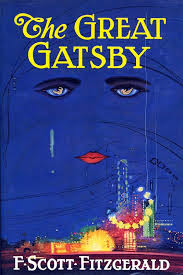 The 1920's were nicknamed "The Roaring Twenties" for the dramatic changes in society. Men went from drinking
tea to drinking beer and whiskey. Women went from elaborate dresses that covered everything to "dresses" that came up to well above their knees. Politics went from an honest area (for the most part) to a get-rich-quick scheme. Some might ask why God allowed the 1920's to be as immoral as they were. This decade was part of His plan (as is all of the past, present, and future).
Francis Scott Key Fitzgerald (known better as F. Scott Fitzgerald) wrote a novel on the 1920's, what occurred during those years, and the effect it had on society. He did this in a historical fiction setting, using a cast of characters: from the wealthy Jay Gatsby to the flakey Daisy Buchanan, and also the passive Nick Carraway. Although The Great Gatsby was treated poorly when it was first published, it has since then been labeled one of the greatest American classics and is now on nearly every high school reading list.
SUMMARY
It is summer 1922. The town West Egg (a fictional place), located in Long Island, is about to go through a dramatic and wild three months. Yale graduate and World War I veteran Nick Carraway has just moved there, just across the water (in the town of East Egg) from his cousin Daisy and her husband Tom Buchanan.
During a visit from Nick to the Buchanans', the reader learns that Tom has been having an affair. There is also a part in the book where Tom takes Myrtle Wilson around New York for an afternoon.
Nick later meets his mysterious millionaire neighbor Jay Gatsby. After attending a few of his parties, Nick learns that Gatsby once had a relationship with Daisy. His purpose for moving to West Egg was to attempt to "restart" a romance with Daisy.
The book continues until two of the main characters die and the reader is left with Nick depressed and contemplating time and how it relates to life.
CONTENT
There is some violence in the story, but not too much. Tom punches Myrtle and often acts brutally. Also, a character is killed when they are hit by a car. There is other violence, but that is the worst of it, I think.
Tom Buchanan has an open affair with Myrtle Wilson, as his wife Daisy has an affair with Jay Gastby. Also, Nick Carraway begins a relationship with golf pro Jordan Baker and the two kiss at the end of one of the chapters. The immorality in the book is one of the biggest problems.
The language throughout the book is overused. There are many uses of God's name, d***, b****, h***, and other words I can't recall (tough these were the worst). The language was the other main problem with The Great Gatsby.
Despite all this trash, there is at least one good lesson we can learn from this novel: the past cannot be relived. The past stays in the past. We can learn much from it, but we can never recreate it. Also, a billboard is described that represents a "dead god" looking out over the decaying moral values of the society. While our morals have disappeared a lot in America, we know that God is not dead but very much alive and controlling all things providently.
Overall The Great Gatsby has interesting insights into the world of the Roaring Twenties, but honestly, I doubt I would have read this book had it not been for school. If you are looking for an enjoyable book that is clean, you are not going to find that here.
GENERAL INFORMATION
Number of pages: 218
Author of book: F. Scott Fitzgerald
Published in: 1925
Primary audience: Adults
The Farm, the War, and Reunited: A Book Review of Michael Morpurgo's "War Horse"
 |
| 2010 Scholastic Edition |
A drunken man purchases a horse at a horse sale. It is a fine horse, but not fit for work on the farm. With the rent needing to be paid, something has to be done. The farmer's son steps in and trains the horse to work on the farm. The two form a deep bond of friendship.
The above paragraph has the makings of an interesting story. Author Michael Morpurgo (known for writing Kaspar: Prince of Cats and Private Peaceful) crafted a tale of a horse who is taken into battle during World War I, the "Great War." This book War Horse was runner-up for Whitebread Book Award in 1982. From it came an award-winning play in 2007, as well as a 2011 Steven Spielberg film.
SUMMARY
The entire book is told from the horse Joey's perspective. The story begins with a five-month old horse being bought by a drunken farmer, Mr. Narracott. He takes the horse home and his son Albert takes an immediate liking to the horse. He names him Joey and quickly teaches him how to work on the farm. The two become close friends.
Trouble comes soon, though. Joey is sold to the British army, specifically to one Captain Nicholls. The British cavalry attacks the Germans, but the battle is disastrous for them and many are killed. They realize they cannot use cavalry in this modern war.
Joey falls into German hands. Later, though, Joey and another British horse named Topthorn find themselves in the care of an elderly man and his granddaughter Emilie. After that, they are again taking by the Germans.
The story continues to the end of World War I, when Joey returns to the British army. The ending is good, and I thought it was appropriate in respect to the entire story.
CONTENT
For a children's book, there is not too much violence, but (as it is during a war) there is enough to make it something younger children probably should not read. There are deaths, injuries, and war violence. There is nothing too descriptive, though, and no gore. Apart from this, Albert's father is drunken and is abusive towards Joey at times.
As the story focuses on a horse, there is really not anything inappropriate. Albert mentions that he has a girl back home and the two are married at the end of the story, but there is nothing immoral in the book.
The language is rather light but still not something for younger children. The word "devil" is used several times, and God's name is used at least that much.
Good lessons appear in this story: loyalty, friendship, and kindness are some of these. For example, Joey is loyal to his friend Topthorn throghout the war and also during their good times with Emilie and her "Grandpapa."
I would recommend this to anyone who likes battle stories, historic books, or just enjoys a good adventure. Although this is a children's book, the violence and language make it more for pre-teens and perhaps any teens who find it intriguing. An interesting thing I would like to add is that the entire story was inspired by a painting and also is based on a true story. I am not sure, however, just how close War Horse is to the life of Captain James Nicholls.
GENERAL INFORMATION
Number of pages: 188 (2010 Scholastic Edition)
Author of book: Michael Morpurgo
Published in: 1982 (Great Britain)
Primary audience: Pre-teens
Sunday, June 23, 2013
Convict on the Run: A Movie Review of Tom Hooper's "Les Misérables"

Tom Hooper attempted something huge with his "Les Mis." It was supposed to be, as I had heard, either be an amazing adaption of both Victor Hugo's book and the original Broadway musical...or it was going to be a massive flop. For the most part, I would say it was the amazing adaption. I have never seen the Broadway production or the past film starring Liam Neeson, so this was my first time seeing Les Mis on the screen. Overall I was impressed, though disappointed with some scenes.
The film won three Academy Awards (including Best Supporting Actress, for Anne Hathaway) and was nominated for eight. The cast included Hugh Jackman as Jean Valjean, Russel Crowe as Javert, and Anne Hathaway as Fantine.
SUMMARY
 When the movie begins, criminal Jean Valjean has been in jail nineteen years for stealing a loaf of bread (in order to feed his sister's starving child). He is released under parole by the legalistic Javert. He finds no refuge anywhere until he comes across a man of God, who is kind to him. He then becomes a believer in God and turns his life around.
Years later, we find out that he is a successful mayor. Unfortunately, Javert comes to town on government business and almost immediately finds something familiar about him. Later, the inspector decides that the mayor is not the convict Jean Valjean and believes he has found someone else.
The mayor reveals himself to be the true Valjean. After the death of the poverty-stricken Fantine, Valjean escapes Javert to take care of her young daughter Cosette. He rescues her from the godless and theiving Thénardiers. Javert is soon on his trail, though, and stops by the inn run by the Thénardiers.
In short, the remainder of the two and-a-half hour film continues to the rebellion and ends with the aftermath.
CONTENT
The violence in this movie is heavy. The most violence is during the attack on the barricade towards the end of the film. All but two rebels are killed during the battle, including a scene where a young boy is shot. The filmmakers were not afraid to show blood (there is one scene where women are shown scrubbing the blood from the street). There is violence throughout the entire movie, but I think the battles were the most violent. One thing the viewer must understand is that the time period in which the movie is set was a very dark and violent era.
 There were two inappropriate and immoral scenes that we fast forwarded. I will not go into detail, but the first scene features prostitutes. My mom thought these two scenes should have earned the film an R rating. Also, some of the women are not dressed modestly.
The language is moderately heavy, including a b***h, a b*****d, at least one h**l, Christ's name, d**n, and God's name three or four times.
Apart from these elements, the movie was wonderful and moving. Themes that are expressed throughout are those of forgiveness, loyalty, and faith. For example, Valjean's faith in God is what gets him through his trials. Also, I think I should mention this is the first musical film to record the actors singing live, rather than add their voices later. This made a big difference.
 This film is meant primarily for adults and perhaps some teens. I would definitely NOT view this film without either of my parents.
In conclusion, Les Misérables is an amazing film, though it is littered with filthy content as nasty as the sewers in the movie. If you do not like musicals, I would not watch this movie (the lines are mostly sung, with few spoken words for the entire two-hour film). It provides some good history, but not what you could get from other films. So my final words would be that many will enjoy the film, but to watch with CAUTION. I would suggest looking for the Focus on the Family Radio Theatre presentation of the book which is much more mild (being for the entire family).
GENERAL INFORMATION
Length: 158 minutes (2 hours, 32 minutes)
Rating: PG-13 (for suggestive and sexual material, violence and thematic elements)
Director: Tom Hooper
Producers: Tom Bevan, Eric Fellner, Debra Hayward, Cameron Mackintosh
Music: Claude-Michel Schönberg
Year of release: 2012
Primary Audience: Adults, (teens, with parental approval)
The Cunning Con of Oz: A Movie Review of Sam Raimi's "Oz The Great and Powerful"
 How did a Kansas man get to the land of Oz and become the great and powerful Wizard of Oz? In the classic 1939 The Wizard of Oz, an elderly fraud is revealed to be the "Great and Powerful Oz." Walt Disney's Pictures latest fantasy release, Oz The Great and Powerful, is the story of how Kansas con man Oscar Diggs finds himself in a fantasy world.
Although this film was based mostly on the 1939 classic, the makers took themes, characters, and places from L. Frank Baum's fourteen Oz Chronicles books and puts them into this family film. The cast includes James Franco as Oscar Diggs/Oz, Mila Kunis as the witch Theodora, and Michelle Williams as the witch Glinda. The movie was a box office hit, making $149 million in just its opening week alone.
SUMMARY
Oscar Diggs is a magician in a traveling circus in 1905 (twenty years before the original Oz film). Immediately, we see he is selfish, deceitful, and immoral. The first scene is him bribing and lying to a young woman in order to get her to make his show a success.
 After the failure of a show, a cyclone hits the area. Oscar (nicknamed "Oz") is in a hot air balloon when the tornado comes through the circus. He is sucked up inside of it and spun around until he lands in a strange new world.
He soon meets Theodora, a young witch. She leads him to the Emerald City, where her sister Evanora awaits them. They tell him that he must destroy the Wicked Witch's wand to drain the power from her. If he does this, they tell him he will be ruler of Oz and inherit a vast fortune of gold.
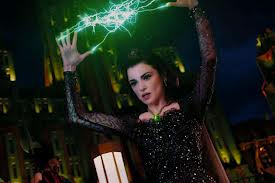 On this quest he is accompanied by a lovable flying monkey named Finley. They meet a porcelain girl along the way and the three of them make a plan to steal the Witch's wand. ***SPOILERS AHEAD*** They discover that the "Wicked Witch" is actually Glinda, the good witch of the South and that Evanora is really the wicked witch of the East. Oz joins Glinda and they go to her kingdom, where the Munchkins dwell.
Evanora meanwhile turns Theodora against Oz (who she loves) and turns her into the Wicked Witch. The two send flying baboons to destroy Oz and Glinda. When that fails, Theodora goes after them.
The movie ends in the final confrontation between the forces of good (led by Oz and Glinda) against the forces of evil (led by Evanora and Theodora). It cleverly ties in this movie to The Wizard of Oz (as do many other scenes in the movie).
CONTENT
I think the violence was slightly borderline for a PG movie. First off, the flying baboons are vicious and may frighten younger viewers (one review said that, "These are not your grandfather's flying monkeys!"). In addition, there are some action scenes and a battle at the end (including an intense duel between Glinda and Evanora). In addition to this, when one of the witches is transformed into the Wicked Witch of the West, she screams and stumbles around the room. My two youngest siblings (aged 7 and 5) viewed the film, but closed their eyes frequently.
 Oz is often seducing women, but nothing is shown beyond a few kisses. He has a love interest in Theodora, Glinda, and also seems to like Evanora. I felt this did not fit very well into the film. It felt awkward and out of place. Also, though, when one of the witches eats a poisoned apple (as mentioned in the above paragraph), she strips down to her underclothes. In relation to this, the witches' dresses are a little immodest, particularly Evanora's and the Wicked Witch's.
The language is rather minor, with only two uses of d***.
The three witches are both good and bad. Witchcraft can only be used for evil, not good. In Oz, though, there is no real-life witchcraft used.
I enjoyed this film a lot and recommend it to those who enjoyed the 1939 musical or just love a good fantasy adventure. The acting amazed me and the musical score was great! The film was enjoyable and there were moments that made myself and my family laugh (the monkey Finley is particularly comical). I think Oz may just find a place with our other movies!
GENERAL INFORMATION
Length: 130 minutes
Rating: PG (for sequences of action and scary images, and brief mild language)
Director: Sam Raimi
Producer: Joe Roth
Music: Danny Elfman
Year of release: 2013
Audience: Pre-teens, teens, family
Saturday, June 15, 2013
Earning Her Way Home: A Book Review of L. Frank Baum's "The Wonderful Wizard of Oz"
 |
| Kindle edition |
All of us have seen the classic 1939 musical-movie of "The Wizard of Oz," watching Judy Garland (as Dorothy) dance down the road with the other colorful characters, singing We're off to see the Wizard! Not as many of us, though, have read the original story by Lyman Frank Baum.
Baum wrote "The Wonderful Wizard of Oz" with the thought in mind that children's fairy tales were too happy. He wanted fairy tales where the characters were put into dangerous predicaments, but where good also triumphs over evil. He wanted to break away from the stereotypical fairy tales of the day and write a new children's tale, the result being "The Wonderful Wizard of Oz."
SUMMARY
Dorothy, a young girl, lives on a Kansas farm with her Uncle Henry and Aunt Em (as well as her beloved dog Toto). Her surroundings are described as gray. Further on into the story, she is sucked up into a cyclone and whisked off to a magical land called Oz.
The minute Dorothy reaches Oz, she is hailed as a hero by the Munchkin people. She killed a wicked witch and angered another one. She decides she wants to return home to the Kansas farm and is told only the great wizard Oz can do this. On the way, she meets a Scarecrow, a Tin-man, and a cowardly Lion. They all wish to get something from the wizard of Oz, so they join Dorothy on her quest.
Finally, they reach the Emerald City, capital city of Oz. To "earn" what they want, the four characters must do as Oz says. They find themselves on yet another quest.
Dorothy and the Lion are captured by the Wicked Witch of the West and their friends must figure out how to rescue them. The book continues for a long while yet, but this covers what is (more or less) seen in the classic movie. The ending is a happy one. Though it is not quite the end! Baum wrote thirteen more books in the Oz Chronicles, though the first of them is the most popular.
CONTENT
For a children's book, this includes some rather intense violence. Older stories such as Mother Goose Rhymes, Hans Christian Andersen tales, etc., include violent themes as well. For example, while protecting their friends, the main characters must fight off creatures sent by the Wicked Witch. During this, there is much violence, such as when the Tin-man chops off the head of one of these creatures. Also, during Dorothy's travels in Oz, she comes across a town of porcelain people. One is broken and killed. There is much more violence than mentioned here. Parents may want to read the book themselves before allowing very young children to read it. Now, though, there is really nothing immoral in the book.
In "The Wonderful Wizard of Oz," it is taught that we can earn salvation for ourselves. In order to reach home, Dorothy must do things on her own, as the wizard commands her. In Christianity, salvation comes not from ourselves, but from Christ. It is only through repentance and belief that we may be saved (and that is after Christ has sought us, not the other way around). Also, there are good and evil witches in the land of Oz. Witchcraft is something evil and cannot be used for good.
This story is delightful (and goes into much more detail than we are shown in the film), though I think children will enjoy it the most. Anyone who reads this, I think, can still get something out of it. The primary audience was meant to be children, and I think that is still the same today. I would recommend, though, looking for the "A-list Collection" audiobook of this story, read by Anne Hathaway (who does a marvelous job). She made it enjoyable for really all ages.
GENERAL INFORMATION
Number of pages: 137
Author of book: L. Frank Baum
Published in: 1900
First in a fourteen-book series
First in a fourteen-book series
Primary audience: Children, Pre-teens
Subscribe to:
Posts (Atom)