Sunday, August 18, 2013

On the Edge of a War: A Movie Review of George Lucas' "Star Wars Episode II: Attack of the Clones"

A galaxy is on the verge of civil war, as the Republic government tries to hold its own against disloyal Separatists. To make matters worse, a famous senator loyal to the Republic is in danger of assassination attempts and must take on a Jedi guard. Thus the stage is set for the second Star Wars film.
Star Wars Episode II: Attack of the Clones did rather decent in 2002's box office, though not nearly as well as the movie preceding it, 1999's The Phantom Menace. It was beat by Spider-Man and The Lord of the Rings: The Two Towers, putting it at #3 at the 2002 box office. The film features the acting talents of Hayden Christiansen as Anakin Skywalker, Natalie Portman as Senator Padmé Amidala, and Ewan McGregor as Anakin's Jedi master Obi-Wan Kenobi.

SUMMARY
   Attack of the Clones opens with a sleek, shiny starship landing on the city planet Couruscant. Just as the senator of Naboo begins her descent down the boarding ramp, there is an explosion. The "senator" was actually a decoy, though, and the true Senator Amidala was disguised as an escort pilot.
   Soon, Senator Amidala meets with Chancellor Palpatine and the Jedi Council to discuss the situation. She is issued Jedi security: old friends Obi-Wan Kenobi and his Padawan learner Anakin Skywalker. Although the Senator believes the extra precautions are not necessary, she is somewhat forced into it. 
   That night, an assassin sends poisonous centipede-like bugs into Amidala's room. Obi-Wan and Anakin begin chasing the assassin and finally catch her in an alley. A mysterious figure shoots her with a toxic dart before she can reveal any information.
   While Obi-Wan investigates the dart's origin, Anakin is assigned to take the Senator back to her home planet Naboo for safety. There, the two fall in love, though Padmé says a marriage could never work: Jedi are forbidden to marry and Padmé's term as senator would be ended. 
   On the stormy planet Kamino, Obi-Wan discovers that a clone army is being created for the Republic, though no official order was placed. He also meets a bounty hunter who he finds is behind the assassination attempts. He chases the hunter to the rocky desert planet Geonosis where is uncovered a Separatist plot to start a war. He is soon captured.
   Anakin and Padmé, eventually, end up captured on Geonosis. When they are rescued by the Jedi, the war officially begins.

CONTENT
   The violence is not very graphic, but it is enough to possibly frighten younger viewers. In one scene, a Jedi is hit by "Sith lightning" and later his arm is cut off with a lightsaber (no blood, but you can tell it has been "burned"). During the battle, some droids are killed and also some clone soldiers (though they have full body armor on and helmets, so you can't completely tell they are human). Also, an assassin is shot by a toxic dart and her face morphs into a monstrous appearance. Towards the end of the film, Obi-Wan, Anakin, and  Padmé are attacked by monsters in a coliseum, which could frighten younger children.
   Throughout the entire film, the only language is a brief use of d**n.
   Anakin and Padmé enter a romantic relationship and there are three or four kissing scenes between them, one of those being at their wedding. Anakin and Obi-Wan chase an assassin into a nightclub and some immodest women are somewhat seen in the background.
   There is the use of the mystical "Force" throughout the entire movie (as in all six Star Wars films). There is meditation and such in the whole film. Though set in a fictional universe, it still is based on real-life practices.
   While not Star Wars at its best, I enjoyed Attack of the Clones. It is an exciting science fiction adventure, though it won't all make sense unless you have seen The Phantom Menace. If you are not really a "sci-fi" fan, this film probably is not for you. Otherwise, it is a decent movie, though it has some drawbacks.

GENERAL INFORMATION
Length: 142 minutes
Rating: PG (for sustained sequences of sci-fi action/violence)
Director: George Lucas
Producer: Rick McCallum
Music: John Williams
Year of release: 2002
Primary audience: Pre-teens, teens, adults

Monday, August 12, 2013

The Cost of Following Christ: A Book Review on Eric Metaxas' "Bonhoeffer: Pastor, Martyr, Prophet, Spy"

It is 1906 in Germany. A baby boy is born to a wealthy and illustrious family with famous relatives. The baby's parents named him Dietrich. Little did they know, this boy would grow up to become an intelligent pastor, defender of Jews, member of the Confessing Church, anti-Nazi, and a martyr for his beliefs. Dietrich Bonhoeffer was truly a remarkable person, and New York Times Best-Selling Author Eric Metaxas wrote a masterpiece on the life and work of this amazing German pastor. Bonhoeffer: Pastor, Martyr, Prophet, Spy: A Righteous Gentile vs. The Third Reich" (being the full title) won the ECPA Book of the Year, the Canterbury Medal by the Becket Fund recognizing courage in the defense of religious liberty, and the Christopher Award (highlighting the power of faith, courage, and action), all in 2011.

SUMMARY
   The book begins with the Prologue in 1945, with the end of World War II. Chapter 1 goes back in time and begins in 1896 with the meeting of Karl Bonhoeffer and Paula von Hase, Dietrich's parents. It ends with Dietrich's memorial service in 1945 (Bonhoeffer died during the war and the book refers to it throughout, so I won't try to hide the "spoiler"). In over 500 pages, it spans the entire thirty-nine years of Bonhoeffer's life.

CONTENT
   This is not a children's book. Bonhoeffer worked against the Third Reich, so he came across much violence including war, death of loved ones, concentration camps, euthanasia, and many other sick and wrong things. Set primarily during World War II (and a little during World War I), there is much violence discussed in the biography. 
   There is not really anything inappropriate in Bonhoeffer, but there are still some parts to mention. The word "prostitution" comes up two or three times, and towards the end of the book, it is mentioned that a German and a Jew had an immoral relationship. Also, Bonhoeffer has a romantic relationship with a younger girl, but there isn't anything inappropriate to be found in this (quite the opposite, actually).
   The only language used in the book is, "My God" a few times and a couple uses of the word "bloody." These words as only used in quotations of Bonhoeffer and others.
   This book is not a novel in any use of the word. It is a biography and historical account of Dietrich Bonhoeffer, so just be prepared for that. I thought the first eight chapters or so were a little bit slow, but those who stick with it are greatly rewarded after reading the last page! Although I enjoy reading novels, this is one of the most amazing and wonderful books I have ever read. I am quite interested in World War II history, and I put Bonhoeffer right up there with The Hiding Place as my favorite books of that period. 
   Bonhoeffer: Pastor, Martyr, Prophet, Spy is a great book, and I recommend it to all who can get a hold of this masterpiece.

GENERAL INFORMATION
Number of pages: 591
Author of book: Eric Metaxas
Published in: 2010
Primary audience: Adults (though I'm sure many teens will enjoy this as well)

A Scarer on the Inside: A Movie Review of Disney/Pixar's "Monsters University"

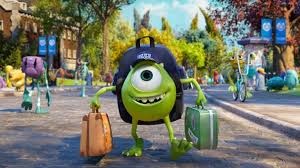
As a young child, I really liked the Disney/Pixar film Monsters Inc. So you can imagine my anticipation as my sister, some friends, and I made our way into a nearly-packed theater. I knew Monsters Inc. couldn't be replaced in my mind, but I was curious and excited to see how the main characters of that movie met and became friends. The sequel Monsters University shows Mike Wazowski and James Sullivan in their college days as they learn to be scarers.
The movie is currently the 7th highest-grossing film of 2013 and the second best Pixar films in terms of opening weekend sales. The film features the voices of Billy Crystal as Mike Wazowski, John Goodman as James P. "Sulley" Sullivan, and Helen Mirren as Dean Abigail Hardscrabble.

SUMMARY
   Mike has always wanted to be a scarer ever since visiting Monsters Inc. on an elementary field trip. Years later, after hard work and studying, Mike is finally headed to Monsters University. He enters the Scaring Class, but after he and rival Sully cause an accident, they are kicked out.
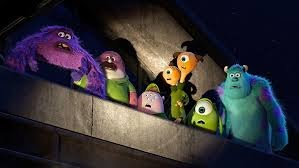
   Soon, Mike finds a way to redeem himself. He announces he is going to sign up for the dangerous, but popular Scare Games. Needing a team, he joins the smaller fraternity on campus: Oozma Kappa. Sulley volunteers to become the final member and the team is entered.
   Sulley and Mike must learn to work as a team if they have a chance of winning the Scare Games. With little chance of even placing in the first game, they get through by a "miracle" and continue on with the competition.

CONTENT
   Monsters University is rated G, so any violence is very minor. The most violent it gets is when some monsters step on prickly, toxic balls that inflates their skin. Also, since the monsters' jobs are to scare kids, we are shown their scariest faces.
   There is not really anything too inappropriate, but there are a few things I should mention. In one scene, a monsters sits on a prickly, toxic ball and his behind is inflated. Also, at a party, some female monsters have fuzzy balls for short skirts, but there is not anything beyond that. Towards the end of the film, a monster announces (in a weird turn of events) that he is marrying his friend's mom.
   There is no language to be found in this film.
   Monsters University delivered some good lessons on not judging someone by their outside appearance, but by their character. Also, it shows that the popular crowds are not always the best to be around (an important lesson for younger and older kids in today's world). I enjoyed the movie and thought it was a nice addition to the Disney/Pixar films. Although I didn't like it as much as Monsters Inc., I thought it was pretty good!

GENERAL INFORMATION
Length: 103 minutes
Rating: G
Director: Dan Scanlon
Producer: Kori Rae
Music: Randy Newman
Year of release: 2013
Primary audience: Kids, family

A Goodie Bandit on the Loose!: A Movie Review of "Hoodwinked!"

You really don't know the true story behind Little Red Riding Hood, just so you know! Did you know Red Riding Hood, her Granny, the Wolf, and the Axeman were all detained for questioning by the police? Did you know that a thief was loose in the forest, stealing recipes for sweets? That is what is going on in the cartoon comedy Hoodwinked!
Directed by Cory & Todd Edwards and Tony Leech, the film was #2 in the box office for two weeks and managed to stay in the top ten for a total of five weeks. It features the voice talents of Anne Hathaway as Red Riding Hood, Glenn Close as Granny, and Patrick Warburton as the Wolf.

SUMMARY
   Hoping to protect her grandmother's famous recipes, Red Puckett takes the recipe book out the vault and begins a trek up the mountain to give her Granny the recipes for safekeeping. On the way, though, she runs across a wolf, his squirrel assistant, and a crazy goat. One thing leads to another and soon the entire house has been turned into a crime scene.
   By the end of the film, the characters begin to unwind the mystery of the "Goodie Bandit" who has been putting stores out of business. The ending is pretty good!

CONTENT
   There is some violence, but nothing more than things you would find in Looney Tunes. Some characters are hit with snowballs and it is implied that a man has been beaten up (seeing his bruises, scrapes, etc.). There are kicks and punches in the film but nothing overly violent. There are also some punches and kicks but nothing graphic.
   There was no language or inappropriate content, I am glad to say.
   Hoodwinked! is one of my family's favorites and it still makes us laugh every time we watch it. The animation is slightly choppy (which can be understood, due to a smaller budget), but the film did amazingly well under the circumstances. Hoodwinked! is one of those movies that has good, clean comedy for the entire family.

GENERAL INFORMATION
Length: 80 minutes
Rating: PG (for some mild violence and thematic elements)
Directors: Cory Edwards, Todd Edwards, Tony Leech
Producers: Katie Hooten, Maurice Kanbar, David K. Lovegren, Sue Bea Montgomery, Preston Stutzman
Music: John Mark Painter, Kristin Wilkinson
Year of release: 2005
General audience: Kids, family

Sunday, July 28, 2013

Once Upon a Time and Happily Ever After: A Book Review of "The Random House Book of Fairy Tales"

All of us are familiar with the typical rendition of stories like Cinderella, Little Red Riding Hood, Beauty and the Best, and many other fairy tales. Fewer of us, though, know the original stories. Ever since I was little, I have enjoyed listening to fairy tales, reading fairy tales, and now reading them to my little siblings. Over the years, I have looked through different fairy tale collections and one of the best I have found would be The Random House Book of Fairy Tales, adapted by Amy Ehrlich.
SUMMARY
   This collection includes nineteen fairy tales, from "The Emperor's New Clothes" to "Thumbelina." Each story, also, includes beautiful illustrations by Diane Goode, which made it an extra bonus! I never read fairy tales the same way after we bought this book. It is a wonderful addition to any family's shelf.
CONTENT
   Some of the fairy tales have some rather violent parts. For example, in the tale "Rapunzel," a character falls a long distance and pierces his eyes on thorns. For the youngest of children, parents might want to take a look at some of the stories before reading them their bedtime stories.
   There is no language and nothing too inappropriate. The princes and princesses throughout the collection have romantic relationships, but there is nothing immoral.
   As in most fairy tales, there are witches and the use of witchcraft (such as in "Snow White" and "The Snow Queen"). Parents will have to use their own judgment in this area.
   I very much enjoyed this collection and would recommend it to families in general, or anyone who likes a good fairy tale.

GENERAL INFORMATION
Number of pages: 208 pages
Author of book: Various (Adapted by Amy Ehrlich)
Published in: 1985
Primary audience: Children

Against the Odds: A Movie Review of George Lucas' "Star Wars Episode I: The Phantom Menace"


2012 3-D poster

Original 1999 movie
poster


 In 1977 the first Star Wars film was released in theaters. Since then, it has become one of the most popular movie series of all time. Two sequels were made after Star Wars (renamed Star Wars Episode IV: A New Hope in 1999) in 1980 and 1983. Years later, a fourth Star Wars film was made, but it told the story of what came before the original films. Thus, The Phantom Menace was named Episode I...even though it was the fourth to be made. Slightly confusing?
The Phantom Menace broke box-office records at the time, passing The Lost World: Jurassic Park. It also quickly passed the popular Independence Day and Titanic. It was re-released in theater in 2012, where it currently is the 12th highest-grossing film ever. The movie's cast includes Liam Neeson as Jedi master Qui-Gon Jinn, Ewan McGregor as Obi-Wan Kenobi, and Natalie Portman as Queen Padmé Amidala.

SUMMARY
   The greedy Trade Fedaration has blockaded the small planet Naboo in hopes building up their organization. The Chancellor of the Republic has sent two Jedi to negotiate a peace treaty with the Fedaration. Once on board, an attempt is made to poison them.
   The Jedi Qui-Gon Jinn and his pupil Obi-Wan Kenobi escape to Naboo. They meet a creature named Jar Jar Binks who takes them to his hidden underwater city. The king sends the Jedi and Jar Jar away in a submarine. They head for the capital city Theed in order to warn the Queen and her advisors.
   Once they reach the Queen, they persuade her to accompany them to the galactic capital Couruscant. During their escape, though, their ship is damaged and they must land on a desolate desert planet. There, they must depend on the racing talents of a young boy, Anakin Skywalker, to get their ship up and running.
   After receiving no help from the corrupted Senate, the heroes return to Naboo where they make a daring plan to confront the evil Trade Fedaration and their droid army.

CONTENT
   The violence is about the same as the previous Star Wars movies. Most of the casualties during battle are that of droid robots. Some humans and gungan creatures are killed, but nothing gory or violent is shown. There is one scene where an alien (that looks similar to a human) is cut in half with a lightsaber and the two pieces are seen falling down a pit. A man is also stabbed with a lightsaber and viewers briefly see the wound. Something to mention, though, is the evil Sith lord Darth Maul. His skin is red and black and he has horns on the top of his head, making his appearance frightening to younger viewers.
   There is no language in the movie. Some of the aliens speaking in their languages are said in the subtitles to "curse."
   As in the three previous Star Wars films, there is the use of the "energy field" called the Force. Qui-Gon meditates at one point in the film and he also explains about life forms known as Midi-Chlorians that are what produce life and tell the Jedi the will of the Force. Also, one of the characters has supposedly been "conceived" by the Force (though they don't specifically say this) and is called the Chosen One. I'm not sure whether or not the makers meant to mock Christianity and Jesus Christ, but I don't like these parts. 
   Despite some drawbacks, The Phantom Menace is an exciting adventure film. Being a Star Wars movie, it is one of the greater science fiction films. My dad is not a fan of science fiction films, but he still will watch it with us. With lightsabers, space battles, and droid armies, The Phantom Menace is, in my opinion, a great action movie!

GENERAL INFORMATION
Length: 136 minutes
Rating: PG (for sci-fi action/violence)
Director: George Lucas
Producer: Rick McCallum
Music: John Williams
Year of release: 1999
Primary audience: Pre-teens, teens, adults

Sunday, July 14, 2013

The Watchers are Everywhere: A Book Review of George Orwell's "1984"

1984 edition
of 1984, with preface
by Walter Cronkite
Three governments rule the world. Ingsoc (the English Socialist Government) knows everything about everyone. Their inventions called telescreens monitor all people, day and night. The shadowy leader of Ingsoc, Big Brother, is always watching his people. The "watchers" can be found everywhere...or so it seems.
George Orwell, pen-name of Englishman Eric Blair, is best known for writing Animal Farm and 1984. Those two stories are his great anti-utopian/socialist works. The flaws in socialism and communism are strongly and clearly pointed out in both books, but 1984 (published in 1948, the title switching the last two digits) goes into great depth to describe a world in which thoughts themselves can have you sent to prison and even put to death. From the first page to the horrific end, 1984 delivers a chilling and realistic version of what our world could be like if socialists and communists were to take over.
SUMMARY
   Winston Smith works for the Ministry of Truth. His job is to rewrite history and make Big Brother (and Ingsoc) look like a savior. There can be no error in his work, as it is enough to arrest a person. One day, though, he does the unthinkable...he thinks. He pulls out a pen and does something illegal: he begins writing a diary.
   Winston continues life in near-constant fear of being caught. Eventually, he meets a fellow worker named Julia. The two are both against the wrongs of Ingsoc and secretly meet together many times. How long can they go on like this? How long until the "Thought Police" discover them and arrest them? Have they already been found out? From start to finish, 1984 is an interesting and enjoyable story, though it is also haunting.
CONTENT
   The novel has its share of objectionable content. The violence in the beginning is only that of informational. For example, Winston explains to the reader that he will be shot in the head for writing a diary and wishing for the end of Big Brother's dictatorship. Also, hangings of criminals are public events to be enjoyed. In addition to that, a character is tortured several times towards the end of the book. Mostly, though, the things that may frighten younger readers in this area is suspense. The main characters are constantly trying to figure out if someone is watching them...and what will happen if they are caught.
   There are three scenes in this book that are inappropriate. In the first scene, Winston imagines a woman taking her clothes off as she runs across a field. In the second scene, two characters have a physical relationship in a forest. In the third scene, it is implied that these people have had a physical relationship.
   I don't recall any foul language in 1984, but there may be some words I just don't remember. Either way, the language is quite minor in the novel.
   Orwell's story is as important to us today as it was when first published in 1948. It portrays the wrongs of socialism and communism for what they are and what horrendous consequences follow. The story is set in a realistic world that is still possible today. I pray those leading our nation will turn to God for help, not themselves or other men. We all, though, need to stand strong against political evils that ay seep into our nation.
GENERAL INFORMATION
Number of pages: 267 (1984 edition)
Author of book: George Orwell
Published in: 1948
Primary audience: Adults