Sunday, February 15, 2015

Be Careful What You Wish For: A Movie Review of "Into the Woods"

Though not many people know it now, Stephen Sondeim's 1987 Broadway Musical Into the Woods was a big hit. It won three Tony Awards but was overshadowed by the great success of the new musical The Phantom of the Opera. In 2014, Disney released their film version of Into the Woods.
The film opened in second place at the box office behind the third Hobbit film, giving it the highest opening weekend for a film version of a Broadway musical. At the time of this review, Into the Woods has three Academy Award nominations, and the American Film Institute named it one of the eleven greatest movies of 2014. The film stars James Corden as The Baker, Emily Blunt as The Baker's Wife, and Meryl Streep as The Witch.

SUMMARY
   The Baker and his wife desperately want to have a child but are unable to. One day, though, a witch storms into their bakery and informs them why they have not had any offspring: a curse. Years ago, the Baker's mother was with child, and she desired to have greens ("greens, greens, nothing but greens"). So the mother sent her husband to the witch's garden next door, telling him to take some vegetables for her. The witch caught him, but the two struck a deal: the man could take the vegetables if the witch was given his unborn baby. But the Baker's father also secretly stole some magic beans, which caused the witch's mother to smite her with the curse of ugliness. So the witch cursed the Baker's father and mother, making it so their family tree would never bear any children.
   Yet the witch offers a way for the Baker and his wife to undo the curse. They must bring her the following ingredients before midnight in three days: the cow as white as milk, the cape as red as blood, the hair as yellow as corn, and a slipper as pure as gold.
   Meanwhile, Little Red Riding Hood sets out for her granny's house (with a full basket of sweets and bread), Cinderella visits her mother's grave, and a boy named Jack is instructed by his mother to sell their cow, Milky White.

   The Baker goes into the woods and sees Red Riding Hood wearing the cape as red as blood, though he is not successful in obtaining it. Soon, the Baker's wife shows up, against his wishes. However, she convinces her husband that they will need to work together to find the ingredients. The Baker and his wife run into Jack, with his cow. In exchange for the cow (that happens to be as white as milk), the Baker and his wife give the boy five of the six magical beans.
   Eventually, through many chaotic adventures and accidents, the Baker and his wife find each item on the witch's list. The ingredients make a spell that reverses the curse of ugliness on the witch, and she undoes her curse on the Baker's house, causing the Baker's wife to become pregnant. All the characters have their happy endings!
  But wait, the story hasn't finished! Jack's mother tossed the magic beans away, and they grew into a giant beanstalk. Jack climbs the bean stalk and finds giants in the sky. He soon begins stealing treasure from them. As his climbs down, a giant chases him, but Jack begins to chop down the stalk. The giant falls to his death. This eventually causes the giant's wife to be very angry. She comes down to find Jack, though she causes earthquakes throughout the kingdom, which throws everything into chaos.
   The characters begin blaming each other for the problems, but they eventually decide to work together in order to defeat the giant.

CONTENT
   While violence is present in Into the Woods, arguably the worst of it is off-screen. These off-screen moments include the Baker cutting open a wolf's stomach, Cinderella's stepsisters having their toes and heels cut off (for the purpose of fitting into Cinderella's famous slipper), and a woman falling down a cliff (we only see her hand lose its grip on a branch). When one stepsister's toes are cut off, we see a drop of blood. A woman is pushed and hits her head on a stump, causing death. Both stepsisters are also blinded by some birds, though the camera cuts away before we see anything. The witch grows a patch of thorns in the path of a prince, which blinds him (the audience does not actually see the blinding, but the scarred and scratched eyes are seen later). One character is hit in the forehead with a stone and falls down dead. 

   When speaking of her robbed garden, the witch compares being stolen from to being raped (she isn't, but she uses the metaphor). There are several kisses throughout the film, usually not between married couples. Cinderella's stepsisters wear dresses with short skirts, and several female costumes partially show their chests. During a song about their "agony," two princes open their shirts to reveal part of their chests. Also, the Baker's wife meets Cinderella's prince (her husband) in the woods. The prince seduces the woman into kissing him a few times. However, the woman realizes that what she did was wrong (even though she does believe it made her marriage to the Baker "mean more"), while the prince is quite unapologetic for his adulterous seduction. Also, when Little Red Riding encounters the Wolf, some reviewers have felt it was meant to be sexual seduction of the girl by the wolf. I did not get that feeling (to me, it was just a hungry wolf wanting to eat human flesh, young and old), but parents will want to note the possibility.
   The profane language is sparse, having two clear uses of God's name.
   In one song, a man and a woman encourage children to decide for themselves what is good is right. They also tell them giants can be good and witches can be right. But this moral relativism is not clearly found anywhere else in the film.
   Two characters appear as ghosts, Cinderella's mother and the Baker's father. The latter could have been more of a vision, but the Baker talks to his father, who encourages his son to not make the same mistakes he did (i.e. abandoning his son). A dead woman appears to her husband, though this also was probably meant to be a memory, rather than a ghost. Also, a witch uses witchcraft to raise a cow from the dead.
   While Into the Woods has some clearly visible problems, I felt that there were a lot of good things to be taken from the movie. For one thing, the movie poster's catchphrase of "be careful what you wish for," while never explicitly spelled out, is shown and pushed through the entire film. Characters wish for things, and they get them...but they realize their wishes weren't quite what they expected (not to mention that they all come with consequences). In reality God has given us the ability to wish for things, but we need to be careful of these wishes, for a few reasons. We need to be sure that these wishes have not become idols, taking the place of God, and we also need to examine the affects our wishes will have on us and others.
   Earlier I mentioned the prince's encounter with the Baker's wife. As I said, the woman feels it makes her marriage mean more. But she does see that what she did was wrong, and she seemed to me to be apologetic. This does not, in any way, condone her actions. While sin is wrong, all people are sinners. The important thing when we sin is that we repent to the LORD for our wrongdoing.
   The witch laments, through song, that "children won't listen," but later she changes her tune. "Children may not obey/but children will listen." She warns the listener to be careful what they say because children will listen (being defined differently than "obey"). This could be a caution to parents to be certain of the things they say to their children, and later the witch's song warns parents to be wary of the path their children take. Children do need to obey, but Proverbs 22:6 instructs fathers and mothers to train up their children in the way of the LORD, so both parent and child are responsible.
   I loved the strong emphasis on fatherhood in the movie. It showed the importance of a father in the absence of the Baker's father and his own choice to stay with his infant child. Seldom do we find such strong examples of this today.

   The acting was just marvelous! James Corden and Meryl Streep were stunning in their roles (as the Baker and the witch), and Emily Blunt was great as the Baker's wife. Also, Daniel Huttlestone, Anna Kendrick, and Lilla Crawford did well portraying Jack, Cinderella, and Red Riding Hood.
   Also, the songs are quite beautiful (and some of them are even fun). I especially enjoyed the songs Prologue: Into the WoodsStay With MeLast Midnight, and Children Will Listen. Stephen Sondheim (writer and musician behind the Broadway play) did wonderful with this masterpiece songs.
   While there are many good things to take away from Into the Woods, viewers should also be careful of the darker aspects. The brief adultery, of course, and the call at the end to decide for yourself what is right.
   While there are some murky parts to this film, I was pleased with the morals that did shine through. Still, don't let this film's PG rating deceive you: it is not a film for children. Based on the maturity of your children, I believe ages thirteen and older could handle the movie, though they will need to think through some anti-biblical worldviews put forth. This was a great movie, and one of the best from 2014, I would say. If you get the chance, I hope you enjoy Into the Woods as much as I did.

GENERAL INFORMATION
Length: 124 minutes
Rating: PG (for thematic elements, fantasy action and peril, and some suggestive material)
Director: Rob Marshall
Producers: Rob Marshall, Marc Platt, John DeLuca, Callim McDougall
Music: Stephen Sondeim (lyrics and score)
Year of release: 2014
Primary audience: Teens, adults

Saturday, February 14, 2015

The 2015 Family-in-Mind Awards: Nominees

   The nominees for the Second Annual FIM Awards are officially here! To read the full list, click here. There are two categories of nominations: one for Kids/Family and one for Teens/Adults.
   The winners will be announced next Saturday, so keep your eyes open!

~Family-in-Mind

Wednesday, February 11, 2015

Coming Soon: FIM Award Nominations

   The annual Family-in-Mind Awards are on their way! The nominations are scheduled to be announced at the end of this weekend. For more information on our changes to the award system this year, read Coming Soon: FIM Awards.

~Family-in-Mind Reviews

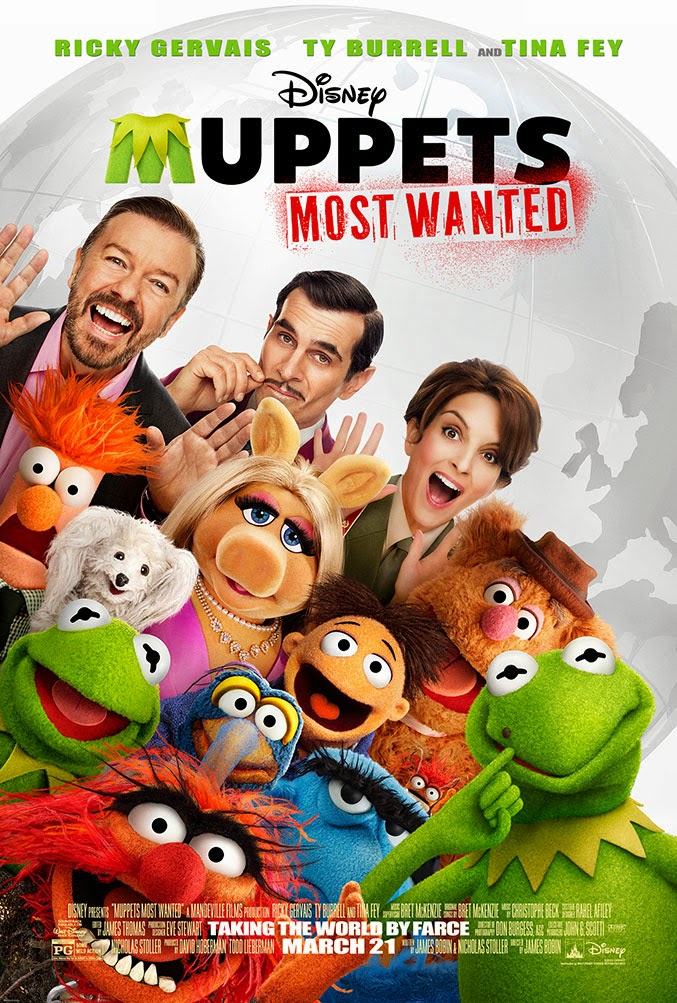
Fraudulent Friend: A Movie Review of "Muppets Most Wanted"

In 1976, the Muppets made a big name in pop culture with their television show. Then in 1979 The Muppets Movie was released. Thirty-five years later, the 12th Muppet film was released in 2014, marking a big milestone in Muppet history.
Muppets Most Wanted, the sequel to 2011's The Muppets, had mostly positive reviews. It did well at the box office during the first week of opening, but steadily dropped afterwards. Apart from Kermit the Frog, Miss Piggy, Gonzo, and all of the Muppets, the film stars Ricky Gervais as Dominic Badguy (pronounced "Badgee," as he clearly states in the movie), Tina Fey as prison guard Nadya, and Ty Burrell as Interpol agent Napoleon.

SUMMARY
   Muppets Most Wanted begins right after the end of The Muppets. The gang sings a song about doing a sequel, but they have no good ideas. That is, until a man named Dominic Badguy suggests them doing a world tour, with himself as tour manager. Kermit is reluctant, but the other Muppets are excited, so he agrees. 
   The Muppets travel to Europe, beginning in Germany. But while they head for Berlin, the world's most dangerous criminal, Constantine the frog, breaks out of a prison in Siberia. What is most astounding about him is that he is almost an exact look-alike to Kermit the Frog.
   While planning their Berlin show, Kermit is frustrated with Miss Piggy's constant assumptions of marriage, as well as ridiculous requests for acts from the other Muppets. Dominic suggests that Kermit goes on a walk, and he hands the frog a map of a route to take.
   In a smog-filled part of the city, he is attacked by Constantine. The evil frog attaches a mole to Kermit's face, making the two look identical. Kermit is taken for Constantine and arrested. He is sent to Siberia.
    Constantine disguises himself as Kermit and impersonates him, effectively taking over the Muppets. During their Berlin show, he and Dominic Badguy use the loud sound effects to mask their attempts to break down a brick wall. They then steal a painting of a Col. Thomas Blood. 
   Later, Interpol agent Napoleon and CIA agent Sam Eagle must work together to discover who stole the painting. Napoleon suspects the "#2 Most Wanted" criminal (The Lemur) as having something to do with the heist. 
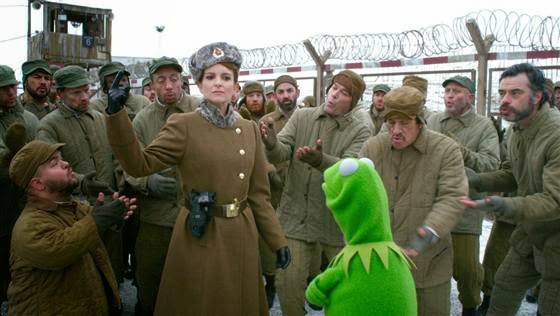
   In a Siberian Gulag, Kermit attempts to escape, but he is stopped at every turn by Nadya, the prison guard. He realizes that there is no way out (at least, none that he has thought of), and so, for the time being, he helps her organize a talent show for the inmates.
   Dominic and Constantine meanwhile guide the Muppets' tour to different locations where they plan to steal valuable items, each part of their master plan. The Muppets go to Madrid, Spain, and then head for Dublin, Ireland. 
   In Dublin, the Muppet Walter finds out that Dominic is no such a good guy. And Fozzie Bear, another Muppet, discovers that "Kermit" is not really Kermit. The two, accompanied by drummer Animal, journey to Siberia, in hopes of rescuing Kermit.
   After escaping, Kermit, Walter, Fozzie, and Animal must get to London, where the Muppets are—and where Dominic and Constantine plan to go through with their master robbery!

CONTENT
   The violence in the film is minor, as it is mostly slapstick, and usually directed towards puppets. Towards the beginning, Constantine knocks out some prison guards and blows up a building when he escapes. There are a few punches and smashes, but nothing too graphic. There are a few explosions, but no one is shown dead or injured. 
   There is no outright sexual content. However, Constantine as "Kermit" sings a song to Miss Piggy ("Stick With Me"). He calls her "baby" once or twice. A female prison guard is shown to be in love with Kermit, as she has lots of pictures of him in her locker. She kisses one and passes out. The Muppets are interrogated, and when Miss Piggy is called in for questions, agent Napoleon smiles and flips the table over, creating a romantic table-setting, complete with wine. Some prisoners do a dance number for their talent show in long underwear (but this is like Little House on the Prairie, and not meant to be sensual, I think).  

   There is no bad language. One character says an unfinished, "What the...?"
   During one song, Miss Piggy asks herself, "How can something so right feel so wrong?" It is dangerous when we trust our feelings as our guides, rather than Jesus Christ. God gave us feelings and emotions to use them for good, so there is a right purpose to them. But when they become the thing that leads us, things can get very messy, very fast.
   Muppets Most Wanted has a good moral about friendship. The Muppets mistreat and ignore Kermit, which leads to problems with Dominic, Constantine, and Interpol. When three Muppets discover the truth about Constantine, they take a perilous journey to Siberia to save him (risking their own freedom in the process). 
   The movie has some clean comedy and some catchy songs ("We're Doing a Sequel," "I'm Number One," "The Big House," and "Together Again" are the catchier ones, in my opinion). Tina Fey was hilarious, especially with her Russian accent, and Ty Burrell was great as the Interpol agent.
   Muppets Most Wanted is appropriate for all ages. It wouldn't be my top choice for a family film, but it is a clean comedy, so it is worth watching in that respect. 

GENERAL INFORMATION
Length: 107 minutes
Rating: PG (for some mild action)
Director: James Bobin
Producers: David Hoberman, Todd Hoberman
Music: Christophe Beck (score), Bret McKenzie (music & lyrics)
Year of release: 2014
Primary audience: Kids, Family

Friday, January 23, 2015

Mothers are Important: A Movie Review of "Moms' Night Out"

Many called 2014 the greatest year for "Christian" films (if you consider NoahExodus: Gods and Kings, and Heaven is For Real as Christian films, I suppose). True, there were many films indirectly connected to Christianity. But only one big comedy film came out that was directed and written by Christians. Moms' Night Out is a comedy drama that shows the importance of mothers and their job.
Just as with 2014's God's Not Dead, the secular community bashed this film. It was called disappointing and even sexist. Among Christians, it received fairly good reviews. The film stars Sarah Drew as Allyson, a mother, Sean Astin as Sean, her husband, and Patricia Heaton as Sondra, the pastor's wife.

SUMMARY
   It's Mother's Day and Allyson is overwhelmed with her husband away on business, leaving her alone with their children. She takes the kids to church but with a few problems.
   Later, she plans a "moms' night out" with her best friend Izzy and the pastor's wife, Sondra. The three arrive at a fancy restaurant, only to find that Allyson's reservation has been mixed up. But this is just the beginning. 

   The moms go bowling, but Allyson's sister-in-law, Bridget, works there. She had asked Allyson to watch her baby son but was refused. Out of curiosity, Allyson asks who is watching the baby, Phoenix. Bridget says her "ex," Joey, is watching him. However, earlier in the evening, Allyson had seen Joey at the restaurant. 
   The four moms, including Bridget, find Joey and he tells them he left the baby with the owner of a tattoo parlor. The moms head down there but find out that he is gone.
   The rest of the movie holds one conundrum after another, with the fathers watching the kids, the missing baby, and a police chase.

CONTENT
   The violence in Moms' Night Out is minor. Two men find themselves tied up while children run around. It is implied that a man steps on a bird, though not intentionally. A woman is accidentally tasered. People go into a shady-looking tattoo parlor. 
   It is implied that Bridget is either divorced or separated from her husband or boyfriend. While the two have a baby, it is not clearly stated whether they were married or not (though I felt it implied they never were).
   There is no inappropriate language.
   A couple of men are shown in a somewhat mocking light. The one man is shown to be a bit irresponsible (in fact, most of the men characters are). However, this is a minor point. 
   The biggest lesson to be taken from Moms' Night Out is the importance of mothering. In the Bible, mothers play an important role. Eve was the mother of all humans; without her, indeed, there would be no us! Moses' mother saved his life by separating herself from her infant son, and he grew to lead God's people out of Egypt, out of bondage. Samuel's mother, Hannah, dedicated her son to the LORD and through that, he became a great prophet of God. The most famous biblical mother is Mary, who bore Jesus Christ, God's Son, who was conceived by the Holy Spirit. None of these mothers were particularly special (in fact, they were all ordinary), but by God's grace they all raised godly sons who were great heroes of the faith.
   Christian films are often criticized for their poor acting. Moms' Night Out may not have amazing acting, but it still was very good. It had two famous actors: Sean Astin (Lord of the Rings trilogy) and Patricia Heaton (Everybody Loves Raymond). Also, Alex Kendrick, popular for his Christian movie ministry, is featured in the movie.
   Moms' Night Out is one wild ride, from start to finish. It has enough comedy to make anyone laugh, and also some good lessons about mothers and their roles. The character Allyson says, at the end, that she is a "beautiful mess." While this is true about mothers especially, it is true for all of God's children. We are all a mess, but through Christ, we are made beautiful. 
   I hope many families enjoy this film!

GENERAL INFORMATION
Length: 98 minutes
Rating: PG (for mild thematic elements and some action)
Directors: Andrew Erwin, John Erwin
Producers: Andrew Erwin, John Erwin, David A.R. White, Kevin Downes, 
Elizabeth Hatcher-Travis, Michael Scott
Music: Marc Fantini, Steffan Fantini
Year of release: 2014
Primary audience: Family, adults

Friday, January 16, 2015

Coming Soon: FIM Awards

   The second annual Family-in-Mind Awards are coming soon. This year, the nominations will be posted a week before the awards themselves are announced. But for 2015, there is a new system. There will be two sets of awards: one for Kids/Family and another for Teens/Adults. The same type and number of awards will be under each section.
   Keep an eye out for the nominations coming soon!

~Family-in-Mind Reviews

Tuesday, January 13, 2015

The End of a Beginning: A Movie Review of "The Hobbit: The Battle of the Five Armies"

In 2003, Peter Jackson released the third and final Lord of the Rings film, Return of the King. Over a decade later, he released the final movie in The Hobbit trilogy, based on the book by JRR Tolkien. Die hard fans will know that The Hobbit: The Battle of the Five Armies is the last Middle-earth movie that Peter Jackson can make, as the "Tolkien estate" will no longer work with him. So this is the last farewell for Peter Jackson to the magical world of Middle-earth.
The Hobbit: The Battle of the Five Armies was a huge success at the worldwide box office. In America, it held the top spot for a while after opening, as well as being the eighth-highest-grossing film of 2014. The movie stars Martin Freeman as Bilbo Baggins, Richard Armitage as Thorin Oakenshield, Luke Evans as Bard the Bowman, and Lee Pace as Elven king Thranduil.

SUMMARY
   The third Hobbit film picks up right where the second one left off...literally! At the end of Desolation of Smaug, the dragon Smaug was on his way to Lake-town, with intentions of attacking the human inhabitants. Battle of the Five Armies opens with Smaug beginning his assault on Lake-town. The humans flee the town, though there are many deaths.
   From a distance, Bilbo and some of the dwarves watch as fire lights up the sky above Lake-town. However, Bilbo notices that Thorin seems to care little for the troubles of the humans.
   Bard the Bowman climbs a tower and attempts to fire arrows into Smaug's "weak spot," but fails. His children flee in a boat, accompanied by Tauriel the elf and several dwarves. But Bain, the son of Bard, retrieves a mighty black arrow for his father and Bard has one, single chance to slay the dragon.
   Refugees of Lake-town escape to the shores and make their way to the ruins of Dale, the city Smaug had attacked so long before.
   Back at the Lonely Mountain (Erebor), Bilbo sees that Thorin is becoming obsessed with the reclaimed gold and treasures of his ancestors. He has "dragon-sickness," as it is referred to throughout the film. This plays on some themes set up at the end of Desolation of Smaug. Thorin is maddened with searching for the greatest of all gems within the mountain: the Arkenstone. Little does he know, Bilbo had stolen it during his encounter with Smaug.
   King Thranduil and his elven army arrive in Dale and provide the humans with food. He tries to convince Bard to lead the humans in attacking the mountain, which Thorin has sealed off at this point. Bard wants peace before war, so he goes to speak with Thorin, but the dwarf king will not listen. The humans and elves then prepare for war.
   During this, Gandalf is still trapped in Dol Guldur, the dark fortress, holding knowledge that an orc army has left for Erebor. He is harmed by an orc, but the elves Galadriel and Elrond, along with the wizard Saruman, come to rescue their friend. After battling Nazgul ghosts (Ring Wraiths), the three must confront the Dark Lord Sauron himself. Galadriel sends him to the evil land Mordor, but she is exhausted from the effort. Saruman informs the others that he will go alone to deal with Sauron (leaving a "cliff-hanger" for The Fellowship of the Ring).
   Gandalf rides to Erebor, where he warns Thranduil of an approaching orc army. The elf will hear none of it and tells Gandalf that he will finish what the wizard began.
   The elves, Legolas and Tauriel, travel to Gundabad, land of orcs, where they see a second orc army marching for Erebor.
   At Erebor, Bilbo realizes a way to prevent fighting between dwarves, men, and elves. He sneaks out of the mountain and takes the Arkenstone to Bard and Thranduil, giving it as a "bartering chip." Enraged by the hobbit's deception, Thorin nearly kills Bilbo, though the hobbit escapes. He will not consent to any of the conditions made by Bard and Thranduil.
   As the elves and men prepare for war, Thorin's cousin, Dain Ironfoot, arrives with his dwarf army. But, before anything can be done, the first orc army arrives. Since Dain is greatly outnumbered, the men and elves join in the battle.
   The remainder of the film is mostly the battle (you will have to figure out the five armies for yourself!). The movie ends, however, with a perfect finish for The Hobbit series, as well as a beginning for The Lord of the Rings.

CONTENT
   The Battle of the Five Armies is, by far, the darkest and most violent of the trilogy. However, it still is not quite as tense as the Lord of the Rings films. As Smaug attacks Lake-town, buildings burn and people are killed. There are human remains in Dale, from the original dragon attack. Thorin commands Bilbo to be thrown over the wall (though he is not).   During the huge battle at the end, many creatures and people are slain: humans, elves, dwarves, orcs, goblins, etc. These warriors/soldiers are impaled, cut, and smashed, among other things. There are decapitations, but only of orcs. Women and children are shown fleeing from orcs, screaming the entire time. Some children are nearly killed (and we do see a dead child, briefly). An orc is stabbed in the head. A dwarf and an orc are impaled. An elf is tossed around, slammed into stones, walls, etc. A pair of dwarves are stabbed and one is dropped from a tower. We see his somewhat bloodied body on the ground. A dwarf makes a reference to splitting someone's head open. Also, a man is nearly executed (presumably) before Bard intervenes.
   Tauriel and Kili have some more romantic scenes, continuing from the second film. Also, a man disguised himself in women's clothing to avoid fighting. He is later seen with gold stuffed in the dress, making it almost appear as though he has breasts.
   There is little language, with one use of b***ard. The same character also calls the orc army "the hordes of h***."
   The use of magic is strong in this film. Elves and wizards use their magic in dueling the Dark Lord. Gandalf is revived magically by an elf. Most of the magic is seen in the Dol Guldur scene.
   In terms of acting, I thought Battle of the Five Armies had the best of the three Hobbit films. Martin Freeman, Richard Armitage, and Luke Evans shone out in their respective roles. Also, Evangeline Lilly as Tauriel and Aiden Turner as Kili were marvelous. And, as always, Cate Blanchett gave an excellent performance as Lady Galadriel.
   This film vividly portrays the struggle between good and evil, in the heroes battling the orcs. There is a very real war going on around us. It is a spiritual war, fought by angels and demons. Christians know that good will triumph in the end, just as good always has triumphed eventually in Middle-earth. Perhaps this is what Tolkien was trying to show in The Hobbit and Lord of the Rings. No matter how dark the world seems, we can rest assured that God's people will be the victors in the end.
   Although I knew the end of The Hobbit trilogy was coming, I was still sad to see it come to the finale. Actually, to be honest, it was a bittersweet feeling. Yes, it was sad, but I was also happy with how Peter Jackson handled his final work in Middle-earth!
   On the musical side of things, composer Howard Shore masterfully produced the music for the film. I also thought this music was the best of the three films. Billy Boyd's performance of "The Last Goodbye" during the credits was moving.
   All in all, this was a wonderful ending to the trilogy. Yet this is not a film for children. Because of the large amount of violence, I believe it is only appropriate for adults, of course, and teens who are able to handle this. Still, it is one of my favorite movies of 2014.

GENERAL INFORMATION
Length: 144 minutes
Rating: PG-13 (for extended sequences of intense fantasy action violence, and frightening images)
Director: Peter Jackson
Producers: Fran Walsh, Peter Jackson, Carolynne Cunningham, Zane Weiner
Music: Howard Shore
Year of release: 2014
Primary audience: Teens, adults